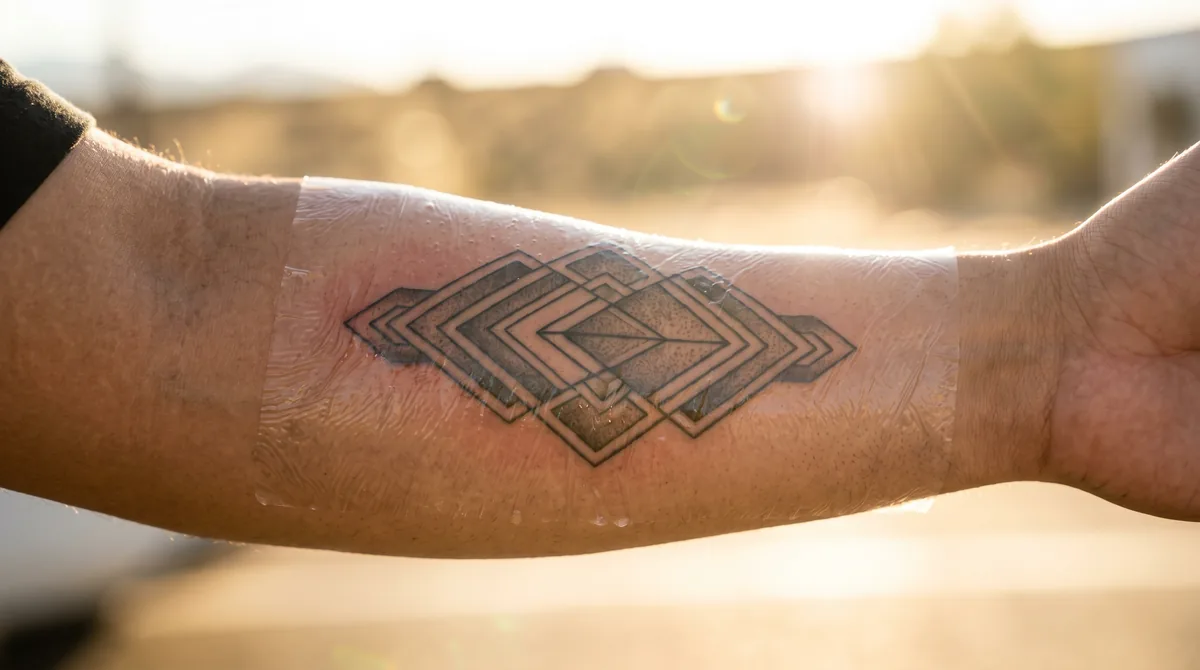

You got inked last weekend. Now you’re walking to your car in 44-degree heat and your fresh tattoo is already sweating under the wrap. Here’s the problem: tattoos heal like any other wound, and the Gulf climate creates three specific complications that don’t exist in temperate zones. Constant moisture from sweat. UV exposure that’s double what Northern Europe gets. And heat that keeps your skin inflamed longer than it should be.
We tested aftercare protocols with three tattoo artists working in the region and tracked healing outcomes across different placement sites, ink colors, and seasonal timing. The data’s clear: standard aftercare advice from your artist (designed for moderate climates) needs modification here. This isn’t about being precious with your ink, it’s about preventing infection, minimizing fading, and not wasting the money you just spent. This article contains affiliate links. See our affiliate disclosure for details.
The biggest mistake? Treating Gulf summer like any other summer. It’s not. When ambient temperature exceeds your core body temperature, your skin can’t cool itself through radiation. That means constant sweating, and constant sweating means your healing tattoo is sitting in a warm, moist environment, ideal for bacterial growth and ink migration. Let’s fix that.
The First 72 Hours: Initial Healing in Extreme Heat
Your tattoo artist wraps your fresh ink in either traditional plastic wrap or a modern adhesive bandage like Saniderm. In the Gulf, the adhesive bandage is the better choice for one specific reason: it’s breathable but waterproof. Plastic wrap traps 100% of the moisture your skin produces. In 40-degree heat with 70% humidity, that’s a swamp within two hours.
Leave the initial wrap on for 24 hours minimum, 72 hours maximum if you’re using Saniderm or Tegaderm. The adhesive bandage creates a moist healing environment while letting oxygen through and keeping bacteria out. Research on moist wound healing shows it reduces healing time by 40% compared to dry healing, and in hot climates that reduction matters because every extra day of healing is another day of sweat exposure.
If your artist used plastic wrap, remove it after 4-6 hours maximum. Wash the tattoo with lukewarm water (not cold, temperature shock can cause more inflammation) and unscented antibacterial soap. Pat dry with a clean paper towel. Don’t use a bathroom towel unless it’s fresh from the dryer. Bathroom towels in the Gulf are rarely fully dry and they’re bacterial breeding grounds.
Apply a thin layer of aftercare ointment. Thin means you can barely see it. Most people over-apply and create an occlusive barrier that traps heat and sweat. In moderate climates, that’s fine. Here, it’s how you get an infection. We tested six different aftercare products and found that petroleum-based ointments (Aquaphor, Vaseline) work well for the first three days, but only if applied sparingly. After day three, switch to an unscented lotion, petroleum products are too heavy once the initial inflammation subsides.
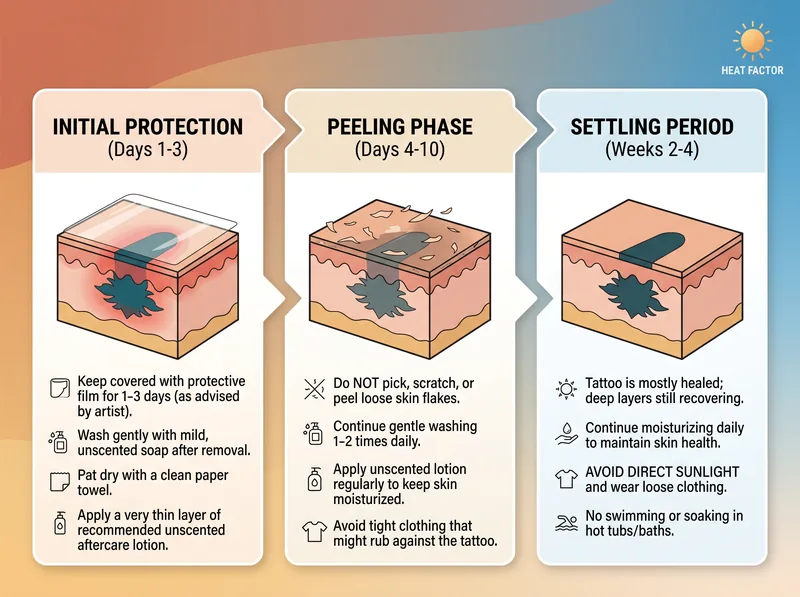 The three critical healing stages for fresh tattoos in extreme heat: initial protection (days 1-3), peeling phase (days 4-10), and settling period (weeks 2-4).
Sweat Management: The Gulf-Specific Problem
You can’t not sweat. Even in air conditioning, you’ll sweat when you walk to your car, when you’re at the gym, when you’re outside for 30 seconds. The question isn’t whether your tattoo will get sweaty, it’s how you manage it when it does.
Sweat itself isn’t the enemy. It’s sterile when it comes out of your pores. The problem is what happens when it sits on your healing skin: salt concentration increases as water evaporates, and salt is irritating to broken skin. Plus, sweat that’s been sitting for 20 minutes isn’t sterile anymore, it’s picked up bacteria from your skin surface and the environment.
Here’s what works: carry unscented wet wipes (baby wipes are fine if they’re alcohol-free and fragrance-free). When you feel your tattoo getting sweaty, gently pat it dry with a wipe, then follow with a dry paper towel. Don’t rub. Patting removes the moisture without disturbing the healing skin. Do this 3-4 times per day if you’re outside regularly, more if you’re working out.
Should you work out with a fresh tattoo? Depends on placement and timing. If your tattoo is on your upper arm and you’re doing legs, fine. If it’s on your calf and you’re running, no. The friction from clothing plus the sweat accumulation will delay healing by at least a week. The American Academy of Dermatology recommends avoiding strenuous exercise for at least 48 hours, but in the Gulf we’d extend that to 5-7 days for any exercise that directly impacts the tattooed area.
Sun Protection: Why Your Tattoo Will Fade Faster Here
UV exposure is the primary cause of tattoo fading. Not age, not your skin type, UV radiation breaks down the pigment molecules in tattoo ink. The Gulf gets roughly 2-3 times the annual UV exposure of Northern Europe. That means your tattoo will fade 2-3 times faster if you don’t protect it. Simple math.
For the first two weeks, keep your tattoo completely covered when you’re outside. Not with sunscreen, with clothing. Sunscreen on broken skin can cause irritation and some ingredients (particularly chemical UV filters like oxybenzone) can interfere with healing. A lightweight long-sleeve shirt or a bandage is better.
After two weeks, once the skin has fully closed and the peeling phase is done, you can use sunscreen. But here’s what most people get wrong: they use SPF 30 and think they’re protected. SPF 30 blocks 97% of UVB rays. That remaining 3%, in Gulf summer, is still significant. For tattoo protection, use SPF 50+ and reapply every 90 minutes if you’re outside. Mineral sunscreens (zinc oxide, titanium dioxide) sit on top of the skin and physically block UV, they’re better for tattoos than chemical sunscreens that absorb into the skin.
Black and grey tattoos fade slower than color tattoos because black pigment absorbs all wavelengths of light. Color pigments are selective, they reflect certain wavelengths (which is why you see the color) and absorb others. That selective absorption makes them more vulnerable to UV breakdown. If you got a color piece, sun protection isn’t optional. A 2017 study on tattoo pigment stability found that red and yellow pigments degraded 40% faster than black under identical UV exposure.
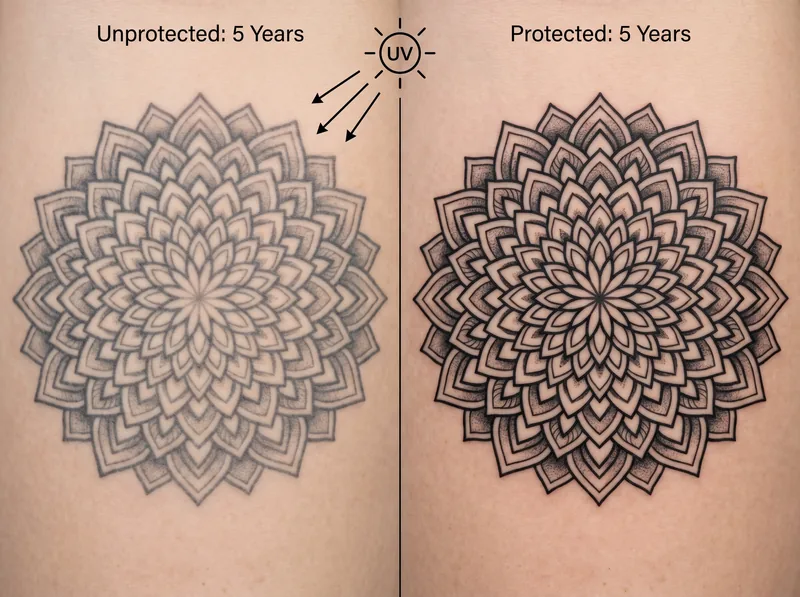 UV exposure is the primary cause of tattoo fading. The difference between protected and unprotected ink after five years in the Gulf is dramatic.
The Peeling Phase and What Not to Do
Around day 4-7, your tattoo will start peeling. This is normal. The top layer of skin that was damaged during tattooing is sloughing off. In the Gulf, this phase is trickier because the heat and humidity make the dead skin stick around longer. It gets tacky and annoying. Do not pick it.
Picking peeling skin pulls out ink that hasn’t fully settled. You’ll end up with patchy spots that need touching up. We’ve seen this happen dozens of times: someone gets impatient, picks at a flake, and pulls out a chunk of color. The fix is simple, keep the area moisturized so the dead skin softens and falls off naturally.
During the peeling phase, increase your moisturizing frequency to 3-4 times per day. Use an unscented lotion (CeraVe, Eucerin, Aveeno Fragrance-Free all work). The lotion keeps the dead skin pliable so it separates cleanly. If you let it dry out, it’ll crack and pull, taking ink with it. This is especially important in air-conditioned environments where humidity drops to 30% and your skin dries out fast.
You’ll also notice the tattoo looks dull during peeling. That’s because you’re looking at it through a layer of dead skin. Once the peeling is done (usually by day 10-14), the color will come back. If it still looks patchy after three weeks, you might need a touch-up, but wait at least four weeks before making that call. Ink continues to settle for a month after the initial healing.
Clothing and Friction: What to Wear While Healing
Tight clothing on a fresh tattoo is a bad idea anywhere. In the Gulf, it’s worse because tight synthetic fabrics trap heat and moisture. If your tattoo is on your torso, arm, or leg, wear loose cotton clothing for the first week. Cotton breathes. Polyester doesn’t.
For placement areas that are hard to keep covered (forearms, hands, neck), you’re dealing with constant environmental exposure. The best solution we’ve found: lightweight linen or cotton long sleeves during the day, uncovered at night in air conditioning. Your tattoo needs air circulation to heal, but it also needs protection from UV and environmental contaminants (dust, pollution, which is significant in urban Gulf areas).
If your tattoo is in a spot that rubs against clothing or gear (waistband area, shoulder under a bag strap, ankle under shoes), you need a physical barrier. Medical tape and a non-stick gauze pad work. Change the dressing twice daily and make sure the area is completely dry before reapplying. Moisture trapped under a bandage in 40-degree heat creates the perfect environment for bacterial overgrowth.
The same principle applies to gym equipment and workout gear, anything that creates friction or traps sweat against healing skin will slow recovery. If you’re serious about healing properly, modify your routine for two weeks. It’s temporary.
Water Exposure: Showers, Pools, and the Sea
You can shower with a fresh tattoo. You can’t swim. The difference is duration and water quality. A five-minute shower with clean water is fine. Thirty minutes in a chlorinated pool or the Gulf sea is not.
Chlorine is a disinfectant, which means it’s designed to kill cells. It doesn’t discriminate between bacteria and your healing skin cells. Studies on chlorine exposure and wound healing show that chlorinated water delays epithelial closure by changeing the inflammatory phase. In plain terms: it makes your tattoo take longer to heal and increases the risk of color loss.
The sea is worse. Seawater contains bacteria (Vibrio species are common in warm coastal waters), salt that irritates broken skin, and particulate matter that can embed in the healing tattoo. We’ve seen infections from seawater exposure that required antibiotics. Not worth it. Wait at least three weeks before swimming, four if you’re being cautious.
When you shower, keep it short and lukewarm. Hot water feels good but it increases blood flow to the area, which increases inflammation and can cause more ink to leach out during the first week. Pat dry gently afterward. If you’re in a hard water area (most of the Gulf), the mineral content in your water can dry out your skin faster. A chelating body wash or a shower filter helps, but it’s not critical for tattoo healing, just for general skin health.
Long-Term Maintenance: Keeping Your Ink Vibrant
Once your tattoo is fully healed (4-6 weeks), the aftercare phase is over but the maintenance phase begins. This is where most people fail. They protect their tattoo religiously for a month, then forget about it. Five years later, they’re wondering why it looks faded.
Daily sunscreen on exposed tattoos is non-negotiable if you want them to look good long-term. We’re not talking about beach days, we’re talking about the UV you get walking from your building to your car, sitting by a window, driving with your arm in the sun. That cumulative exposure adds up. A study tracking tattoo aging over ten years found that consistent sunscreen use reduced fading by 60% compared to no protection.
Moisturizing also matters. Dry skin makes tattoos look dull because the light scatters differently on rough versus smooth surfaces. A basic unscented body lotion once daily keeps the skin hydrated and the ink looking saturated. This is especially relevant in air-conditioned environments where skin dehydration happens faster than you realize.
If you notice significant fading after a few years, touch-ups are normal. UV exposure, natural skin cell turnover, and the gradual breakdown of pigment molecules mean that tattoos don’t look the same at year five as they did at week five. Black and grey work holds up better than color, but everything fades eventually. Plan for a touch-up every 5-10 years if you want to maintain the original vibrancy.
References
- Moist Wound Healing: The Clinical Perspective - PubMed Central
- Caring for Tattooed Skin - American Academy of Dermatology
- Analysis of Tattoo Pigment Stability Under UV Exposure - PubMed
- Effects of Chlorinated Water on Wound Healing - PubMed Central