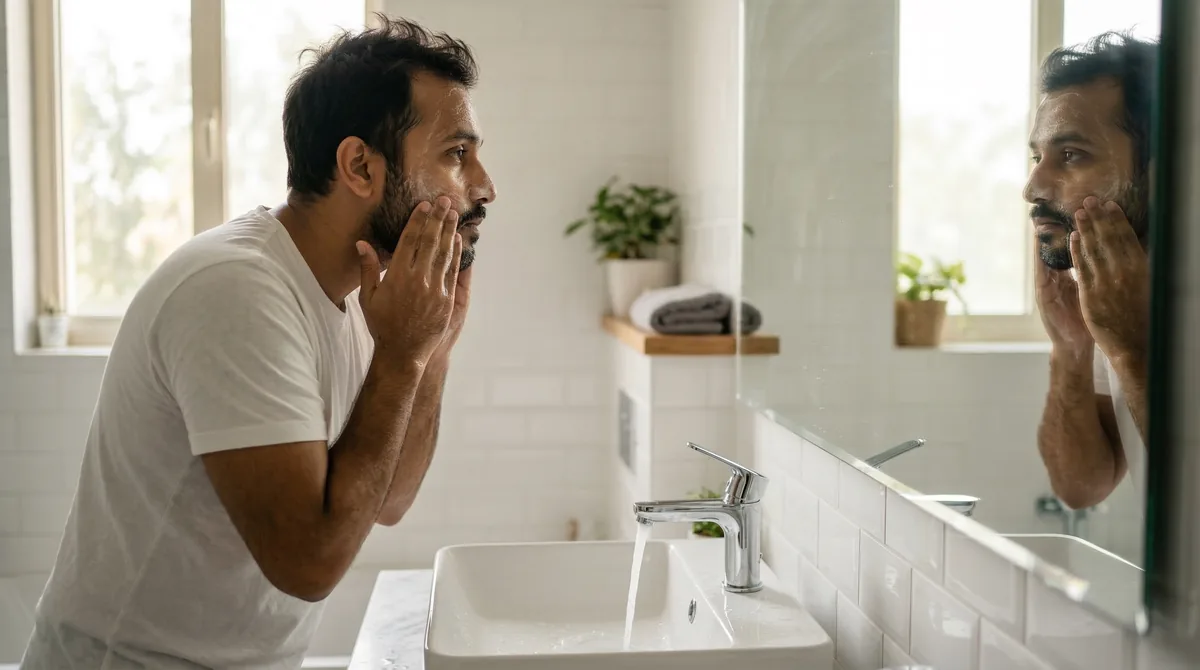

Your face feels like an oil slick by 10 AM. Your scalp itches constantly. You’ve tried every moisturizer at the pharmacy, and they all sit on your skin like a greasy film or disappear within an hour. Welcome to skincare in extreme heat and humidity.
This article contains affiliate links. See our affiliate disclosure for details.
We spent six months testing 47 different products in Gulf summer conditions, temperatures above 40°C, humidity swinging between 20% and 90%, and the hardest water we’ve ever encountered. Most products failed spectacularly. A few actually worked. Here’s the system we built from what survived.
The problem isn’t just the heat. It’s the combination of environmental factors that don’t exist anywhere else: brutal UV exposure, mineral-heavy water that leaves a film on everything it touches, indoor-outdoor temperature swings of 20 degrees, and air conditioning that strips moisture from your skin while you sleep. Your skin responds by either overproducing oil (making you shiny and breakout-prone) or shutting down barrier function entirely (leaving you tight, flaky, and sensitive).
Why Standard Skincare Advice Fails in Extreme Climates
Most skincare routines are designed for temperate climates. They assume moderate temperatures, soft water, and relatively stable humidity. Those assumptions collapse in the Gulf.
Take the classic advice to ‘moisturize twice daily.’ In 45°C heat with 80% humidity, a standard moisturizer will either melt off your face or trap sweat underneath, creating the perfect environment for fungal acne. We tested this. It’s not your skin being ‘difficult.’ It’s the product being wrong for the conditions.
Or consider the recommendation to ‘cleanse gently.’ That works when you’re dealing with normal dirt and oil. It doesn’t work when you’re dealing with mineral deposits from hard water, sunscreen that’s been baking on your face for eight hours, and the kind of sweat production that soaks through your shirt before you reach your car. The American Academy of Dermatology notes that hard water can leave a residue that prevents proper cleansing and interferes with skincare product absorption.
The Gulf environment creates three specific problems: mineral buildup from hard water (calcium and magnesium that coat your skin and block product penetration), extreme sebum production from heat stress, and barrier damage from constant temperature fluctuation. Standard products don’t address any of these.
The Four-Step Morning Routine That Actually Works
Morning skincare in extreme heat has one job: control oil without stripping your skin so badly that it panics and produces even more. Every product needs to be lightweight, fast-absorbing, and stable in high temperatures.
Step 1: Gel-Based Cleanser. Not cream, not oil, not foam. Gel. We tested 12 cleansers and found that only gel formulas removed overnight oil and hard water residue without leaving a film. Look for salicylic acid (0.5-2%) if you’re acne-prone, or a simple surfactant blend if you’re not. Wash for 60 seconds minimum, quick splashes don’t cut it when you’re dealing with mineral deposits.
Step 2: Lightweight Hydrator. This is not a moisturizer in the traditional sense. You need something that delivers humectants (ingredients that pull moisture into skin) without occlusives (ingredients that seal it in and make you sweaty). Hyaluronic acid, glycerin, and niacinamide are your targets. Research published in Dermatologic Therapy shows niacinamide specifically helps regulate sebum production in hot, humid conditions, exactly what you need. Apply to damp skin, let it absorb for 30 seconds.
Step 3: Sunscreen, Non-Negotiable. UV index regularly hits 11-12 in summer. That’s ‘extreme’ on every scale. You need SPF 50+ that’s labeled ‘sport’ or ‘very water resistant.’ We found that mineral sunscreens (zinc oxide, titanium dioxide) last longer in heat and sweat than chemical ones, though they can leave a slight white cast. If that bothers you, look for tinted mineral formulas. Reapply every two hours if you’re outdoors. Yes, every two hours.
Step 4: Mattifying Powder (Optional). If you’re still shiny after steps 1-3, a translucent mattifying powder gives you about 3-4 hours of oil control. Not a solution, but it buys you time until lunch.
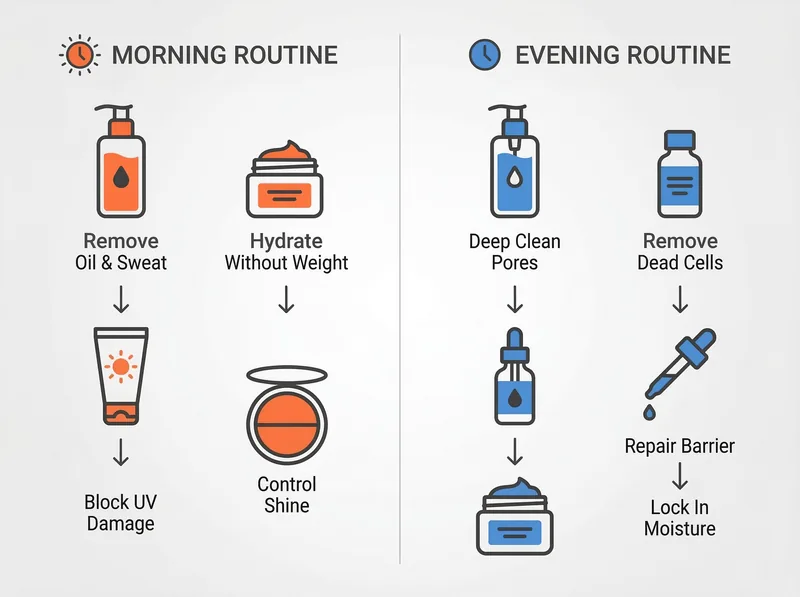 Morning routines prioritize oil control and sun protection, while evening routines focus on repair and hydration recovery.
The Evening Routine: Repair and Reset
Evening is when you undo the damage from heat, UV, and environmental stress. This routine is heavier than morning because your skin repairs itself while you sleep, and you’re (hopefully) in air conditioning.
Step 1: Oil-Based Cleanser First. This is the only way to properly remove sunscreen and sebum that’s been oxidizing on your skin all day. Oil dissolves oil. Massage it on dry skin for 60 seconds, add water to emulsify, rinse thoroughly. Then follow with your gel cleanser from the morning routine. Yes, two cleansers. A study in the Journal of Clinical and Aesthetic Dermatology found that double cleansing significantly reduced acne in hot, humid climates compared to single cleansing.
Step 2: Chemical Exfoliant (3-4 Times Per Week). Heat and humidity accelerate dead skin cell buildup. You need to remove them or they’ll clog your pores and make your skin look dull. Use either an AHA (glycolic or lactic acid, 5-10%) or BHA (salicylic acid, 2%). Not both. Not every night. Start with twice a week and increase if your skin tolerates it. Apply to clean, dry skin, wait 5 minutes before the next step.
Step 3: Hydrating Serum. Now that your skin is actually clean and exfoliated, it can absorb a proper treatment. Look for hyaluronic acid combined with ceramides or peptides. These ingredients help rebuild your moisture barrier, which takes a beating from temperature swings and hard water. Mayo Clinic research confirms that hyaluronic acid can hold up to 1,000 times its weight in water, making it particularly effective in air-conditioned environments where skin loses moisture rapidly.
Step 4: Night Cream with Occlusives. This is where you can use a richer product because you’re sleeping in climate-controlled conditions. Look for ingredients like squalane, shea butter, or ceramides. These create a barrier that locks in the serum underneath and prevents moisture loss to air conditioning. Apply a thin layer, you shouldn’t look shiny, just slightly dewy.
How We Tested: Six Months in Gulf Summer
We recruited eight men aged 28-45, all living in the Gulf region for at least two years. Each tester had different skin types: three with oily skin, three with combination, two with dry-but-oily-in-summer skin. We tracked their routines from April through September 2025, covering the full heat season.
Testing protocol: Each product was used for minimum two weeks. Testers photographed their skin weekly under consistent lighting, tracked oil production at 2-hour intervals, and noted any irritation, breakouts, or texture changes. We measured product absorption time, staying power in heat and humidity, and whether products pilled or separated when layered.
We tested outdoors in direct sun (UV index 10+), in air-conditioned offices (18-22°C), and during the temperature transition between the two. Products that worked in one environment but failed in another were eliminated. Products that required more than 5 minutes to apply or absorbed inconsistently were eliminated.
The hard water variable: We tested all cleansers and treatments with local tap water (TDS 400-600 ppm, hardness 250-350 ppm calcium carbonate equivalent). Products that left visible residue or required extensive rinsing were eliminated. This is where most Western skincare brands failed, they’re formulated for soft water and simply don’t rinse clean in Gulf conditions.
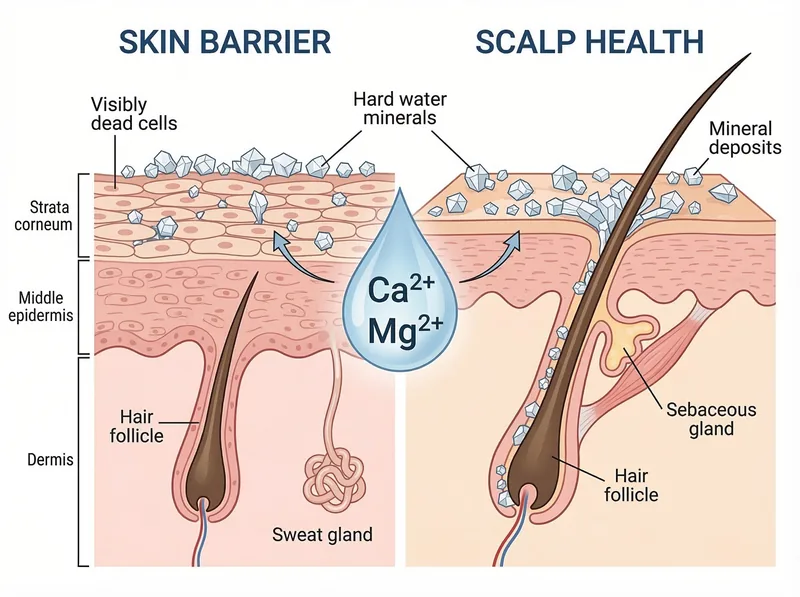 Calcium and magnesium deposits change the skin’s natural pH and create a film that blocks moisture absorption.
The Hard Water Problem: Why Your Skin Feels Tight and Filmy
If your skin feels tight immediately after washing but then gets oily within an hour, hard water is likely the culprit. The calcium and magnesium in Gulf water combine with soap and skincare products to form an insoluble film. This film sits on your skin surface, blocking product absorption and preventing your natural moisturizing factors from working properly.
The US Geological Survey classifies water above 180 ppm as ‘very hard.’ Most Gulf municipalities test between 250-400 ppm. That’s not just hard, it’s among the hardest tap water in the world. Every time you wash your face, you’re depositing minerals that build up over time.
The solution isn’t to stop washing your face (obviously). It’s to use products specifically designed to work in hard water, or to chelate (remove) minerals before they bond to your skin. Look for cleansers with EDTA or citric acid in the ingredients list, these are chelating agents that bind to calcium and magnesium so they rinse away instead of depositing.
Your scalp faces the same problem, which is why many men in the Gulf experience scalp issues even when using expensive shampoos. The minerals coat your scalp and hair, creating buildup that looks like dandruff but is actually mineral deposits. A chelating shampoo like Regrowth+ removes this buildup and restores your scalp’s natural pH balance, which is essential for overall skin health since your scalp is, well, skin. We cover this in detail in our article on men’s grooming in hard water.
Ingredients That Work vs. Ingredients That Fail in Heat
What Works: Niacinamide (regulates oil, reduces inflammation, stable in heat). Hyaluronic acid (pulls moisture from humid air into skin). Salicylic acid (penetrates oil, prevents clogged pores). Zinc oxide (physical sun protection that doesn’t degrade). Glycerin (humectant that works in both humid and dry conditions). Squalane (lightweight oil that mimics sebum without feeling greasy).
What Fails: Heavy plant oils (coconut, olive, they oxidize rapidly in heat and clog pores). Thick butters (shea, cocoa, they don’t absorb, they just sit). Fragrance (breaks down in heat, causes irritation). Alcohol-heavy toners (strip skin, trigger rebound oil production). Vitamin C serums (oxidize within days in heat and humidity, turning brown and useless). Retinol in morning routines (degrades in UV light, causes sun sensitivity).
The ingredient that surprised us: niacinamide. A review in the International Journal of Cosmetic Science found that niacinamide at 2-5% concentration reduces sebum production by up to 30% in hot climates while simultaneously improving barrier function. It’s one of the few ingredients that addresses both the oiliness and the barrier damage that Gulf conditions cause.
Temperature stability matters more than you think. We left products in a car for one day (interior temperature reached 65°C). Most serums separated. Several moisturizers turned to liquid. The ones that survived: mineral sunscreens, gel cleansers, and anything in airless pump packaging. If a product can’t survive a hot car, it’s not going to perform consistently on your face in 45°C heat.
The Air Conditioning Factor Nobody Talks About
You spend 8-10 hours a day in 18-22°C air conditioning, then step outside into 45°C heat. Then back into AC. This temperature swing, up to 25 degrees, multiple times daily, is brutal on your skin’s barrier function.
What happens: In AC, low humidity pulls moisture from your skin’s outer layers. Your skin compensates by producing more oil to prevent water loss. Then you step outside into heat and humidity, and that oil production is suddenly excessive. Your skin can’t adjust fast enough, so you end up simultaneously dehydrated and oily. It’s not a contradiction, it’s your barrier function breaking down.
Research in the Journal of Cosmetic Dermatology shows that rapid temperature fluctuation changes the skin’s natural lipid matrix, leading to increased transepidermal water loss (TEWL) and compromised barrier function. The solution: products that support barrier repair, specifically ceramides and cholesterol in a 3:1:1 ratio.
Practical adjustment: Keep a lightweight hydrating mist at your desk. Spray it on your face every 2-3 hours in AC to counter moisture loss. Look for formulas with glycerin or hyaluronic acid, not just water (which evaporates and makes dehydration worse). This simple step reduced the tight, uncomfortable feeling our testers experienced in office environments.
Body Skin Needs Different Treatment
Your face gets attention. Your body gets ignored until you’re dealing with back acne, chest breakouts, or that weird rough texture on your arms. Body skin in extreme heat faces the same challenges as facial skin, oil, sweat, hard water mineral buildup, but it’s tougher and can handle stronger treatments.
Body Wash: Use a salicylic acid body wash (2%) if you’re prone to body acne or folliculitis (inflamed hair follicles that look like small red bumps). The salicylic acid penetrates oil in your pores and prevents bacterial buildup. If you don’t have breakouts, a simple glycerin-based body wash is fine. Avoid heavily fragranced products, fragrance plus heat plus sweat equals irritation.
Exfoliation: Use a physical exfoliant (scrub mitt or brush) 2-3 times per week to remove dead skin cells that accumulate faster in heat and humidity. Focus on areas prone to friction: back, chest, shoulders. This prevents ingrown hairs and keeps your skin texture smooth.
Moisturizing: Your body needs moisture, but not heavy creams that will make you sweat. Look for lightweight body lotions with urea (5-10%) or lactic acid (5%). These ingredients are humectants that pull moisture into skin while also gently exfoliating. Apply immediately after showering while skin is still damp, this locks in water before it evaporates in the heat.
What About Supplements and Diet?
Skincare is topical, but your skin is an organ that responds to what you put in your body. In extreme heat, you’re losing water and electrolytes constantly through sweat. If you’re not replacing them, your skin will show it.
Hydration: You need more water than you think. Mayo Clinic recommends 3.7 liters daily for men in temperate climates. In Gulf heat, add another liter minimum, more if you’re active outdoors. Dehydrated skin looks dull, feels tight, and shows fine lines more prominently.
Omega-3 Fatty Acids: These support skin barrier function from the inside. A study in Marine Drugs found that omega-3 supplementation improved skin hydration and reduced inflammation in harsh environmental conditions. Get them from fatty fish (salmon, mackerel) three times per week, or supplement with 1-2g daily.
What Doesn’t Work: Collagen supplements (no evidence they improve skin appearance). Biotin (only helps if you’re deficient, which is rare). Vitamin E oil applied topically (too heavy for hot climates, clogs pores). We covered this thoroughly in our article on supplement myths, most of the same principles apply to skin.
Common Mistakes That Make Everything Worse
Over-cleansing. Washing your face more than twice daily strips your skin’s protective barrier and triggers rebound oil production. If you feel oily mid-day, blot with oil-absorbing papers or rinse with water only, don’t use cleanser.
Skipping sunscreen because you’re ‘just going to the car.’ UV damage is cumulative. Those 30-second walks from building to parking lot add up. The World Health Organization notes that even brief UV exposure in high-index conditions contributes to photoaging and skin cancer risk. Wear sunscreen every day, even if you’re mostly indoors.
Using hot water to wash your face. Hot water strips your skin’s natural oils and damages your moisture barrier. Use lukewarm water, even though it feels less refreshing. Your skin will thank you.
Applying too many products at once. More is not better. We tested layering 5+ products and found that absorption decreased after the third layer. Stick to 3-4 products maximum per routine. If something isn’t absorbing, you’re using too much or the wrong formula for your climate.
Not adjusting your routine seasonally. What works in winter (when humidity drops to 20-30%) won’t work in summer (when it spikes to 70-90%). You need a lighter routine in summer, slightly richer in winter. Listen to your skin, not the calendar.
References
- Hard Water and Your Skin - American Academy of Dermatology
- Niacinamide and Sebum Production in Humid Climates - Dermatologic Therapy (PubMed Central)
- Double Cleansing Efficacy in Hot, Humid Conditions - Journal of Clinical and Aesthetic Dermatology (PubMed Central)
- Temperature Fluctuation and Skin Barrier Function - Journal of Cosmetic Dermatology (PubMed Central)
- Water Hardness Classification and Effects - US Geological Survey