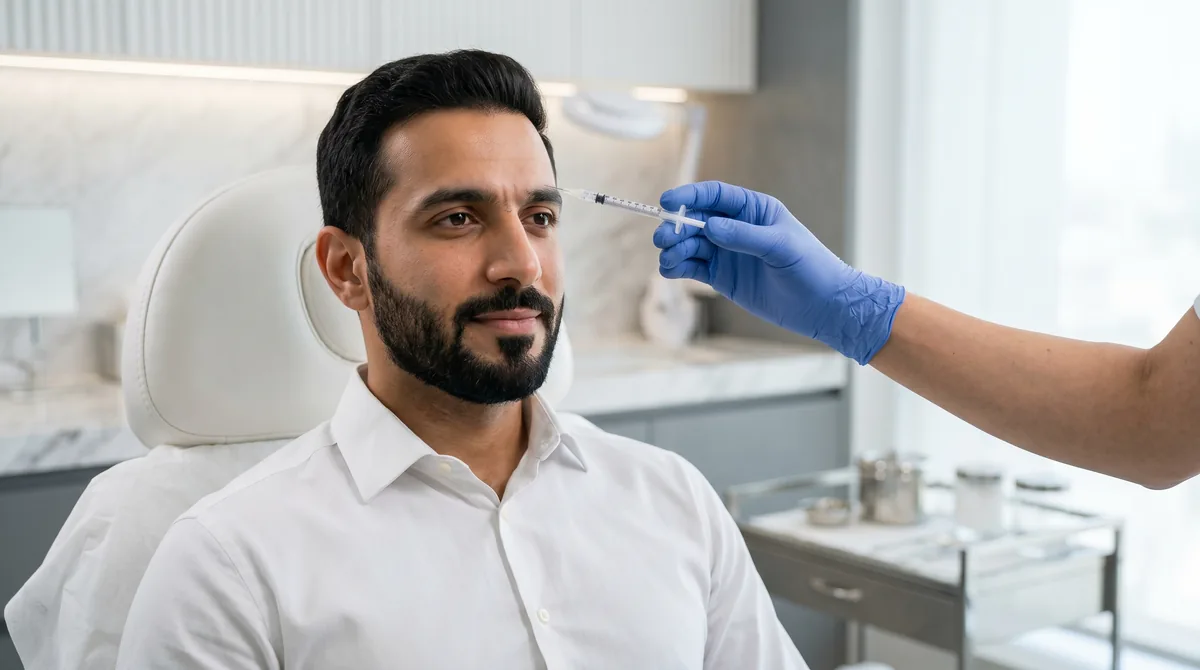

Botox isn’t just for Hollywood actors anymore. Walk into any upscale clinic in the Gulf and you’ll see men in their 30s and 40s sitting in the waiting room, scrolling through their phones like they’re waiting for a haircut. The stigma has evaporated. The question isn’t whether men get Botox anymore. It’s whether you should, what it actually does, and what you’ll pay for it locally.
We’re seeing a massive shift. Cosmetic procedures for men in the region have grown 42% since 2022, according to data from the International Society of Aesthetic Plastic Surgery. Botox leads the pack. It’s quick, it’s relatively affordable, and it doesn’t require downtime. For professionals in competitive industries where looking sharp matters, it’s become routine maintenance.
This isn’t vanity. It’s strategy. Your face communicates before you open your mouth, and in the Gulf’s business culture where first impressions carry weight, looking tired or older than you are has real costs. Botox addresses that. But it’s also a medical procedure with real risks, real costs, and real limitations. Here’s what you need to know before you book that appointment.
What Botox Actually Does (and Doesn’t Do)
Botox is botulinum toxin type A. It’s a purified protein that temporarily paralyzes muscles. When injected into specific facial muscles, it prevents them from contracting, which smooths the wrinkles those contractions create. That’s it. It doesn’t fill wrinkles, it doesn’t tighten skin, and it doesn’t reverse sun damage. It just stops the muscle from moving.
The effect is temporary. The toxin binds to nerve endings and blocks the release of acetylcholine, the neurotransmitter that tells muscles to contract. Over 3-4 months, your body metabolizes the toxin, nerve endings regenerate, and muscle function returns. You’re back to baseline. That’s why Botox requires repeat treatments.
For men, the three most common injection sites are the forehead (horizontal lines), the glabella (vertical frown lines between the eyebrows), and crow’s feet (lines radiating from the outer corners of the eyes). These are dynamic wrinkles caused by repeated muscle movement. Botox works on these. It doesn’t work on static wrinkles (the ones visible even when your face is relaxed) or on skin texture issues like enlarged pores or sun spots.
The key difference for men versus women is dosage and placement. Men have thicker skin and stronger facial muscles, so they typically need 20-30% more units to achieve the same effect. A skilled injector will also preserve some movement to avoid the frozen look that reads as unnatural on masculine faces. You want to look refreshed, not surprised.
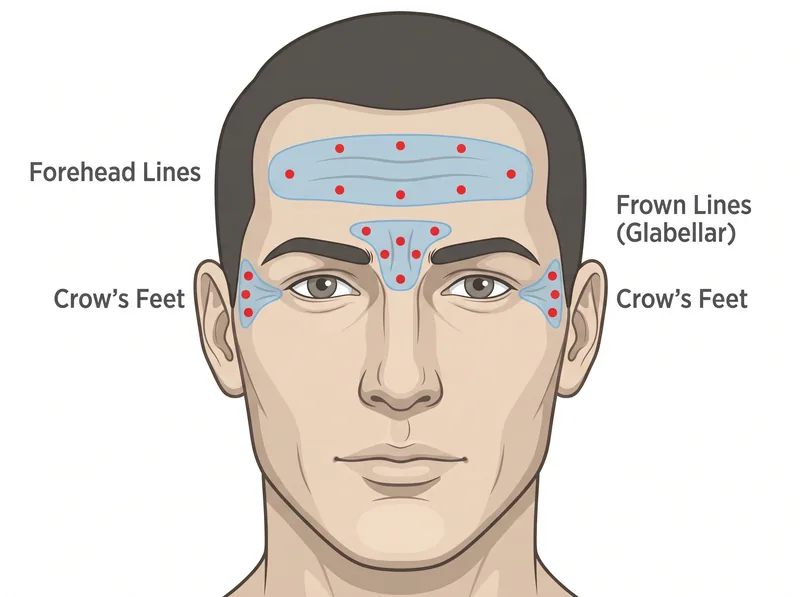 The three primary injection zones for men: forehead lines, crow’s feet, and glabellar (frown) lines between the eyebrows.
What It Costs in the Gulf and What You’re Actually Paying For
Botox pricing in the Gulf is typically quoted per unit or per area. Expect to pay between AED 35-60 per unit at reputable clinics. A full treatment for men usually requires 40-70 units depending on the areas treated and the strength of your facial muscles. That puts a typical session at AED 1,800-3,500.
Here’s the breakdown by area. Forehead lines: 15-25 units. Glabellar (frown) lines: 20-30 units. Crow’s feet: 10-15 units per side. If you’re treating all three areas in one session, you’re looking at 50-70 units total. Some clinics offer package pricing (e.g., AED 2,500 for a full face), which can save you 10-15% compared to per-unit pricing.
But the per-unit price isn’t the whole story. What you’re really paying for is the injector’s skill. An experienced injector knows male facial anatomy, understands how to preserve natural movement, and can avoid complications like brow droop or asymmetry. A cheap injector using diluted product or poor technique will give you poor results or worse, visible mistakes that take months to wear off.
Red flags to watch for: clinics advertising Botox at AED 20-25 per unit (likely using counterfeit or over-diluted product), practitioners who aren’t board-certified dermatologists or plastic surgeons, and facilities that don’t conduct a proper consultation before treatment. You’re injecting a neurotoxin into your face. This isn’t the place to bargain hunt.
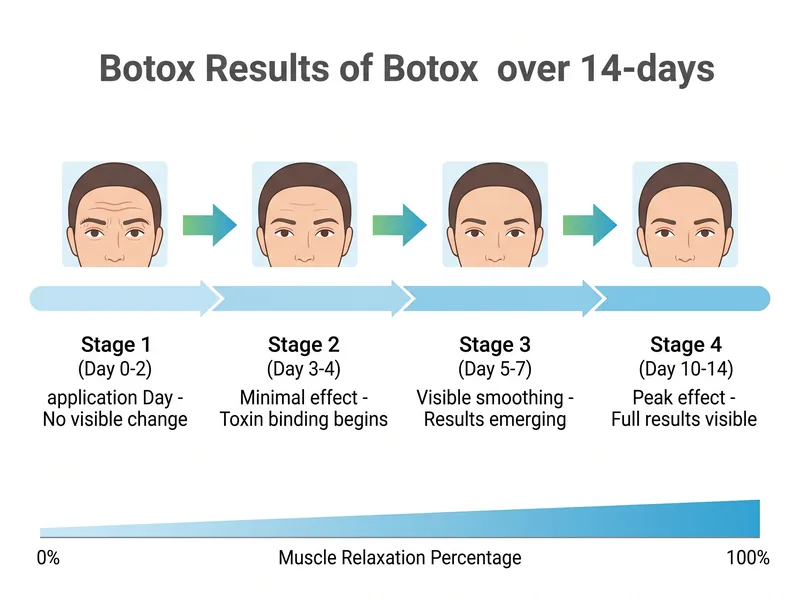 Typical results timeline: minimal change in the first 48 hours, visible smoothing by day 5-7, peak effect at 10-14 days.
The Treatment Process and What to Expect
The actual injection process takes 10-15 minutes. You’ll sit in a reclined chair. The injector will mark the injection points with a washable pen, clean the area with alcohol, and then inject small amounts of Botox into each marked muscle using a very fine needle. Most men describe the sensation as a quick pinch or mosquito bite. No anesthetic is needed.
You can return to work immediately. There’s no downtime. You might have small red marks at the injection sites for 30-60 minutes, but they fade quickly. The most common side effects are mild bruising (which you can cover with concealer if needed) and a slight headache for a few hours. Serious complications like eyelid droop or asymmetry are rare when the procedure is done correctly, occurring in less than 1% of cases according to published safety data.
Results aren’t immediate. You won’t see any change for the first 48 hours. By day 3-4, you’ll start to notice the treated muscles feel slightly weaker when you try to furrow your brow or raise your eyebrows. By day 7, the smoothing effect becomes visible. Peak results appear at 10-14 days. This is when you should schedule your follow-up appointment if you need any touch-ups.
The effect lasts 3-4 months on average. Some men metabolize Botox faster (heavy gym-goers and those with very active facial expressions tend to see shorter duration). Your first treatment might last only 2-3 months. Subsequent treatments often last longer as the muscles become trained to relax. Most men settle into a maintenance schedule of 3-4 treatments per year.
Why Gulf Men Are Choosing Botox Now
The cultural shift is real. Five years ago, men getting cosmetic procedures in the Gulf kept it quiet. Now it’s a normal topic of conversation in gyms, offices, and even family gatherings. The term ‘Brotox’ has entered the local vocabulary. Social media has normalized it. Influencers and business figures talk openly about their treatments.
Part of it is professional competition. In industries like finance, real estate, consulting, and hospitality where client-facing roles dominate, looking polished and energetic is part of the job. A 45-year-old executive competing with 30-year-olds for the same clients has an incentive to look current. Botox is a low-risk way to maintain that edge without surgery or significant recovery time.
The Gulf’s climate accelerates visible aging. Intense UV exposure, chronic dehydration from heat, and humidity damage to the skin barrier all contribute to premature lines and skin texture changes. Men who spend time outdoors or commute in harsh sun develop forehead lines and crow’s feet earlier than their counterparts in temperate climates. Botox addresses the dynamic component of that damage.
There’s also the preventative angle. Younger men in their late 20s and early 30s are starting Botox before deep wrinkles set in. The logic is sound: if you prevent the muscle from creasing the skin repeatedly, you delay the formation of permanent static wrinkles. It’s the same principle as sunscreen. Prevention is cheaper and more effective than correction.
What Can Go Wrong and How to Avoid It
The most common complaint isn’t a medical complication. It’s dissatisfaction with the aesthetic result. The frozen forehead. The Spock eyebrow (one brow higher than the other). The inability to show expression. These are technique problems, not product problems. They happen when the injector uses too much product, injects in the wrong location, or doesn’t account for your natural facial movement patterns.
Serious medical complications are rare but possible. Eyelid ptosis (drooping eyelid) occurs in about 1-5% of treatments when Botox migrates to the muscle that lifts the eyelid. It’s temporary but can last 2-3 months until the toxin wears off. Asymmetry, where one side of your face moves differently than the other, happens when dosing isn’t balanced correctly. Double vision and difficulty swallowing are extremely rare and typically only occur with very high doses or injection into the wrong muscle groups.
Allergic reactions to Botox itself are exceptionally rare (the protein is highly purified), but reactions to the preservatives in the solution do happen. If you have a history of allergies to albumin or have a neuromuscular disease like myasthenia gravis or ALS, you shouldn’t get Botox at all. A proper consultation should screen for these contraindications.
How to minimize risk: choose a board-certified dermatologist or plastic surgeon with specific experience treating men. Ask to see before-and-after photos of male patients. Avoid med spas or clinics where nurses or aestheticians are doing the injections without direct physician supervision. And start conservatively. You can always add more units at a two-week follow-up if the initial dose was too subtle. You can’t undo an overdose except by waiting it out.
How It Fits Into a Broader Anti-Aging Strategy
Botox isn’t a standalone solution. It’s one tool in a larger maintenance system. It addresses dynamic wrinkles caused by muscle movement. It doesn’t address skin texture, pigmentation, volume loss, or sagging. For those issues, you need other interventions: retinoids for texture and collagen production, chemical peels or laser for pigmentation, dermal fillers for volume loss, and potentially skin tightening procedures for laxity.
The most effective approach combines Botox with a solid daily skincare routine. That means sunscreen every single day (the Gulf’s UV index regularly hits 10+), a retinoid at night to stimulate collagen turnover, and a moisturizer designed for hot, dry climates. Botox will smooth the lines, but skincare maintains the skin quality underneath.
For men dealing with multiple signs of aging, Botox often pairs with dermal fillers. Botox relaxes the muscles that create lines. Fillers replace lost volume in areas like the temples, under-eye hollows, and nasolabial folds. The combination addresses both dynamic and static aging. But this also doubles the cost and complexity. A full Botox and filler session can easily run AED 6,000-10,000 depending on the areas treated.
The timeline matters. If you’re in your late 20s to mid-30s with minimal lines, Botox alone might be sufficient for prevention. If you’re in your 40s or 50s with established wrinkles and volume loss, you’ll likely need a combination approach. And if you’re dealing with significant sun damage or skin texture issues, you should address those with skincare and resurfacing treatments before spending money on injectables. Get the foundation right first.
The Verdict: Is It Worth It?
For the right candidate, yes. If you’re bothered by forehead lines or frown lines, if you work in a client-facing role where appearance matters, and if you have the budget for quarterly maintenance, Botox delivers measurable results with minimal risk and zero downtime. It’s not a miracle. It won’t make you look 20 again. But it will make you look less tired and more current.
The cost-benefit calculation is personal. At AED 2,500-3,000 per session, four times a year, you’re looking at AED 10,000-12,000 annually. That’s the price of a mid-range gym membership or a decent watch. For some men, it’s a worthwhile investment in professional presentation. For others, it’s not a priority. There’s no right answer, only what aligns with your goals and budget.
The key is managing expectations. Botox is maintenance, not transformation. It’s a subtle improvement that most people won’t consciously notice but will register as ‘you look good’ or ‘you seem well-rested.’ If you’re looking for dramatic change, you’re in the wrong category. If you want to look like a slightly fresher version of yourself, Botox can deliver that.
Our recommendation: if you’re curious, start with a single area (forehead or glabellar lines) at a reputable clinic. See how you respond to the treatment, how you feel about the results, and whether the maintenance schedule fits your lifestyle. You can always expand to additional areas later. But go in with realistic expectations, choose your injector carefully, and understand that this is a recurring cost, not a one-time fix.
References
- Global Aesthetic Survey Results 2023 - International Society of Aesthetic Plastic Surgery
- Safety and Efficacy of Botulinum Toxin Type A in the Treatment of Glabellar Lines - PubMed
- Botulinum Toxin Overview and Patient Safety - American Academy of Dermatology
- Botox Injections: Uses, Side Effects, and Procedure - Mayo Clinic