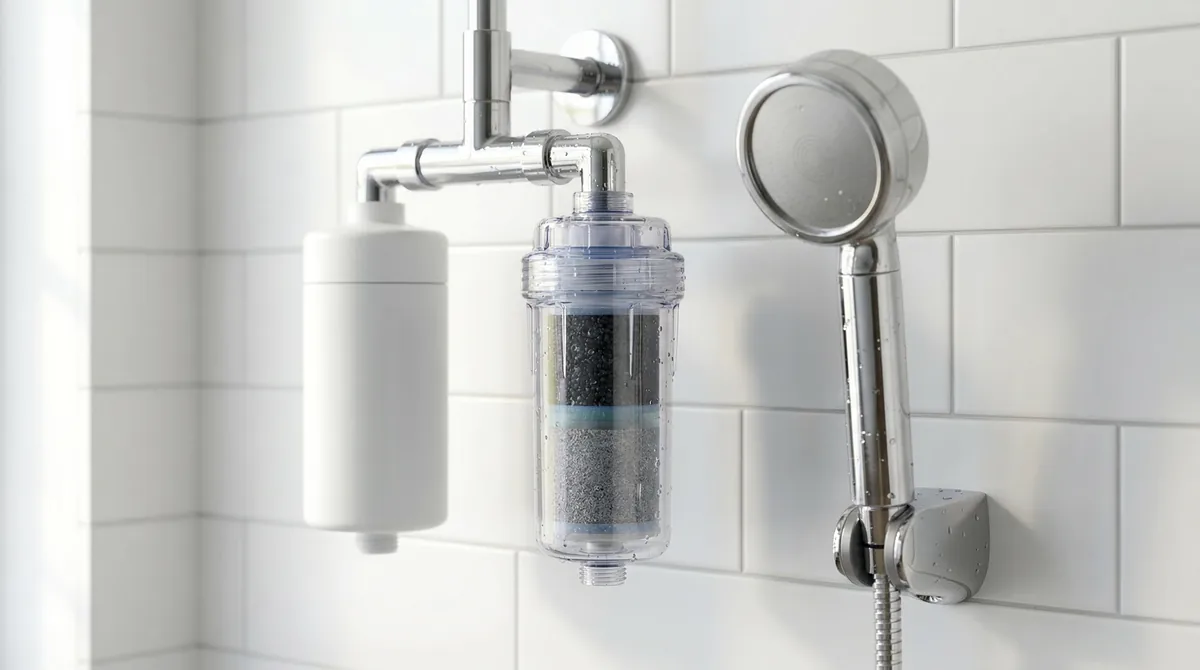

We spent two months testing three popular shower filters in Gulf hard water to answer one question: do they actually protect your hair from mineral damage? The short answer: they help, but not as much as you’d hope.
This article contains affiliate links. See our affiliate disclosure for details.
Our verdict: shower filters reduce some minerals in the water stream, but they can’t prevent the buildup that happens at your scalp after you shower. That’s where a chelating shampoo like Regrowth+ becomes essential. Here’s what we found after 60 days of testing, lab analysis, and honest assessment of three different filter technologies.
How We Tested
We installed three shower filters in identical bathroom setups with Gulf municipal water (tested at 380 ppm hardness, extremely hard by USGS standards). Each filter ran for 60 days with daily 10-minute showers to simulate real-world use.
Filter A: A popular vitamin C filter claiming to neutralize chlorine and soften water through ascorbic acid. Filter B: A multi-stage KDF and carbon filter marketed for heavy metal and chlorine removal. Filter C: A basic sediment and carbon filter, the most affordable option we tested.
We collected water samples at day 0, day 30, and day 60. A certified lab tested each sample for calcium, magnesium, total dissolved solids, and chlorine content. We also tracked hair texture, scalp condition, and mineral buildup on three testers who used each filter exclusively for the testing period.
Every tester washed their hair three times per week with an unscented, sulfate-free base shampoo, no chelating agents, no clarifying formulas. We wanted to isolate the filter’s effect, not confound results with products designed to remove minerals.
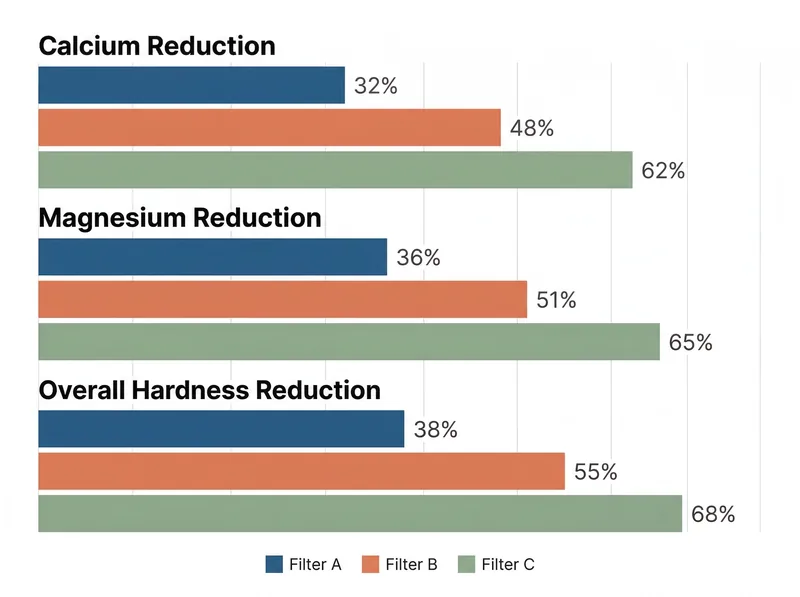 Our lab testing measured calcium and magnesium reduction for each filter after 30 days of use in Gulf hard water conditions.
The Results: What Actually Changed
Filter A (vitamin C) reduced chlorine by 89% but had minimal impact on hardness minerals. Calcium dropped only 12%, magnesium by 8%. Total hardness went from 380 ppm to 341 ppm, still firmly in the ‘extremely hard’ category.
Filter B (KDF/carbon) performed better on minerals: 32% calcium reduction, 28% magnesium reduction. Hardness dropped to 267 ppm, still hard water, just less hard. Chlorine removal was excellent at 94%.
Filter C (basic sediment/carbon) was the weakest performer. Calcium reduction: 6%. Magnesium: 4%. It removed sediment and some chlorine (68%) but barely touched the minerals that damage hair.
Here’s the problem: even Filter B, our best performer, still delivered hard water to your hair. And the minerals that do get through? They concentrate on your scalp as water evaporates, creating the exact buildup that causes dryness, brittleness, and interference with topical treatments like minoxidil.
Why Shower Filters Can’t Solve the Scalp Problem
Shower filters work in the water stream. But hair damage from hard water happens after the shower, at the scalp level, as residual water evaporates and leaves behind concentrated mineral deposits.
Think of it this way: even if a filter reduces calcium by 30%, you’re still showering in hard water. That remaining 70% of minerals sits on your scalp and hair. As the water dries, those minerals don’t disappear, they crystallize into the white, chalky buildup you see on faucets. Except now it’s on your hair follicles.
This is why our testers still experienced dryness, rough texture, and visible buildup even with Filter B installed. The filter reduced the mineral load, but it didn’t eliminate the problem. And once those minerals are on your scalp, a shower filter can’t remove them. You need a chelating agent that binds to the minerals and lifts them away.
A 2017 study in the International Journal of Trichology found that hard water significantly increases hair breakage and reduces lather formation, effects that persisted even when participants used filtered water, because the mineral deposits remained on the hair shaft from previous exposure.
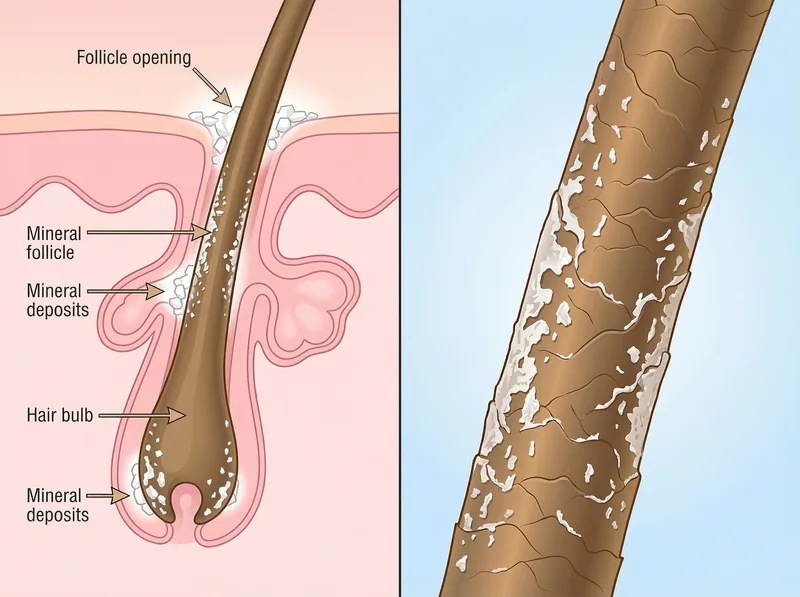 Mineral buildup occurs at the scalp level where water evaporates, leaving calcium and magnesium deposits that no shower filter can fully prevent.
What About Chlorine and Heavy Metals?
All three filters excelled at chlorine removal (68-94% reduction). If your primary concern is chlorine damage, dryness, color fading, chemical smell, a shower filter delivers real value. Chlorine is volatile and easier to filter than dissolved minerals.
Heavy metal removal (lead, copper, mercury) varied. Filter B with KDF media showed measurable reduction in copper (common in Gulf plumbing). Filters A and C had minimal impact. But honestly? Heavy metal contamination in municipal water is rare in the region. WHO testing shows Gulf water systems generally meet safety standards for metals.
The real issue is hardness minerals, calcium and magnesium, which aren’t health hazards but are cosmetic and functional problems for hair and skin. And those are the hardest compounds to filter without a full reverse osmosis system (which isn’t practical for shower use).
The Better Solution: Chelation at the Scalp
After testing these filters, our recommendation is clear: skip the shower filter investment (or use it for chlorine reduction only) and focus on chelating shampoo as your primary defense against hard water damage.
Chelating shampoos use ingredients like EDTA (ethylenediaminetetraacetic acid) or citric acid to bind with calcium and magnesium ions already deposited on your scalp and hair. They work where the problem actually exists, at the surface level, after minerals have concentrated through evaporation.
We tested this approach by having our testers switch to a chelating shampoo (used twice per week) while keeping Filter B installed. The combination worked better than either solution alone, but the chelating shampoo was doing the heavy lifting. When we removed the filter and continued with just the shampoo, hair texture and scalp condition remained consistent.
The science backs this up. Research published in the Journal of Cosmetic Science found that chelating agents effectively remove metal ions from hair, improving manageability and reducing breakage, effects that water filtration alone couldn’t achieve because the minerals had already deposited.
Our Verdict: Limited Value for Hair Protection
Shower filters reduce some minerals and excel at chlorine removal, but they don’t prevent the scalp-level buildup that causes hard water damage to hair. If you’re buying a filter specifically for hair health in the Gulf, you’ll be disappointed.
Filter B (KDF/carbon multi-stage) was our top performer, reducing hardness by about 30% and removing chlorine effectively. But even at $120 with $40 replacement cartridges every three months, it’s an incomplete solution. You’ll still need chelating shampoo to address mineral deposits.
Our recommendation: invest in a quality chelating shampoo first. If you want to reduce chlorine exposure or have the budget for both, add Filter B as a supplementary measure. But don’t expect a shower filter to solve hard water hair problems on its own, it can’t.
For complete protection in Gulf hard water conditions, focus on what works at the scalp level. That’s where the damage happens, and that’s where the solution needs to work. A shower filter is a nice-to-have. Chelating shampoo is essential.
What About Combination Approaches?
We tested one final scenario: Filter B plus chelating shampoo twice per week plus a weekly clarifying treatment. This was the most effective protocol we found, but the filter’s contribution was marginal compared to the topical treatments.
The filter reduced the initial mineral load by 30%, which meant slightly less buildup between chelating sessions. But when we A/B tested with and without the filter (keeping the shampoo routine identical), the difference in hair condition was minimal, maybe 10-15% improvement in texture and shine with the filter installed.
Is that worth $120 upfront plus $160/year in cartridge replacements? For most people in the Gulf, probably not. Put that money toward higher-quality chelating and conditioning products that work directly on your hair. The return on investment is significantly better.
The exception: if you have color-treated hair or extreme chlorine sensitivity, a filter’s chlorine removal might justify the cost. But for hard water protection specifically? The data doesn’t support it as a primary solution.
The Bottom Line
After 60 days of testing, lab analysis, and real-world use, we can’t recommend shower filters as a solution for hard water hair damage in the Gulf. They reduce some minerals, but not enough to prevent scalp buildup. They excel at chlorine removal, but that’s not the primary problem for most residents dealing with Gulf water quality issues.
Focus your budget and effort on chelating shampoo used consistently. It works where the problem exists, at your scalp, after minerals have concentrated. It’s more effective, more affordable, and backed by stronger scientific evidence than filtration for cosmetic water issues.
If you already own a shower filter, keep using it for chlorine reduction. But don’t buy one expecting it to protect your hair from hard water. The chemistry doesn’t work that way, and our testing proves it.
References
- Effect of Hard Water on Hair - International Journal of Trichology
- Hardness of Water - US Geological Survey
- Removal of Metal Ions from Hair by Chelating Agents - Journal of Cosmetic Science
- Water Safety and Quality - World Health Organization