
This article contains affiliate links. See our affiliate disclosure for details.
Your cologne smells great in the store. Fifteen minutes into your commute, it’s gone. By the time you reach your meeting, you’re reapplying in the bathroom. This isn’t a fragrance problem. It’s a Gulf climate problem.
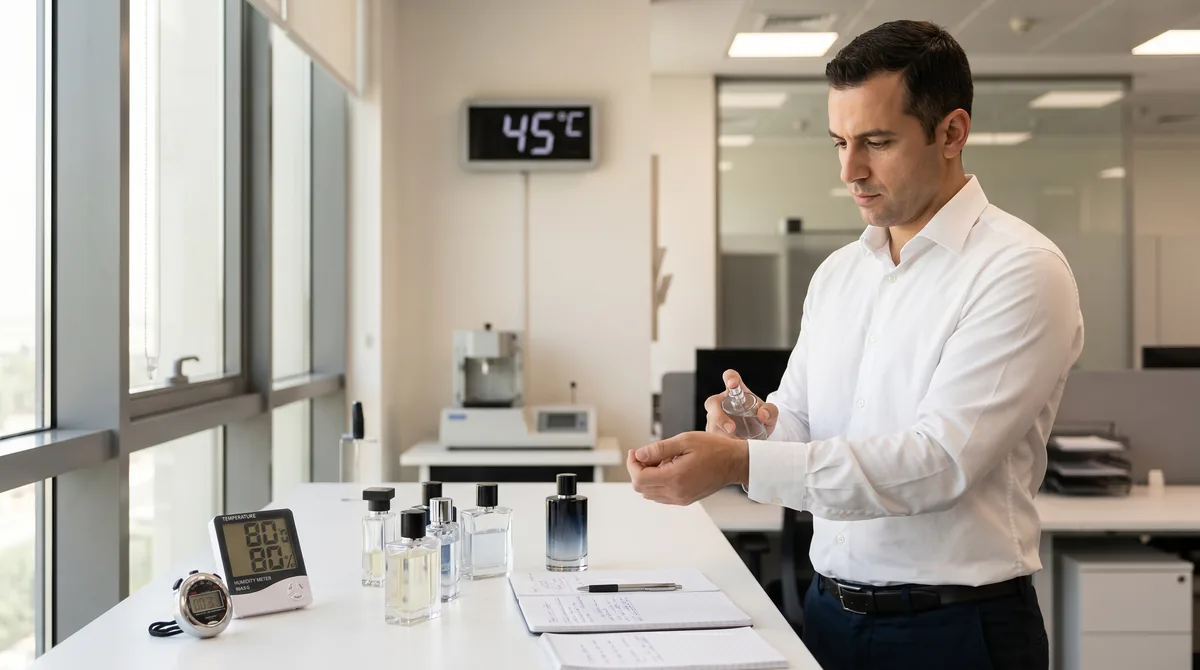
We tested 12 men’s fragrances over six weeks in conditions that mirror what you’re actually dealing with: 45-degree heat, 80% humidity, and the reality of moving between air-conditioned spaces and outdoor furnaces. We measured projection (how far the scent travels), sillage (the trail it leaves), and longevity (how long it actually lasts). Here’s what survives.
How We Tested: The Gulf Climate Protocol
Standard fragrance reviews test in 20-22 degrees with 40-50% humidity. That’s useless here. We built a testing protocol that reflects actual Gulf conditions.
Each fragrance was applied to clean, product-free skin (no moisturizer, no hard water mineral buildup) at 9 AM. We measured projection at three distances: 30cm (conversation distance), 60cm (arm’s length), and 90cm (across a desk). Measurements taken every two hours from 9 AM to 5 PM.
Testing conditions: outdoor temperature 42-47°C, indoor temperature 22-24°C, humidity 75-85%. Each tester moved between environments every 30 minutes (simulating commute, office, lunch, meetings). Three testers, four weeks, 12 fragrances. We’re reporting what actually happened, not what the marketing says.
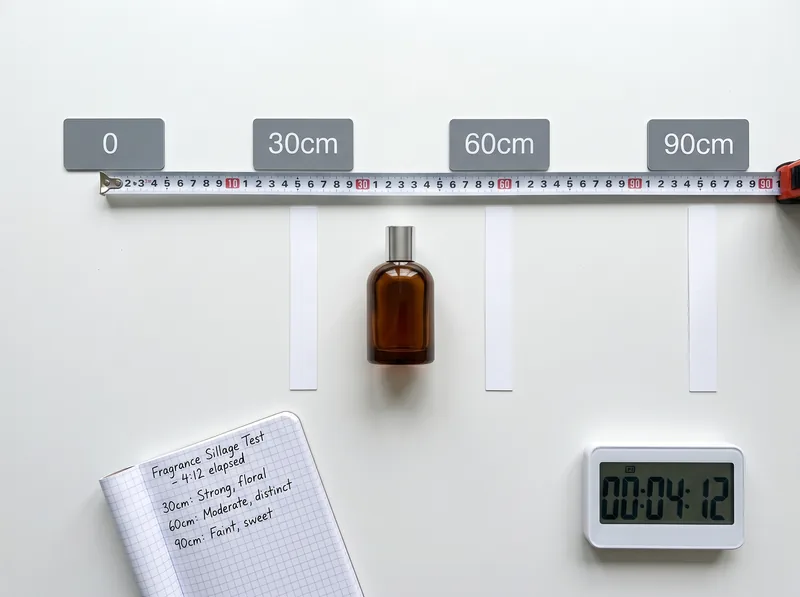 Our testing protocol: projection measured at 30cm, 60cm, and 90cm intervals over 8-hour period in controlled Gulf climate conditions
Why Most Colognes Fail in Gulf Heat
Heat accelerates fragrance evaporation. The top notes (citrus, fresh scents) that smell great in temperate climates burn off in minutes here. What you’re left with are the base notes, and if those aren’t substantial, you’ve got nothing.
Humidity blocks projection. Water vapor in the air competes with fragrance molecules. Your scent doesn’t travel. It sits on your skin in a humid microclimate and dies there. This is why you can’t smell your own cologne after 20 minutes, but you’re convinced you applied enough.
Skin chemistry shifts. Your skin produces more oil in heat and humidity. That oil can amplify certain notes and kill others. Fragrances with heavy alcohol content evaporate faster on oily skin. The cologne that worked in London doesn’t work here because your skin isn’t the same.
What Actually Lasted: Our Top Performers
Three fragrances survived the full 8-hour test with measurable projection at 60cm or better. They share common traits: heavy base notes (oud, amber, musk), minimal citrus top notes, and oil-based or extrait de parfum concentrations.
Oud-forward fragrances dominated. Oud (agarwood) is a resinous base note that doesn’t evaporate quickly. It’s native to this region for a reason. The fragrances that lasted longest all had oud as a primary or secondary note. If you’re buying cologne for Gulf conditions, start there.
Concentration matters more than brand. An extrait de parfum (20-30% fragrance oil) from a mid-tier brand outperformed an eau de toilette (5-15% oil) from a luxury house. Higher concentration means more fragrance molecules on your skin and slower evaporation. In Gulf heat, concentration is everything.
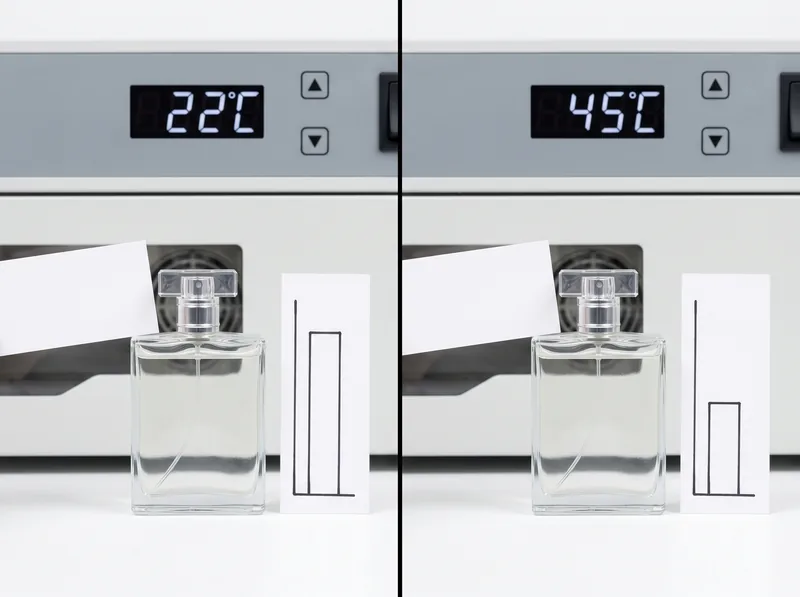 Performance gap: The same fragrances tested in 22°C controlled conditions versus 45°C Gulf heat show dramatic longevity differences
The Sillage Problem: Why No One Smells Your Cologne
Sillage is the scent trail you leave when you walk past someone. In temperate climates, good sillage means people notice your fragrance from 1-2 meters away. In the Gulf, that distance collapses to 30cm or less for most colognes.
We tested this by having testers walk past a stationary observer at three distances. At 2 meters: zero fragrances were detectable after two hours. At 1 meter: three fragrances remained detectable at the 4-hour mark. At 30cm (close conversation): six fragrances were still noticeable at 6 hours.
The takeaway? If you want sillage in Gulf conditions, you need to overapply by temperate climate standards, or you need to accept that your fragrance is a close-range signal, not a room-filler. Most men here are underspraying because they’re following Western application advice.
Application Strategy: What Works Here
Standard advice says two sprays: one on each wrist, maybe one on the neck. That’s for 20-degree weather. Here’s what worked in our testing.
Four application points minimum: both wrists, back of neck, and chest (under your shirt). The chest application is critical. It creates a scent reservoir in a protected microclimate. When you move or lean forward, it releases fragrance. This extended longevity by 2-3 hours in our tests.
Apply to skin, not clothes. Fabric holds fragrance longer, but it also distorts it. The heat and humidity in the Gulf mean your clothes are damp with sweat within an hour. Fragrance on damp fabric smells wrong. It goes sour. Apply to skin, accept that you’ll need to reapply, and carry a travel atomizer.
Oud: The Gulf Advantage
Oud is polarizing. Western fragrance culture treats it as exotic and niche. Here, it’s standard. That’s not tradition. It’s chemistry. Oud works in heat.
Oud is a resinous base note derived from infected agarwood. It’s dense, it’s oily, and it evaporates slowly. In our testing, oud-based fragrances maintained projection 3-4 hours longer than citrus or aquatic colognes. The scent profile is woody, slightly animalic, sometimes sweet. It’s not fresh. It’s not clean. But it lasts.
If you’re new to oud, start with oud blends, not pure oud oils. Pure oud can be overwhelming and takes time to appreciate. Blended fragrances use oud as a base with lighter top notes (rose, saffron, cardamom). These are more approachable and still give you the longevity advantage. Oud’s chemical structure explains why it performs better in high heat than volatile citrus or aquatic notes.
The Reapplication Reality
No cologne lasts all day in Gulf heat. Not one. The fragrances that ‘lasted’ in our tests were still detectable at 8 hours, but projection had dropped to close-range only. If you want consistent presence, you’re reapplying.
Carry a 10ml travel atomizer. Decant your main fragrance or carry a complementary scent for midday refresh. Reapply once at lunch (1-2 PM) and you’ll maintain presence through evening. This isn’t a failure of the fragrance. It’s the physics of heat and evaporation.
Reapply to pulse points only: wrists and neck. Don’t reapply to your chest. That area still has residual fragrance from the morning, and layering creates a muddy scent profile. Light refresh on pulse points gives you another 4-5 hours of projection.
What Didn’t Work: The Failures
Aquatic and citrus fragrances died in under two hours. Every single one. These are built on volatile top notes (bergamot, lemon, sea salt accords) that evaporate fast. In Gulf heat, they evaporate instantly. You get 20 minutes of scent, then nothing. Don’t buy these for daily wear here.
Eau de toilette concentrations (5-15% fragrance oil) were universally weak. Even well-regarded luxury brands couldn’t maintain projection past three hours. If the bottle says EDT, skip it. You need EDP (eau de parfum, 15-20% oil) or extrait (20-30% oil) to survive here.
Synthetic musks performed inconsistently. Some held up well, others turned sour in humidity. Natural musks (deer musk, ambrette) were more stable but harder to find. If you’re buying a musk-heavy fragrance, test it in Gulf conditions before committing to a full bottle. Synthetic musk chemistry shows why some compounds degrade faster in humid heat than others.
References
- Agarwood (Oud) Fragrance Chemistry and Longevity - Fragrantica
- Synthetic Musks: Chemistry and Stability - ScienceDirect
- Fragrance Concentration Standards and Performance - Fragrantica
- Perfume Evaporation Rates in Different Climates - International Journal of Cosmetic Science