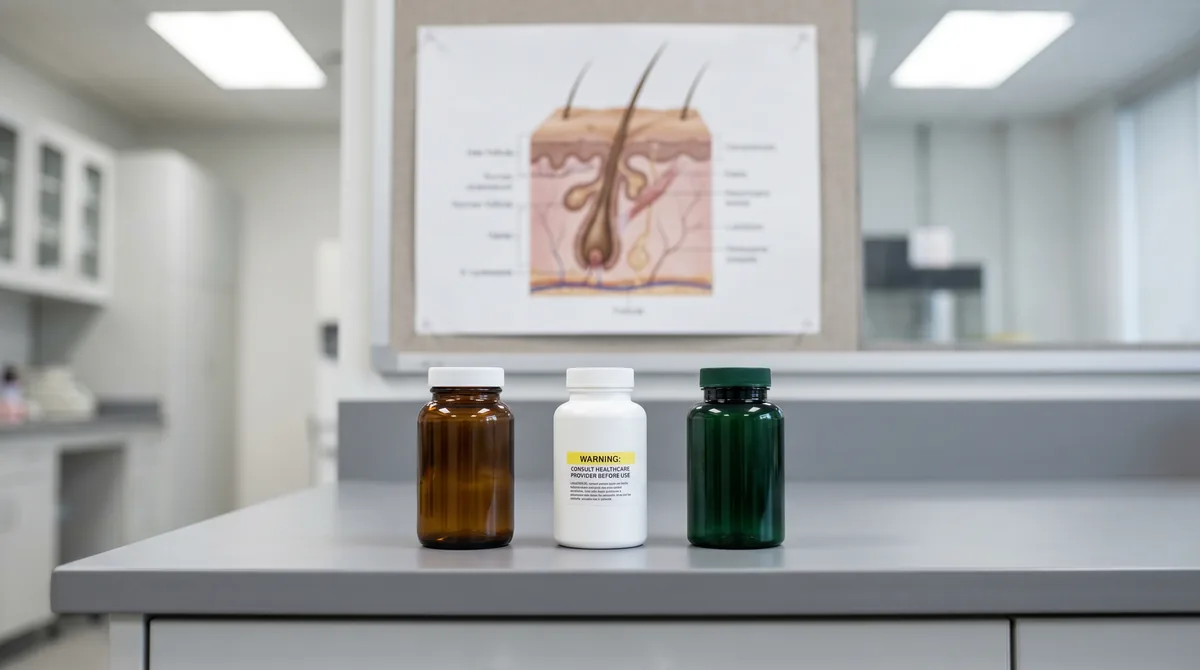

You’re taking a libido supplement because you want better performance. More energy, stronger drive, maybe some testosterone support. The marketing says it’s natural. Herbal. Safe. What they don’t mention is the hair follicle cost that comes with manipulating your hormone levels from the inside.
This article contains affiliate links. See our affiliate disclosure for details.
Here’s the problem: most libido boosters work by increasing testosterone production or mimicking its effects. That sounds great until you understand what your body does with extra testosterone. It converts it to DHT through an enzyme called 5-alpha reductase. And DHT is the primary hormone that miniaturizes hair follicles in men with genetic sensitivity. The same supplement that’s boosting your libido is potentially accelerating your hair loss.
We’re seeing more men in the Gulf region reporting sudden hair shedding after starting testosterone-boosting supplements. The pattern is consistent: three to six months after starting maca, tongkat ali, or tribulus, they notice increased shedding, temple recession, or crown thinning. The supplement industry doesn’t talk about this because it’s bad for business. But the mechanism is well-documented in endocrinology research.
This isn’t about fear-mongering. Some men take these supplements and experience no hair issues. But if you’re genetically predisposed to androgenetic alopecia (male pattern baldness), internal hormone manipulation is playing with fire. The contrast with external environmental factors is stark: hard water damages hair from the outside and can be neutralized with products like Regrowth+. Hormone supplements alter your internal chemistry in ways that can’t be easily reversed.
The Hormone Manipulation Problem: How Libido Boosters Actually Work
Most libido supplements work through one of three mechanisms: they increase luteinizing hormone (which signals your testes to produce more testosterone), they inhibit aromatase (preventing testosterone from converting to estrogen), or they directly mimic testosterone’s effects in the body. All three pathways lead to the same outcome: more androgenic activity.
Tongkat ali (Eurycoma longifolia) is the most researched example. A 2012 study in the Journal of the International Society of Sports Nutrition showed it increased testosterone by 37% in men taking 200mg daily for one month. That’s a significant hormonal shift. Your body doesn’t distinguish between testosterone from a supplement and testosterone from your own production. It processes both the same way.
The problem starts with 5-alpha reductase, the enzyme that converts testosterone to dihydrotestosterone (DHT). DHT is five times more potent than testosterone at binding to androgen receptors. In genetically susceptible hair follicles, DHT causes progressive miniaturization: the follicle shrinks, the growth phase shortens, and eventually the follicle stops producing terminal hair entirely.
Here’s what the supplement companies won’t tell you: if you’re genetically predisposed to male pattern baldness, increasing your testosterone production also increases your DHT production. You can’t have one without the other unless you’re simultaneously taking a 5-alpha reductase inhibitor like finasteride. And most men taking libido supplements aren’t taking finasteride.
The timeline matters. Hair loss from hormonal changes doesn’t happen overnight. You’ll typically see increased shedding three to six months after starting the supplement. By the time you connect the dots, you’ve already lost ground. And unlike stopping the supplement, which you can do immediately, reversing follicle miniaturization takes months to years.
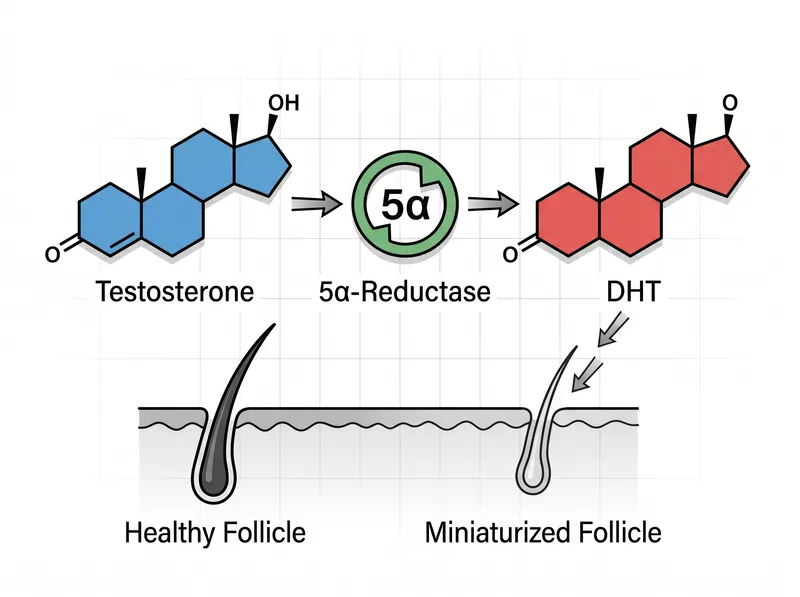 The hormone pathway: how testosterone boosters can accelerate DHT production and follicle miniaturization
Supplement-by-Supplement Breakdown: What the Research Shows
Maca root (Lepidium meyenii) is often marketed as a safer option because it doesn’t directly increase testosterone. The research supports this: a 2002 study in Andrologia found maca improved sexual function without changing testosterone or estrogen levels. But here’s the catch: maca contains compounds called macamides that have androgen-like effects. They don’t show up on hormone tests, but they still activate androgen receptors.
Does this cause hair loss? The evidence is mixed. Some men report no issues. Others report shedding. The problem is we don’t have long-term studies tracking hair density in maca users. What we do know is that any compound with androgen-receptor activity has the potential to affect DHT-sensitive follicles.
Tongkat ali is more problematic. The testosterone increase is real and measurable. A 2013 study showed 200mg daily increased free testosterone by 46% in men with low baseline levels. If you’re already in the normal range, the effect is smaller but still present. For men with androgenetic alopecia, this is a direct pathway to increased DHT production.
Tribulus terrestris is similar. It increases luteinizing hormone, which signals testosterone production. A 2000 study found it increased testosterone by 16% in healthy men. That’s enough to matter for hair-sensitive individuals. The supplement industry markets tribulus as ‘natural’ and ‘safe,’ but natural doesn’t mean side-effect-free when you’re manipulating hormone levels.
Fenugreek is interesting because it works differently. It inhibits 5-alpha reductase, the enzyme that converts testosterone to DHT. In theory, this should protect hair. A 2011 study found fenugreek improved libido without increasing testosterone. But it also increased DHT in some subjects, suggesting the 5-alpha reductase inhibition isn’t complete. The net effect on hair is unclear.
Ashwagandha (Withania somnifera) has the most favorable profile. It reduces cortisol and improves stress response, which can indirectly support testosterone. A 2019 study found it increased testosterone by 15% in men undergoing resistance training. But the mechanism is stress reduction, not direct hormonal manipulation. For most men, ashwagandha is the lowest-risk option if you’re concerned about hair loss.
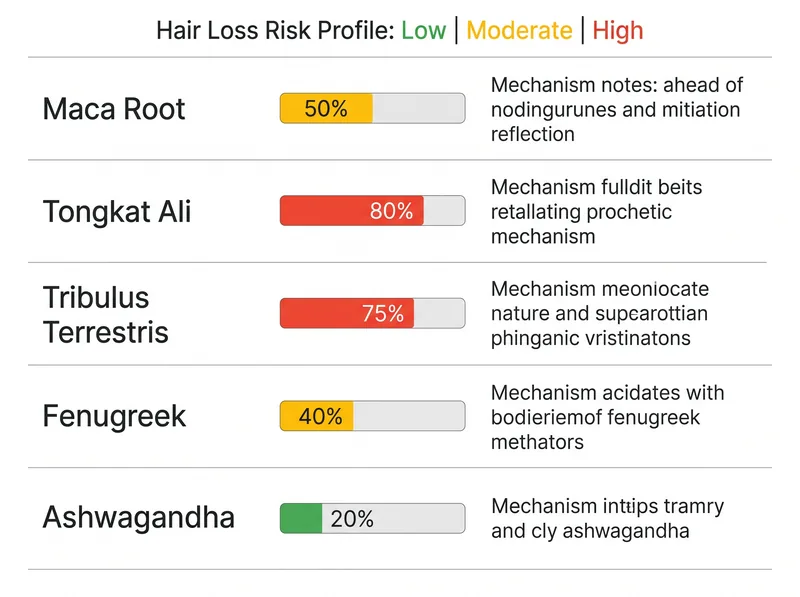 Risk profiles: how different libido supplements affect DHT and hair follicles
The Gulf Context: Heat, Stress, and Why Men Here Are More Vulnerable
Men in the Gulf region face a compounding problem. The climate itself is a stressor. High heat, intense UV exposure, and chronic dehydration all increase cortisol. Improved cortisol suppresses testosterone production, which is why many men here feel the need for libido support in the first place.
But here’s the trap: when you artificially boost testosterone with supplements, you’re creating a hormonal spike that your body wasn’t naturally producing. The Gulf climate is already taxing your endocrine system. Adding a supplement that forces testosterone production higher than your body’s natural set point creates a mismatch. Your cortisol is chronically improved, your testosterone is artificially improved, and your DHT follows.
The hard water factor adds another layer. Mineral buildup on the scalp creates inflammation and impairs follicle function. When you combine that external stress with internal hormonal manipulation, you’re attacking hair follicles from both directions. This is why we see faster progression of hair loss in men who move to the Gulf region and start taking libido supplements.
The stress-testosterone-hair loss cycle is well-documented. Chronic stress damages follicles through multiple pathways. When you add a supplement that increases DHT production, you’re not solving the root problem. You’re masking low testosterone with artificial improvion while potentially accelerating hair loss.
What to Do Instead: The Safer Approach to Libido and Hair Protection
If you’re experiencing low libido, the first step is identifying the cause, not reaching for a supplement. Get your hormone levels tested: total testosterone, free testosterone, estradiol, SHBG, and cortisol. A proper endocrine panel will tell you whether you actually have a testosterone deficiency or whether something else is going on.
Most men in the Gulf with libido issues don’t have low testosterone. They have high cortisol from chronic stress, poor sleep from heat changeion, and vitamin D deficiency from spending all day indoors in air conditioning. These are fixable without hormonal manipulation.
If your testosterone is genuinely low (below 300 ng/dL), work with an endocrinologist on proper testosterone replacement therapy (TRT). TRT is controlled, monitored, and can be paired with finasteride to block DHT conversion. Taking unregulated supplements that spike your testosterone without medical supervision is riskier for your hair and less effective for your libido.
For men who want to support libido without hormonal manipulation, focus on the fundamentals: sleep improvation, stress management, resistance training, and adequate protein intake. These improve testosterone naturally without forcing production beyond your body’s set point. The increase is gradual and your body adapts without the sudden DHT spike that damages follicles.
If you’re already taking a libido supplement and you’re noticing increased shedding, stop the supplement immediately. Document your shedding pattern. Wait three months. If the shedding stops, the supplement was the cause. If it continues, you may have androgenetic alopecia that was going to progress regardless. At that point, consider minoxidil or finasteride as evidence-based treatments.
For environmental protection, address the external factors you can control. In the Gulf region, hard water is a constant assault on hair and scalp health. Using a chelating shampoo removes mineral buildup and reduces inflammation. This doesn’t fix hormonal hair loss, but it prevents you from compounding the problem with external damage.
The Bottom Line: Risk vs. Reward for Hair-Conscious Men
Here’s the honest assessment: if you have no family history of male pattern baldness and you’re taking a libido supplement, your hair risk is low. If you have a family history of baldness but you’re not currently experiencing hair loss, the risk is moderate. If you’re already thinning and you start taking a testosterone booster, you’re accelerating the progression.
The reward side is equally unclear. Most libido supplements show modest improvements in sexual function, typically in the 15-30% range for subjective measures. That’s not nothing, but it’s not a dramatic transformation. And the effect often plateaus after three to six months as your body adapts.
The risk-reward calculation changes if you’re willing to pair a libido supplement with a DHT blocker. Taking tongkat ali with finasteride gives you the testosterone boost without the DHT spike. But at that point, you’re taking two drugs to solve a problem that might be better addressed by fixing your sleep, reducing stress, and training harder.
Our verdict: for most men concerned about hair loss, libido supplements aren’t worth the risk. The hormonal manipulation is real, the hair loss potential is documented, and the libido benefit is modest. If you’re going to manipulate your hormones, do it under medical supervision with proper monitoring and DHT protection.
If you’re not willing to take finasteride, don’t take testosterone boosters. It’s that simple. You can’t have it both ways. Either accept your natural testosterone levels and improve them through lifestyle, or commit to medical intervention with proper hair protection. Half-measures lead to hair loss.
References
- Effect of Tongkat Ali on stress hormones and psychological mood state in moderately stressed subjects - PubMed
- Lepidium meyenii (Maca) improved semen parameters in adult men - PubMed
- Tongkat Ali as a potential herbal supplement for physically active male and female seniors - PubMed
- Clinical evaluation of the spermatogenic activity of the root extract of Tribulus terrestris - PubMed
- Physiological aspects of male libido enhanced by standardized Trigonella foenum-graecum extract - PubMed