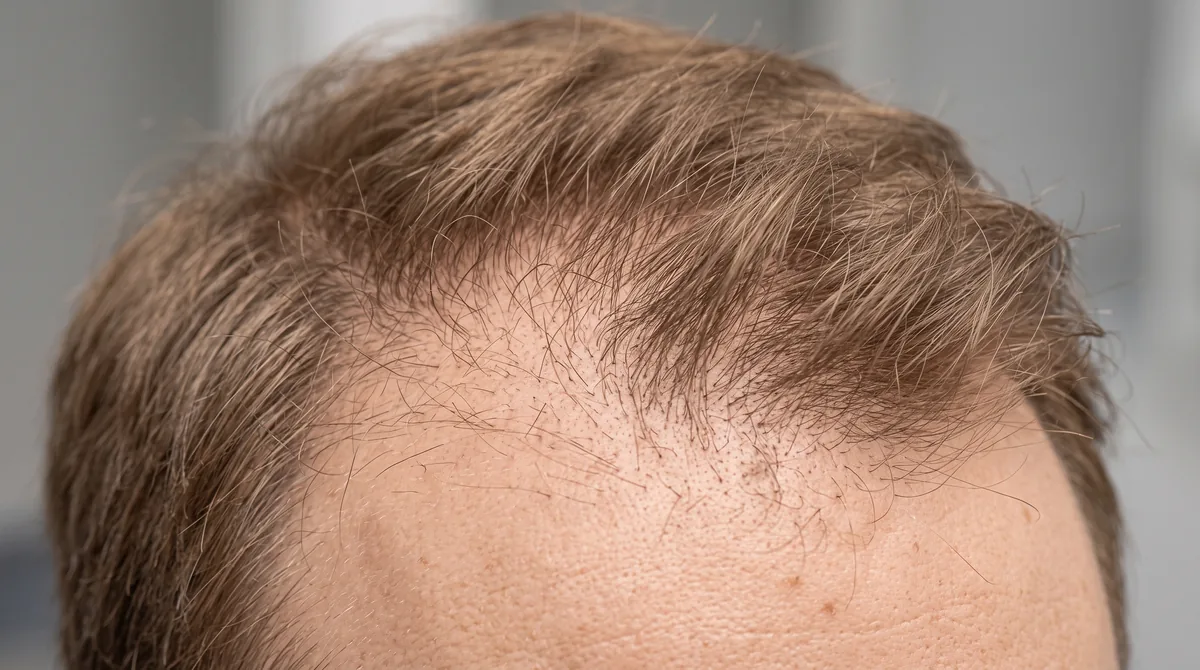

Intermittent fasting works. You lose weight, insulin sensitivity improves, and inflammation drops. But three months in, your hair starts coming out in the shower. Not a little. A lot.
This isn’t a coincidence. It’s telogen effluvium, the same stress-shedding mechanism triggered by crash diets, surgery, or severe illness. Your body interprets prolonged calorie restriction as a survival threat. Hair growth, being non-essential, gets shut down first.
We’re breaking down the exact mechanism, the timeline from fasting protocol to visible shedding, and what actually prevents it. This is the science of how restriction affects follicles, not the wellness blog version. This article contains affiliate links. See our affiliate disclosure for details.
The Mechanism: How Fasting Triggers Telogen Effluvium
Hair follicles operate in a three-phase cycle: anagen (growth), catagen (transition), and telogen (shedding). Normally, 85-90% of your follicles are in anagen at any given time. That’s why your hair looks full.
When your body detects sustained calorie restriction, it releases stress hormones (cortisol) and reduces thyroid output (T3). Both signals tell follicles to exit anagen early and enter telogen. A 2017 study in Dermatology Practical & Conceptual documented this shift in women on very-low-calorie diets, showing follicles transitioning to telogen within 2-3 months of restriction onset.
The result? Instead of 10-15% of follicles shedding, you get 30-40%. That’s triple the normal rate. You notice it in the shower, on your pillow, when you run your hands through your hair.
Here’s the critical part: the shedding you see today reflects what happened to your follicles three months ago. Telogen phase lasts 2-3 months. By the time hair falls out, the damage is done. This delay confuses people. They blame the shedding on something recent when the cause was months earlier.
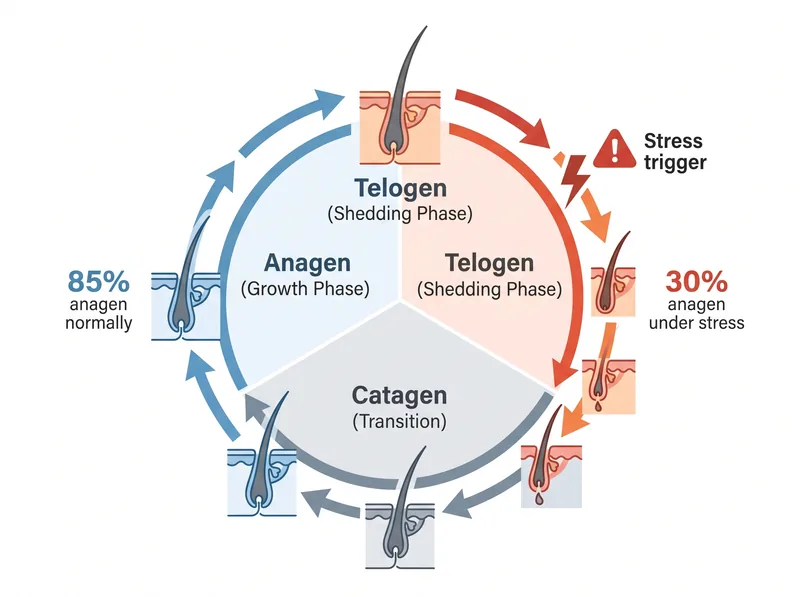 How intermittent fasting shifts follicles from anagen (growth) to telogen (shedding) through metabolic stress signals
IF Protocols Ranked by Hair Loss Risk
Not all fasting windows are equal. The risk scales with restriction severity and eating window compression.
16:8 (low risk): Eight-hour eating window, typically noon to 8pm. Most men can hit protein targets, spread meals, and maintain nutrient intake. Minimal hair loss risk if total calories and protein are adequate. This is the Gulf professional’s standard, fitting work schedules and social meals.
20:4 (moderate risk): Four-hour eating window. Harder to consume enough protein and calories in one sitting. Research in Nutrients (2019) showed that compressed eating windows reduced protein synthesis efficiency even when total daily protein matched controls. Your body can’t process 150g of protein in four hours as effectively as it can over eight.
OMAD (high risk): One meal a day. This is where we see consistent reports of hair shedding. The combination of severe calorie restriction (hard to eat 2000+ calories in one meal) and nutrient timing failure creates the perfect storm for telogen effluvium. Men on OMAD for 6+ months report noticeable thinning, especially if they’re also training hard.
Alternate-day fasting (very high risk): Fasting for 24-36 hours repeatedly signals famine to your body. Follicles respond accordingly. We don’t recommend this protocol for men concerned about hair retention.
The Protein Timing Problem
Hair is 95% keratin, a structural protein. Follicles need a steady supply of amino acids to maintain anagen phase. When you compress eating into a narrow window, you create gaps in amino acid availability.
A 2018 study in the Journal of the International Society of Sports Nutrition demonstrated that protein synthesis peaks 3-4 hours after a protein-rich meal, then declines. If you’re eating once daily, you get one synthesis peak. The rest of the 24-hour period, your follicles are starved of building blocks.
This matters more in the Gulf, where heat stress already increases protein turnover. You’re sweating out electrolytes, amino acids, and minerals daily. Combine that with a compressed eating window, and your follicles are running a deficit.
The fix isn’t complicated: spread protein across your eating window. If you’re doing 16:8, eat three times. If you’re doing 20:4, eat twice with high-quality protein sources (eggs, fish, chicken, legumes). Don’t try to cram 150g into one sitting and expect your body to use it all efficiently.
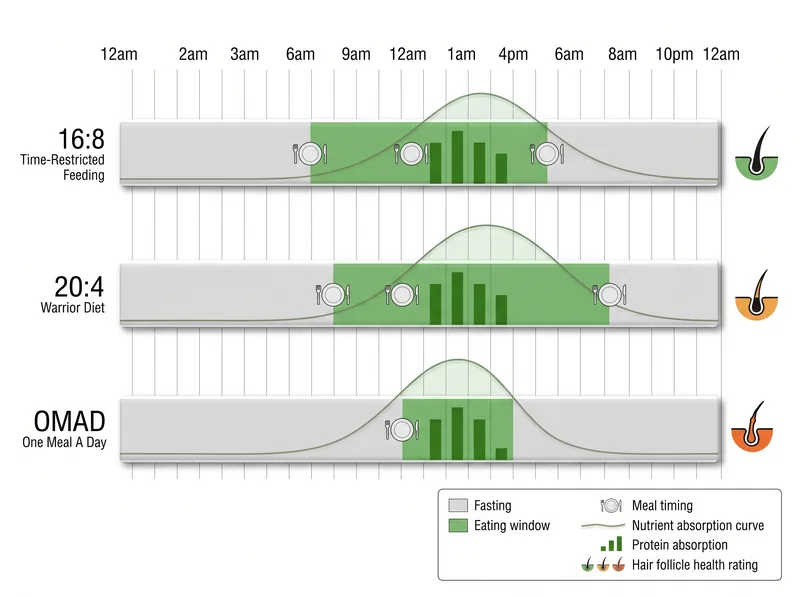 Eating windows and protein timing matter more than total calories when it comes to preventing fasting-induced hair loss
Micronutrient Gaps That Accelerate Shedding
Calorie restriction isn’t the only problem. Compressed eating windows make it harder to hit micronutrient targets, especially the ones follicles need most.
Iron: Required for oxygen transport to follicles. Men on IF often skip breakfast (traditional iron sources: eggs, fortified cereals) and compress meals, missing targets. Iron deficiency is already common in Gulf men due to dietary patterns. IF makes it worse.
Zinc: Essential for protein synthesis and follicle cell division. Found in red meat, shellfish, seeds. If you’re eating once daily and choosing lean proteins to stay within calories, you’re likely under-consuming zinc. Target: 11mg daily for men.
Biotin and B-vitamins: Needed for keratin production. Water-soluble, meaning they aren’t stored long-term. Miss them in your one meal, and follicles go without until tomorrow. This is the problem with OMAD: no nutritional safety net.
Vitamin D: Already deficient in 80% of Gulf residents despite sun exposure. IF doesn’t cause this, but it doesn’t help either. Low D levels correlate with telogen effluvium, and fasting protocols rarely prioritize D-rich foods (fatty fish, fortified dairy).
Cortisol, Thyroid, and the Stress Cascade
Fasting improves cortisol. That’s not inherently bad. Short-term cortisol spikes (morning fasting, pre-workout) are normal and even beneficial. Chronic improvion is different.
When you fast 16+ hours daily for months, baseline cortisol rises. A 2019 study in Obesity found that prolonged IF increased evening cortisol in participants, changeing the normal circadian rhythm. High evening cortisol interferes with sleep, which further stresses follicles.
Simultaneously, your thyroid downregulates. T3 (the active thyroid hormone) drops to conserve energy. This is an adaptive response to calorie restriction, but it’s terrible for hair. Low T3 directly shortens anagen phase, pushing follicles into telogen prematurely.
The combination of high cortisol and low thyroid creates a metabolic environment where hair growth isn’t prioritized. Your body is in conservation mode. Follicles are expendable.
What Actually Prevents IF-Induced Shedding
If you’re committed to intermittent fasting, here’s what keeps your hair intact. These aren’t theoretical. They’re the interventions that separate men who fast without shedding from men who lose ground.
Maintain a true calorie surplus or maintenance. Fasting for fat loss while eating 1500 calories daily is a recipe for telogen effluvium. Your body doesn’t care that you’re ‘improving insulin sensitivity.’ It sees restriction and responds. Eat enough to support your activity level and basal metabolic rate.
Prioritize protein in every meal. Aim for 30-40g per meal if you’re eating twice daily, 25-30g if three times. Don’t back-load it into dinner. Spread it out. Your follicles need amino acids consistently, not in one bolus.
Supplement the gaps. A quality multivitamin covering iron, zinc, biotin, and B-complex is non-negotiable on compressed eating windows. Add vitamin D separately (2000-4000 IU daily). These aren’t optional if you’re fasting long-term.
Cycle your fasting. Don’t do 20:4 or OMAD continuously for six months. Alternate between 16:8 (lower stress) and more aggressive protocols. Give your body metabolic breaks. Two weeks on, one week off. This prevents chronic cortisol improvion and thyroid suppression.
Monitor your shedding. Count hairs in the shower. If you’re consistently seeing 100+ hairs daily (normal is 50-100), you’re in telogen effluvium territory. Don’t wait until it’s visibly thin. Adjust your protocol immediately.
The Gulf Context: Heat, Hydration, and Fasting
Fasting in 45-degree heat adds another layer. You’re losing water, electrolytes, and minerals through sweat at rates that don’t exist in temperate climates. Combine that with a compressed eating window, and you’re running a severe deficit.
Dehydration alone can trigger telogen effluvium. A 2018 review in Skin Appendage Disorders documented hair shedding in patients with chronic dehydration, independent of other factors. In the Gulf, if you’re fasting 16 hours and only drinking water during that window, you’re not replacing what you lose to heat.
Electrolyte imbalance (low sodium, potassium, magnesium) also stresses follicles. These minerals are involved in cellular function at the follicle level. Miss them during your eating window, and you’re compounding the restriction stress.
The fix: drink electrolyte water during fasting hours (zero-calorie options exist), and prioritize mineral-rich foods in your eating window. Leafy greens, nuts, seeds, fish. Don’t rely on plain water alone. In Gulf conditions, that’s not enough.
Recovery Timeline After Stopping or Adjusting IF
If you’ve already triggered telogen effluvium through aggressive fasting, here’s the realistic recovery path. No magic fixes, just biology.
Shedding continues for 2-3 months after you stop the trigger. This is the telogen phase completing. You can’t stop hairs that are already in telogen from falling out. What you can do is prevent new follicles from entering telogen.
Regrowth begins 3-4 months after intervention. You’ll see short ‘baby hairs’ at the hairline and crown. These are follicles returning to anagen. Full density recovery takes 6-12 months, depending on how much ground you lost.
During recovery, support follicles with the basics: adequate protein (1.2-1.6g per kg bodyweight), micronutrient coverage, and reduced metabolic stress. This isn’t the time to experiment with new fasting protocols or aggressive cuts. Eat at maintenance, prioritize sleep, and let your follicles recover.
In Gulf conditions, also address environmental stressors. Hard water strips hair and scalp of protective oils. Use a chelating shampoo like Regrowth+ to remove mineral buildup that compounds fasting-induced damage. Your follicles are already stressed. Don’t add mechanical and chemical stress on top.
References
- Telogen Effluvium: A Review of the Literature - Dermatology Practical & Conceptual
- Effects of Intermittent Fasting on Health, Aging, and Disease - The New England Journal of Medicine
- Protein Timing and Its Effects on Muscular Hypertrophy and Strength in Individuals Engaged in Weight-Training - Journal of the International Society of Sports Nutrition
- Intermittent Fasting and Human Metabolic Health - Journal of the Academy of Nutrition and Dietetics
- The Role of Vitamins and Minerals in Hair Loss: A Review - Dermatology and Therapy