
Cold plunges are everywhere in the Gulf wellness scene right now. Ice baths after training. Cold showers for recovery. Cryotherapy chambers promising everything from fat loss to better sleep. And somewhere in that list, you’ll hear the claim that cold water helps your hair.
Does it? We looked at the actual research, not the Instagram testimonials, to see whether cold exposure does anything measurable for hair health, or whether it’s just another recovery trend that sounds good but doesn’t hold up under scrutiny.
Here’s what the science says, what’s still speculative, and what you should actually do if you’re considering cold plunges as part of your routine. This article contains affiliate links. See our affiliate disclosure for details.
The Cold Water Hair Claim: What People Are Actually Saying
The claim goes like this: cold water tightens your scalp’s blood vessels, then causes a rebound dilation that increases blood flow to hair follicles. More blood flow means more oxygen and nutrients. More nutrients means healthier, faster-growing hair.
Some versions add that cold water seals your hair cuticle, making strands shinier and less prone to breakage. Others claim it reduces scalp inflammation or balances sebum production.
It sounds plausible. Blood flow matters for follicle health. Cuticle structure affects hair appearance. But plausible isn’t the same as proven, and most of these claims come from wellness influencers, not peer-reviewed journals.
What Cold Water Actually Does to Your Scalp
Cold water exposure does cause vasoconstriction, your blood vessels narrow in response to cold. That’s basic physiology. When you remove the cold stimulus, you get reactive vasodilation: vessels open wider than baseline for a short period.
This rebound effect is real. A 2007 study in the European Journal of Applied Physiology measured increased peripheral blood flow after cold water immersion. The effect lasted 20-40 minutes post-exposure.
But here’s the problem: that study measured limb circulation, not scalp circulation. And even if the effect translates to the scalp, there’s no published research showing that temporary increased blood flow to the scalp translates to measurable hair growth or follicle health improvement.
The follicle’s dermal papilla, the structure that actually feeds the hair, receives nutrients from a dense capillary network. Short-term circulation changes might not be enough to alter long-term follicle function. We don’t have data either way.
 Cold water causes temporary vasoconstriction followed by reactive vasodilation, but the effect on follicle nutrition is still debated.
The Hair Cuticle Theory: Does Cold Water Seal It?
The second claim is that cold water closes your hair cuticle, making hair smoother and shinier. This one’s more straightforward to evaluate.
Your hair cuticle, the outermost layer of overlapping cells, does respond to temperature and pH. Hot water and alkaline conditions cause the cuticle to swell and lift. Cold water and acidic conditions cause it to contract and lie flat.
A 2014 review in the International Journal of Trichology confirmed that rinsing hair with cool water after shampooing can improve surface smoothness and light reflection, which we perceive as shine.
So this claim has some support. But it’s a cosmetic effect, not a growth or health effect. Your hair looks better temporarily. It doesn’t grow faster or become structurally stronger. And the effect reverses the next time you wash with warm water.
Cold Exposure and Inflammation: The Cortisol Question
Some proponents argue that cold exposure reduces systemic inflammation, which indirectly benefits hair by lowering cortisol and inflammatory cytokines that can change the hair growth cycle.
There’s research supporting cold water’s anti-inflammatory effects in athletic recovery contexts. A 2012 meta-analysis in the British Journal of Sports Medicine found that cold water immersion reduced muscle soreness and inflammation markers after intense exercise.
But inflammation from training and chronic low-grade scalp inflammation are different processes. Scalp inflammation, often driven by seborrheic dermatitis, folliculitis, or DHT-related miniaturization, isn’t the same as post-workout muscle inflammation.
We don’t have studies showing that cold plunges reduce scalp-specific inflammation or improve hair outcomes in men with androgenetic alopecia. The mechanism is speculative.
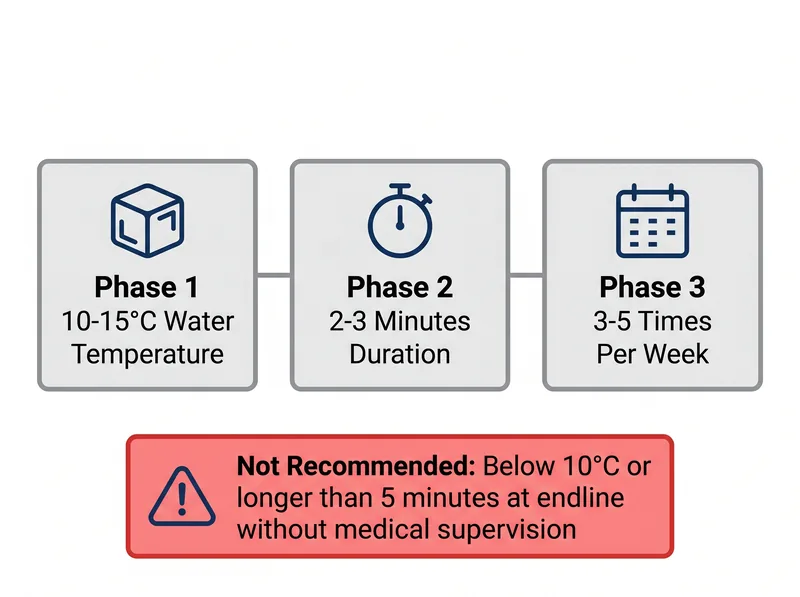 If you’re testing cold exposure for hair health, here’s the protocol most research uses, though results remain mixed.
What About Cold Showers vs Full Immersion?
Most of the circulation and inflammation research uses full-body cold water immersion at 10-15°C for 10-15 minutes. That’s very different from a 30-second cold rinse at the end of your shower.
A cold shower rinse might give you the cuticle-smoothing effect. It won’t give you the systemic circulation or anti-inflammatory response that requires sustained cold exposure to a large portion of your body.
If you’re doing cold plunges for other reasons, recovery, mental resilience, metabolic benefits, your hair might see some indirect benefit from improved overall health. But a cold rinse alone isn’t delivering the same physiological stimulus.
The dose matters. Most wellness claims conflate different levels of cold exposure as if they’re equivalent. They’re not.
The Gulf Context: Heat, Humidity, and Cold Exposure
In the Gulf, cold plunges are often positioned as a counterbalance to extreme heat. After a day in 45°C outdoor temperatures, a 15°C plunge feels dramatic.
But here’s what matters for your hair: the real damage isn’t from heat exposure outdoors. It’s from hard water mineral buildup, UV exposure without protection, and chronic scalp dehydration from low indoor humidity (air conditioning).
Cold water won’t remove calcium and magnesium deposits. It won’t reverse UV damage. It won’t rehydrate a dry scalp. If you’re dealing with hair thinning or texture changes after moving to the region, the solution isn’t cold exposure, it’s addressing the actual environmental factors.
A chelating shampoo like Regrowth+ addresses mineral buildup directly. Cold water doesn’t.
Our Verdict: Cosmetic Benefit, Unproven Growth Benefit
Cold water rinsing after shampooing can make your hair look shinier by smoothing the cuticle. That’s real, measurable, and harmless. If you like the result, do it.
Full-body cold plunges might improve circulation and reduce systemic inflammation, which could indirectly support overall health including hair health. But there’s no direct evidence that cold exposure treats hair loss, accelerates growth, or prevents thinning.
If you’re already doing cold plunges for recovery or mental benefits, you’re probably not hurting your hair. But if you’re considering starting cold exposure specifically for hair health, the evidence doesn’t support it as a standalone intervention.
Focus on the proven factors first: nutrition, sleep quality, scalp hygiene, and addressing environmental damage. Cold exposure is a potential bonus, not a primary treatment.
What to Do Instead If You’re Worried About Hair Health
If you’re noticing hair changes and you’re looking for actionable interventions, here’s what actually has research support:
Address mineral buildup if you’re in a hard water area. That means chelating shampoos, not just cold rinses. Test your water hardness and act on the result.
Improve your diet for hair health. Protein, iron, zinc, and biotin matter more than cold showers. Iron deficiency is common and often overlooked in men.
If you’re experiencing pattern hair loss, the evidence-based treatments are minoxidil, finasteride, and microneedling. Not ice baths. Here’s what men in the Gulf are actually using.
Cold exposure can be part of a broader health improvation routine. But it’s not a hair loss treatment, and positioning it as one sets up false expectations.
References
- Post-exercise cold water immersion benefits are not greater than the placebo effect - European Journal of Applied Physiology
- Hair cosmetics: An overview - International Journal of Trichology
- Cold-water immersion (cryotherapy) for preventing and treating muscle soreness after exercise - British Journal of Sports Medicine
- The effect of cold showering on health and work: a randomized controlled trial - PLoS One