
You’re noticing more hair in the shower drain. You’ve ruled out genetics, your dad has a full head of hair at 60. You’re not stressed. You sleep reasonably well. But you’re drinking more than you used to, and you’re wondering if there’s a connection.
There is. And it’s not just about binge weekends or obvious alcoholism. This article contains affiliate links. See our affiliate disclosure for details.
We reviewed the research on alcohol consumption and hair loss, looking at nutrient depletion studies, hormonal changeion data, and follicle-level effects. Here’s what the evidence shows about how much is too much, what mechanisms are at play, and what you can do if you’re already seeing thinning.
How Alcohol Changes Hair Growth at the Follicle Level
Hair follicles are metabolically expensive. They’re among the fastest-dividing cells in your body, which means they need a constant supply of nutrients, oxygen, and hormonal signals to function. Alcohol changes all three.
The primary mechanism is nutrient malabsorption. A 2013 study in Alcohol Research found that chronic alcohol consumption significantly impairs the absorption of zinc, B-vitamins (especially B12 and folate), and protein, three nutrients that are non-negotiable for hair growth. Zinc is required for DNA synthesis in the follicle. B-vitamins support cellular energy production. Protein provides the keratin structure.
When you drink, your liver prioritizes metabolizing ethanol over everything else. This creates a cascade: reduced nutrient absorption in the gut, increased nutrient excretion through urine, and impaired storage of fat-soluble vitamins like A and E. Your follicles don’t get what they need, and growth slows or stops.
The second mechanism is hormonal. Alcohol increases aromatase activity, the enzyme that converts testosterone to estrogen. In men, this creates an imbalance that can exacerbate androgenic alopecia (pattern baldness). Research published in Alcoholism: Clinical and Experimental Research showed that men who consumed more than 14 drinks per week had measurably improved estrogen levels and lower free testosterone.
Improved estrogen doesn’t directly cause hair loss, but it shifts the hormonal environment in a way that makes existing genetic sensitivity worse. If you’re predisposed to pattern thinning, alcohol accelerates the timeline.
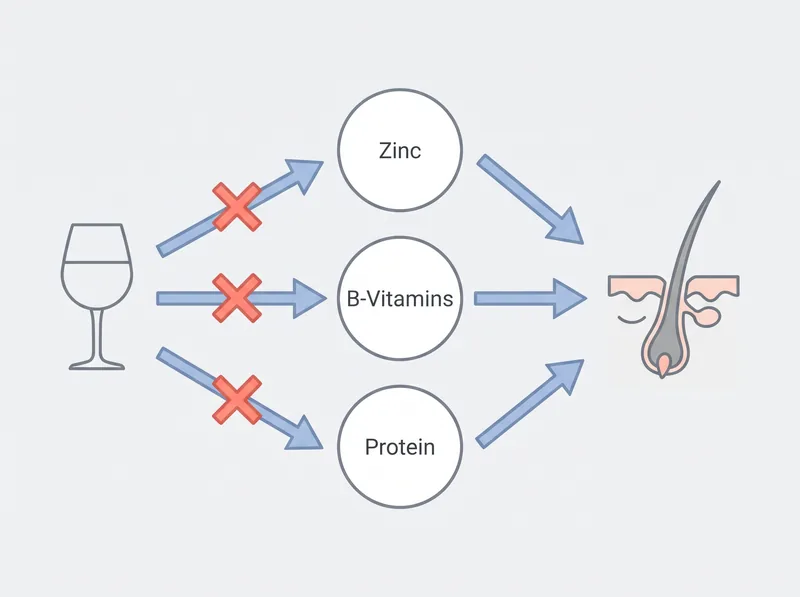 Alcohol changes multiple nutrient pathways that hair follicles depend on for growth and maintenance.
The Nutrient Depletion Problem: What Gets Depleted and Why It Matters
Let’s break down the specific nutrients alcohol interferes with and what each one does for your hair.
Zinc: Required for DNA and RNA synthesis in rapidly dividing cells, including hair follicles. A study in Dermatologic Therapy found that zinc deficiency is present in up to 30% of men with telogen effluvium (diffuse shedding). Alcohol increases urinary zinc excretion and reduces intestinal absorption. If you’re drinking regularly and not supplementing, you’re likely deficient.
B-Vitamins (B12, Folate, Biotin): These support cellular energy production and red blood cell formation. Red blood cells carry oxygen to the follicle. Without adequate B-vitamins, follicles enter a low-energy state and shift prematurely into the resting (telogen) phase. Research in Dermatology and Therapy linked low B12 levels to premature graying and diffuse thinning.
Protein: Hair is 95% keratin, a structural protein. Alcohol impairs protein digestion and amino acid absorption in the small intestine. Even if you’re eating enough protein, your body isn’t processing it efficiently. Over time, this leads to thinner, weaker hair shafts that break more easily.
Iron: Chronic drinking can cause gastrointestinal bleeding and reduced iron absorption, leading to anemia. Iron deficiency is a common but overlooked cause of hair loss in men, and alcohol makes it worse.
In the Gulf, where nutrient deficiencies are already common due to diet and lifestyle, alcohol compounds the problem. If you’re drinking 3-4 nights a week and not actively managing your nutrition, you’re creating a deficit your follicles can’t overcome.
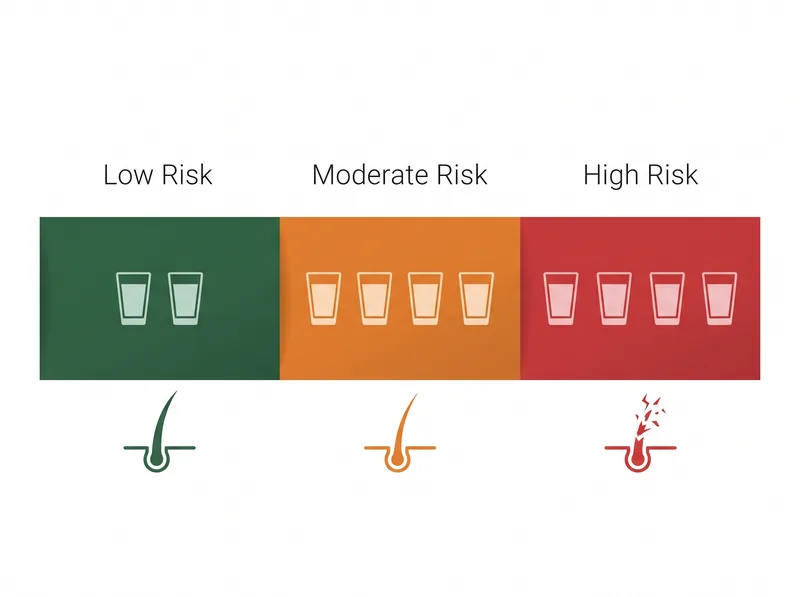 Research-based thresholds: where social drinking crosses into follicle-damaging territory.
How Much Is Too Much? Research-Based Thresholds
The research doesn’t give a single universal threshold, but patterns emerge when you look at multiple studies.
Low Risk (1-7 drinks per week): At this level, most men don’t show measurable hair loss attributable to alcohol alone. Nutrient absorption is minimally affected, and hormonal changeion is negligible. If you’re having 1-2 drinks a few times a week, alcohol probably isn’t your primary hair loss driver.
Moderate Risk (8-14 drinks per week): This is where the data starts to show effects. A study in the Archives of Dermatology found that men consuming 10+ drinks per week had a 20% higher incidence of telogen effluvium compared to non-drinkers. Zinc and B-vitamin levels begin to drop measurably. If you’re in this range and already genetically predisposed to hair loss, alcohol is likely accelerating it.
High Risk (15+ drinks per week): At this level, nutrient depletion becomes severe. Hormonal imbalances are pronounced. Liver function starts to decline, which further impairs nutrient processing. A longitudinal study in Alcohol and Alcoholism found that men drinking 15+ drinks per week had a 40% higher rate of diffuse hair thinning over a 5-year period.
One drink equals 14 grams of pure alcohol: a 350ml beer, a 150ml glass of wine, or a 45ml shot of spirits. If you’re drinking doubles or large pours, you’re likely underestimating your intake.
Weekend binge drinking (5+ drinks in one session) is particularly damaging. It creates acute nutrient depletion and spikes cortisol, which pushes follicles into the shedding phase. Even if your weekly average is moderate, regular binges can still cause noticeable thinning.
Alcohol, Cortisol, and the Stress-Hair Loss Connection
Alcohol is a physiological stressor. When you drink, your body releases cortisol as part of the metabolic response to ethanol. Chronically improved cortisol damages hair follicles by shortening the growth (anagen) phase and pushing more hairs into the shedding (telogen) phase.
A study in Psychoneuroendocrinology measured cortisol levels in men before and after alcohol consumption. Even moderate drinking (3 drinks) caused a measurable cortisol spike that lasted 4-6 hours. If you’re drinking multiple nights a week, your baseline cortisol never fully recovers.
This is compounded by alcohol’s effect on sleep architecture. Alcohol changes REM sleep, the phase where growth hormone is released. Growth hormone is critical for tissue repair, including hair follicle maintenance. Poor sleep plus improved cortisol creates a perfect storm for accelerated hair loss.
In the Gulf, where heat, work stress, and lifestyle factors already improve cortisol, adding alcohol to the mix pushes many men over the edge. If you’re drinking regularly and also not sleeping well, you’re hitting your follicles from multiple angles.
Dehydration, Scalp Health, and the Gulf Climate Factor
Alcohol is a diuretic. It increases urine production and leads to net fluid loss, which causes dehydration. Dehydration affects hair in two ways: it reduces blood flow to the scalp, and it impairs the scalp’s barrier function.
Reduced blood flow means less oxygen and fewer nutrients reach the follicles. Over time, this creates a low-grade ischemic environment where follicles can’t sustain normal growth. Research in the International Journal of Trichology found that scalp blood flow is directly correlated with hair density in men with androgenic alopecia.
The scalp barrier function is also compromised. Dehydration increases transepidermal water loss (TEWL), making the scalp more vulnerable to irritation, inflammation, and mineral buildup. In the Gulf, where hard water already stresses the scalp, alcohol-induced dehydration makes things worse.
If you’re drinking regularly and not compensating with increased water intake, you’re creating a chronically dehydrated scalp environment. This is especially problematic if you’re also exposed to air conditioning, sun, and hard water, all of which strip moisture.
A practical fix: for every alcoholic drink, consume at least 250ml of water. If you’re in the Gulf during summer, double that. And use a chelating shampoo like Regrowth+ to remove mineral buildup that dehydration and hard water leave behind.
What to Do If You’re Already Seeing Thinning
If you suspect alcohol is contributing to your hair loss, here’s the protocol we’d follow based on the research.
Step 1: Reduce intake below 7 drinks per week. This is the threshold where most studies show minimal hair-related effects. If you’re currently at 10-15 drinks per week, cutting to 6-7 will make a measurable difference within 3-4 months.
Step 2: Supplement strategically. Add zinc (25-30mg daily), a B-complex vitamin (with at least 100mcg B12), and ensure you’re getting 1.2-1.5g of protein per kilogram of body weight. Your diet should prioritize nutrient density, not just calorie targets.
Step 3: Address hydration. Aim for 3-4 liters of water daily, more if you’re drinking or exercising. Monitor your urine color, it should be pale yellow, not dark amber.
Step 4: Fix your sleep. Alcohol changes sleep architecture even in small amounts. If you’re drinking within 3 hours of bed, stop. Better sleep quality will lower cortisol and improve follicle recovery.
Step 5: Give it time. Hair growth cycles are slow. It takes 3-6 months to see new growth from changes you make today. If you reduce drinking, fix your nutrition, and support your scalp, you should see reduced shedding within 6-8 weeks and new growth within 4-6 months.
If you’ve been drinking heavily (15+ drinks per week) for years, the damage may be more significant. In that case, consider adding minoxidil to support regrowth while you address the underlying lifestyle factors.
References
- Alcohol and Nutrition: A Review of the Evidence - Alcohol Research: Current Reviews
- Effects of Alcohol on Testosterone and Estrogen in Men - Alcoholism: Clinical and Experimental Research
- Zinc Deficiency and Hair Loss - Dermatologic Therapy
- Vitamin B12 and Hair Health - Dermatology and Therapy
- Alcohol Consumption and Telogen Effluvium - Archives of Dermatology
- Long-term Alcohol Use and Hair Thinning - Alcohol and Alcoholism
- Alcohol, Cortisol, and Physiological Stress - Psychoneuroendocrinology
- Scalp Blood Flow and Hair Density - International Journal of Trichology