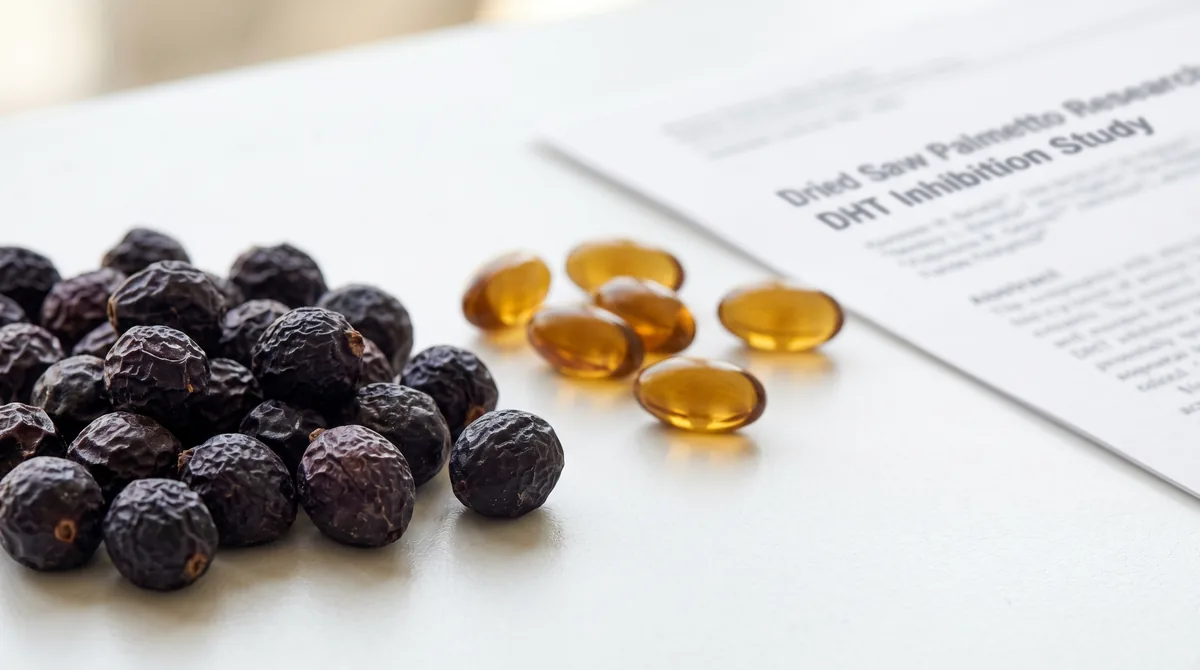

Your hair’s thinning. You’ve read about finasteride, but you’re not ready to commit to a prescription drug with potential side effects. You want something natural that actually works. Enter saw palmetto.
This article contains affiliate links. See our affiliate disclosure for details.
Saw palmetto is the most researched natural DHT inhibitor available. It blocks the same enzyme that finasteride targets, just less aggressively. The question isn’t whether it works in theory. The question is whether it works in practice, at what dose, and for whom.
We reviewed the clinical trials, analyzed the dosing protocols, and examined what Gulf men can realistically expect. Here’s what the research actually shows.
What Saw Palmetto Does (and Why It Matters for Hair)
Saw palmetto is a berry extract from the Serenoa repens plant. It’s been used for decades to treat benign prostatic hyperplasia. The mechanism? It inhibits 5-alpha-reductase, the enzyme that converts testosterone into dihydrotestosterone (DHT).
DHT is the primary hormone responsible for androgenetic alopecia. It binds to receptors in genetically susceptible hair follicles, causing them to shrink over time. This process is called miniaturization. Eventually, the follicles stop producing terminal hairs altogether.
Finasteride blocks 5-alpha-reductase type II with about 70% efficiency. Saw palmetto inhibits both type I and type II, but at a lower potency. Think of it as a gentler intervention with a broader target.
The trade-off: fewer side effects, but also slower and less dramatic results. For men who want to address DHT without prescription medication, it’s the most evidence-backed option available.
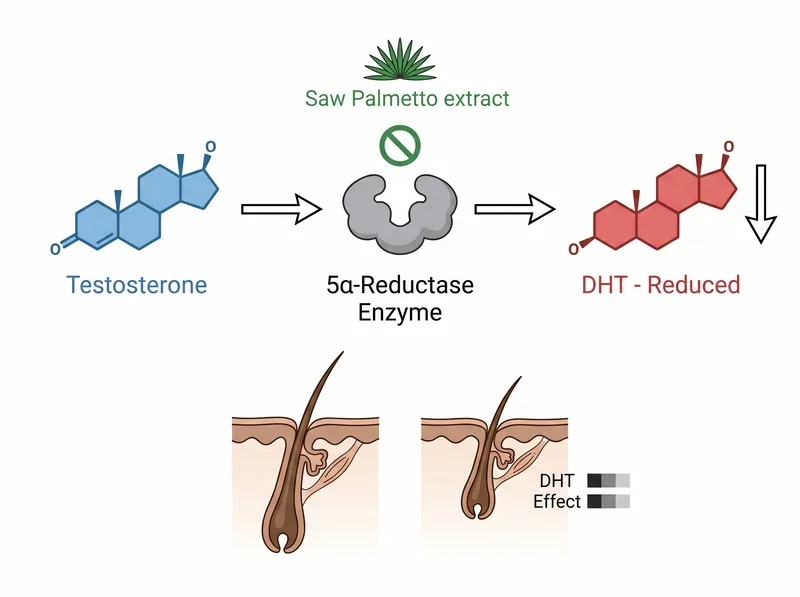 Saw palmetto works by blocking the enzyme that converts testosterone into DHT, the hormone responsible for follicle miniaturization.
The Clinical Evidence: What Studies Actually Found
Let’s start with the most cited study. In 2002, researchers gave 10 men 400mg of saw palmetto daily for 4.7 months on average. Results showed 60% of participants experienced improvement in overall hair quality, though the sample size was too small for statistical significance.
A larger 2012 study followed 100 men with mild to moderate hair loss. Half received 320mg of saw palmetto daily, half received a placebo. After 24 weeks, the saw palmetto group showed a 27% increase in total hair count compared to baseline. The placebo group showed no change.
The most complete review came in 2020. Researchers analyzed multiple trials and concluded that saw palmetto produces measurable improvements in hair density and thickness, but results require 3-6 months minimum. Peak efficacy appears around 12 months of consistent use.
Here’s the critical detail: all successful studies used standardized extracts containing 85-95% fatty acids and sterols. Whole berry powder or non-standardized supplements showed inconsistent results. The extraction method matters as much as the dose.
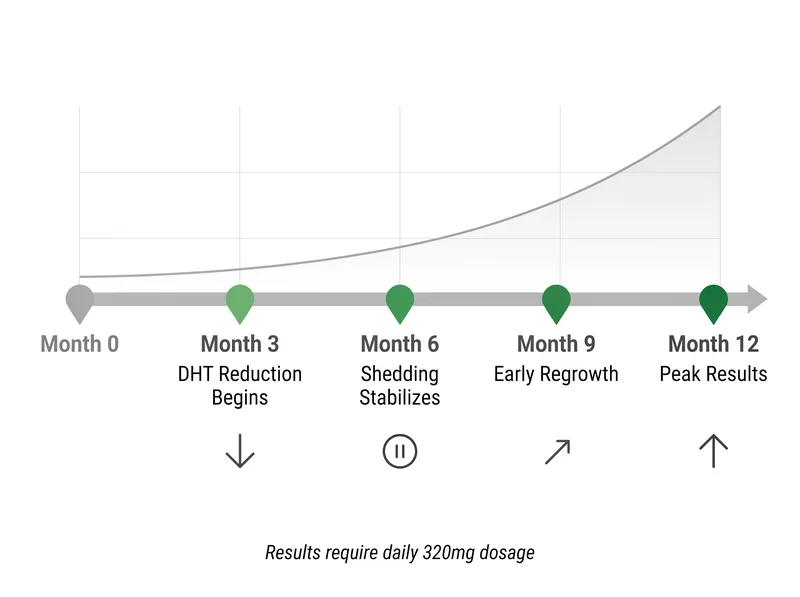 Clinical studies show saw palmetto requires 3-6 months before visible improvements, with peak results at 12 months of consistent use.
Dosage, Timing, and What Works in Practice
The clinically validated dose is 320mg daily of standardized liposterolic extract. Some studies used 400mg, but 320mg appears to be the minimum effective threshold. Taking less means you’re underdosing relative to what’s been tested.
Timing matters less than consistency. Most trials had participants take the dose once daily with food to improve absorption. The fatty acid content requires dietary fat for optimal uptake. Taking it on an empty stomach reduces bioavailability.
You won’t see results in 4-6 weeks. That’s not how DHT inhibition works. The follicle miniaturization process took years to develop. Reversing it takes months. Expect 3 months before shedding stabilizes, 6 months before early regrowth becomes visible.
If you’re not seeing improvement by month 9, saw palmetto likely isn’t effective for your specific hair loss pattern. Some men respond well, others don’t. Genetic variability in 5-alpha-reductase expression explains the inconsistency.
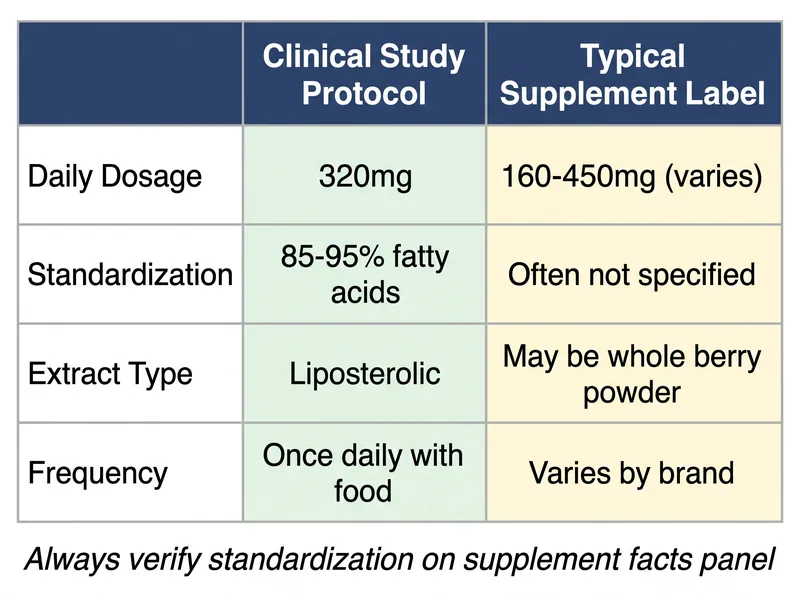 Most studies used 320mg daily of standardized extract. Many commercial supplements contain lower doses or non-standardized extracts.
Saw Palmetto vs Finasteride: The Honest Comparison
Finasteride is more potent. It reduces scalp DHT by approximately 64% at a 1mg daily dose. Saw palmetto reduces it by an estimated 32% based on serum measurements. That’s roughly half the DHT suppression.
The side effect profile differs significantly. Saw palmetto has minimal reported sexual side effects in clinical trials, while finasteride carries a 1-4% risk of sexual dysfunction that persists in some users even after discontinuation.
Here’s the practical breakdown. If your hair loss is aggressive (Norwood 4+), finasteride is the more effective choice. If you’re in the early stages (Norwood 2-3) and want a preventative approach with lower risk, saw palmetto is worth trying first.
You can’t combine them long-term without medical supervision. Both target the same pathway. Stacking them doesn’t double the effect, it just increases the risk of over-suppressing DHT, which has its own hormonal consequences. Choose one or the other.
What to Look for When Buying Saw Palmetto
The supplement industry is poorly regulated. Many saw palmetto products contain whole berry powder instead of the liposterolic extract used in studies. The powder is cheaper to produce and less effective.
Check the label for ‘standardized to 85-95% fatty acids and sterols.’ If that phrase isn’t on the bottle, you’re not getting the clinically tested formulation. Also verify the dose per capsule. Some brands use 160mg and recommend two capsules daily, which is fine if you actually take both.
Third-party testing matters. Look for USP verification or NSF certification. These indicate the product was tested for purity and potency by an independent lab. Without certification, you’re trusting the manufacturer’s claims without verification.
Avoid proprietary blends that list saw palmetto alongside other ingredients without specifying individual doses. You need to know exactly how much saw palmetto you’re getting. Blends obscure that information.
The Gulf Context: Hard Water, DHT, and Combined Strategies
Saw palmetto addresses internal DHT production. It doesn’t fix external scalp damage from hard water. If you’re in the Gulf, you’re dealing with both problems simultaneously. DHT miniaturizes follicles from within. Mineral buildup weakens hair structure from outside.
This is why men in the region often see limited results from DHT inhibitors alone. The follicle is under attack from two directions. You need a two-axis approach: internal DHT suppression plus external mineral chelation.
A chelating shampoo like Regrowth+ removes calcium and magnesium deposits that hard water leaves on the scalp. This creates a cleaner environment for follicles to respond to DHT reduction. Neither intervention works optimally without the other.
Think of it this way: saw palmetto slows the miniaturization process. Chelation removes the environmental stressor that accelerates it. Combined, they address the full scope of what’s damaging your hair in this climate.
Realistic Expectations and When to Adjust Your Approach
Saw palmetto is not a hair loss cure. It’s a maintenance tool that can slow progression and, in some cases, produce modest regrowth. If you’re expecting finasteride-level results, you’ll be disappointed.
Best-case scenario: you stabilize shedding within 3-4 months, see minor density improvement by month 6, and maintain that improvement with continued use. Worst-case: no response by month 9, at which point you need to consider stronger interventions.
If saw palmetto doesn’t work after 9-12 months of consistent use at 320mg daily, your options are finasteride, minoxidil, or both. You can also explore PRP treatments or microneedling as adjunct therapies.
The key is tracking progress objectively. Take monthly photos in consistent lighting. Measure your hairline position. Count hairs lost in the shower. Subjective assessment is unreliable. You need data to know whether it’s working.
References
- Inhibition of 5-alpha-reductase activity in human skin by zinc and azelaic acid - PubMed
- Effects of a saw palmetto herbal blend in men with symptomatic benign prostatic hyperplasia - PubMed
- Comparative effectiveness of finasteride vs Serenoa repens in male androgenetic alopecia - PubMed
- Saw Palmetto: Uses, Side Effects, and More - Mayo Clinic
- Serenoa repens for benign prostatic hyperplasia - PubMed Central