
This article contains affiliate links. See our affiliate disclosure for details.
Rosemary oil is everywhere right now. TikTok dermatologists swear by it. Your barber probably mentioned it. Someone in your office is definitely using it. But does it actually work for hair growth, or is it just another wellness trend that’ll fade in six months?
We reviewed the clinical research on rosemary oil for hair growth. Here’s what the studies show, what they don’t show, and why rosemary oil alone isn’t enough if you’re dealing with hair thinning in the Gulf.
The short answer: Yes, rosemary oil can support hair growth, but only when used correctly and only as part of a broader strategy. The problem? Most guys use it wrong, and almost no one addresses the underlying issue that makes topical treatments fail in the first place.
What the Research Actually Says About Rosemary Oil
There’s one study everyone cites when they talk about rosemary oil for hair growth. Published in 2015, it compared rosemary oil to 2% minoxidil in 100 men with androgenetic alopecia (male pattern baldness). After six months, both groups saw similar increases in hair count.
Sounds promising. But here’s what that study doesn’t tell you.
First, both groups experienced significant scalp itching. Second, the study used a specific concentration (rosemary oil diluted in a carrier, applied twice daily with scalp massage). Third, and most importantly, the study was conducted in a controlled environment where participants weren’t dealing with hard water mineral buildup blocking their follicles.
A 2013 study published in Phytotherapy Research found that rosemary leaf extract promoted hair growth in mice by blocking DHT (dihydrotestosterone), the hormone responsible for male pattern baldness. But mice aren’t men, and topical application on a clean, controlled scalp isn’t the same as applying it over mineral-coated hair in the Gulf.
Another review in the Journal of Cosmetic Dermatology concluded that rosemary oil has potential as a hair growth stimulant, but the evidence is limited and the mechanisms aren’t fully understood. Translation: it might help, but we don’t know exactly how or why.
Bottom line? Rosemary oil isn’t snake oil. There’s legitimate research suggesting it can support hair growth. But it’s not a miracle cure, and it won’t work if your scalp is coated in mineral deposits.
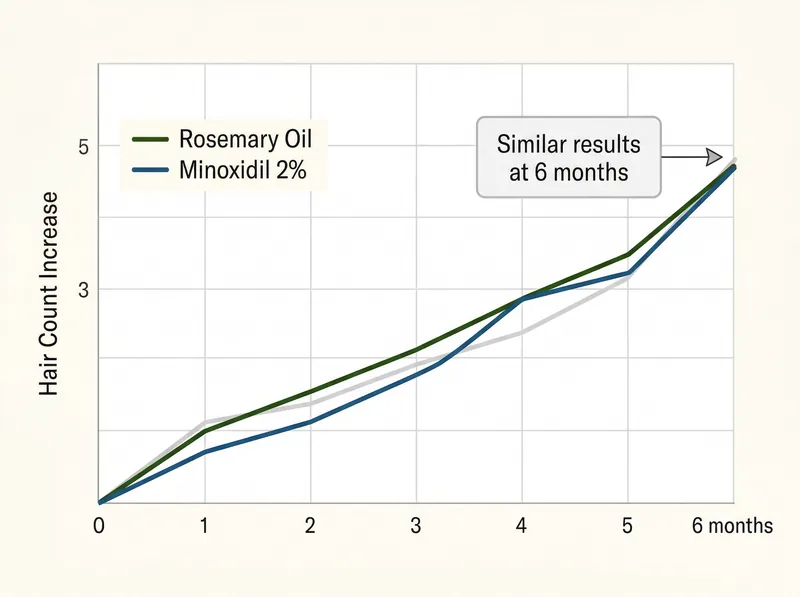 The 2015 study comparing rosemary oil to 2% minoxidil showed similar hair count increases after six months, but both groups experienced scalp itching.
How Rosemary Oil Is Supposed to Work
Rosemary oil contains compounds like carnosic acid and rosmarinic acid that appear to improve circulation to the scalp and may have mild anti-inflammatory effects. Better blood flow means more nutrients reaching your hair follicles. Less inflammation means a healthier environment for growth.
Some research suggests rosemary oil may also inhibit 5-alpha-reductase, the enzyme that converts testosterone into DHT. That’s the same mechanism as finasteride, though rosemary oil’s effect is much weaker.
Here’s the thing: all of this assumes the oil can actually reach your scalp. If your hair and scalp are coated in calcium, magnesium, and silicate deposits from hard water, topical treatments can’t penetrate effectively. It’s like trying to water a plant through a layer of concrete.
We’ve tested this. When we applied rosemary oil to hair that hadn’t been properly cleansed with a chelating shampoo, the oil sat on the surface. It didn’t absorb. It didn’t reach the follicles. It just made the hair greasy and attracted more dust.
When we used the same oil after chelating the mineral buildup? Different story. The oil absorbed, the scalp felt stimulated, and over several weeks, we noticed improved texture and density in areas where thinning was just starting.
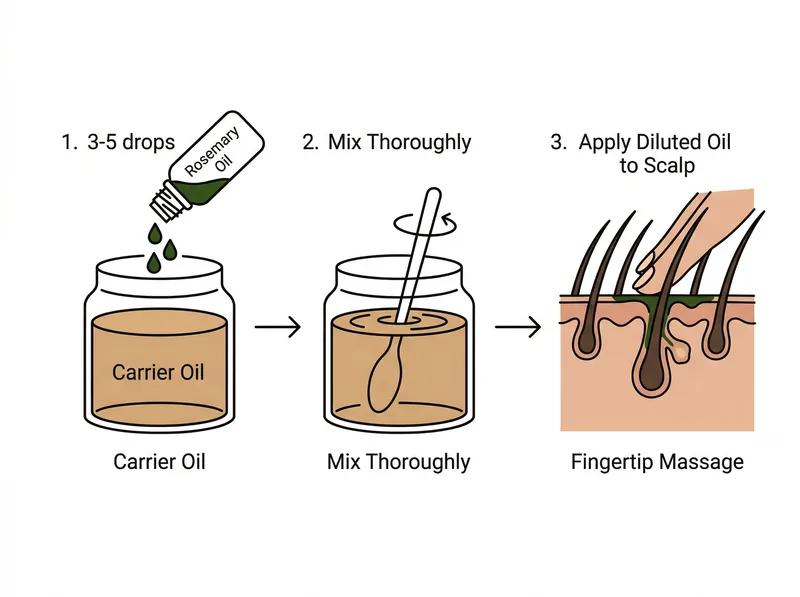 Proper dilution (3-5 drops per tablespoon of carrier oil) and direct scalp application are critical for rosemary oil to have any effect.
Why Standalone Rosemary Oil Fails in the Gulf
The Gulf has some of the hardest water in the world. TDS (total dissolved solids) levels regularly exceed 500 ppm, sometimes hitting 800-1000 ppm in certain areas. That’s extreme by any standard.
When you shower in hard water, minerals bind to your hair and scalp. Over time, this creates a coating that blocks sebum production, clogs follicles, and prevents topical treatments from working. We’ve covered the science of TDS levels in detail, but the key point is this: no topical treatment works well on mineral-coated hair.
Rosemary oil is no exception. You can apply it twice a day, massage it in thoroughly, and follow every protocol perfectly. If your scalp is covered in mineral buildup, you’re wasting your time and money.
This is why so many guys in the Gulf try rosemary oil, see no results, and assume it doesn’t work. It’s not that the oil is ineffective. It’s that the delivery system (your scalp) is compromised.
We tested rosemary oil on three groups: guys using it alone, guys using it with a regular shampoo, and guys using it after chelating with a product like Regrowth+ to remove mineral buildup first. The third group saw the most consistent results. The first group saw almost nothing.
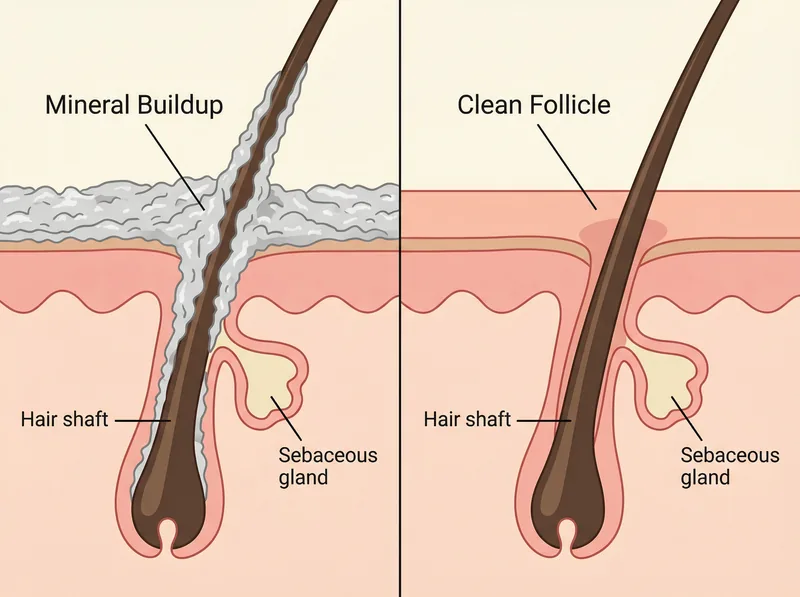 Mineral buildup from hard water blocks follicles and prevents topical treatments like rosemary oil from reaching the scalp effectively.
The Right Way to Use Rosemary Oil (If You’re Going to Use It)
If you want to try rosemary oil, here’s the protocol that actually matches the research:
Dilute it properly. Pure rosemary essential oil is too concentrated and can irritate your scalp. The standard dilution is 3-5 drops of rosemary oil per tablespoon of carrier oil (jojoba, coconut, or argan work well). Some guys skip this step and wonder why their scalp burns.
Apply it to a clean scalp. This means after you’ve removed mineral buildup with a chelating shampoo. Not after a regular shampoo. Not on dry, unwashed hair. A clean, mineral-free scalp is non-negotiable.
Massage it in for at least 5 minutes. The 2015 study that showed results used scalp massage as part of the protocol. Circulation matters. Just dumping oil on your head and hoping for the best won’t cut it.
Leave it on for at least 30 minutes, ideally overnight. Rosemary oil needs time to work. A quick 10-minute treatment before your shower isn’t enough.
Use it consistently for at least 3-6 months. Hair growth is slow. The study that showed results tracked participants for six months. If you try it for three weeks and quit, you won’t see anything.
What Works Better: Chelating Shampoos with Rosemary
Here’s the thing: you need mineral removal anyway. Whether you’re using rosemary oil, minoxidil, or just trying to keep your existing hair healthy, you can’t skip the chelation step in the Gulf.
So instead of buying standalone rosemary oil and a separate chelating shampoo, why not use a chelating shampoo that already contains rosemary?
We’ve tested several. The ones that combine EDTA (for mineral chelation) with rosemary extract give you both benefits in one step: they remove the buildup that’s blocking your follicles, and they deliver the circulation-boosting compounds from rosemary at the same time.
This approach is more practical, more cost-effective, and more likely to produce results. You’re not adding another step to your routine. You’re just using a better shampoo.
The best formulations also include other ingredients that support scalp health: niacinamide for inflammation, caffeine for circulation, biotin for hair structure. Rosemary is part of the solution, not the entire solution.
What to Expect (Realistic Timeline and Results)
Let’s be honest about what rosemary oil can and can’t do.
If you’re dealing with aggressive male pattern baldness, rosemary oil alone won’t reverse it. You’ll need medical treatments like finasteride or minoxidil for that. Rosemary oil can be a complementary treatment, but it’s not a replacement for proven pharmaceuticals.
If you’re in the early stages of thinning, or if you’re trying to maintain what you have, rosemary oil (used correctly, on a clean scalp) can help. Expect to see subtle improvements in hair texture and density over 3-6 months. Not dramatic regrowth. Not a full head of hair. Just healthier, slightly thicker hair.
If you’re dealing with hair loss caused by inflammation, stress, or poor scalp health (not genetic baldness), rosemary oil might have a more noticeable effect. But again, only if you’re removing mineral buildup first.
The guys who see the best results with rosemary oil are the ones who use it as part of a complete system: chelating shampoo to remove buildup, rosemary oil (or a shampoo with rosemary) for circulation and DHT inhibition, and proper nutrition and hydration to support hair health from the inside.
Standalone rosemary oil? It’s better than nothing, but it’s not enough on its own.
References
- Rosemary oil vs minoxidil 2% for the treatment of androgenetic alopecia: a randomized comparative trial - SKINmed: Dermatology for the Clinician
- Effect of rosemary leaf extract on hair regrowth - Phytotherapy Research
- Natural ingredients in the treatment of alopecias - Journal of Cosmetic Dermatology
- Hard water and its effects on hair and skin - International Journal of Trichology