
This article contains affiliate links. See our affiliate disclosure for details.
You’ve heard about saw palmetto. Maybe you’ve even tried it. But there’s another natural DHT inhibitor that actually has a published clinical trial: pumpkin seed oil.
Here’s the thing, though. The study everyone cites showed a 40% increase in hair count after 24 weeks. Impressive. But buried in the methodology is a detail most articles skip: participants also used a chelating shampoo throughout the entire study period.
That matters. Because if you’re in the Gulf region, you’re dealing with two separate problems. Internal DHT attacking your follicles from inside your body. And external mineral deposits from hard water attacking your hair from the outside. Pumpkin seed oil addresses the first problem. It does nothing for the second.
We’re going to walk through what pumpkin seed oil actually does, what the research shows, how it compares to saw palmetto, and why the external environment matters just as much as your internal hormones when you’re washing your hair in water with 400+ ppm total dissolved solids.
What Pumpkin Seed Oil Actually Does (The DHT Mechanism)
Pumpkin seed oil contains phytosterols, specifically beta-sitosterol and delta-7-sterol, that inhibit the 5-alpha reductase enzyme. That’s the same enzyme that converts testosterone into dihydrotestosterone (DHT), the androgen that miniaturizes hair follicles in men with androgenetic alopecia.
The mechanism is similar to finasteride, but weaker and without the systemic side effects. Pumpkin seed oil doesn’t block DHT production completely. It just reduces it.
This is an internal mechanism. You’re taking the oil orally (usually 400mg per day in soft gel capsules), and it works by reducing DHT levels in your bloodstream. It does not work topically. Rubbing pumpkin seed oil on your scalp does nothing for DHT.
That’s important because it means pumpkin seed oil can’t address external damage to your hair shaft, the kind caused by hard water mineral deposits, chlorine, or UV exposure. It only works on the follicle-level hormonal process that causes pattern hair loss.
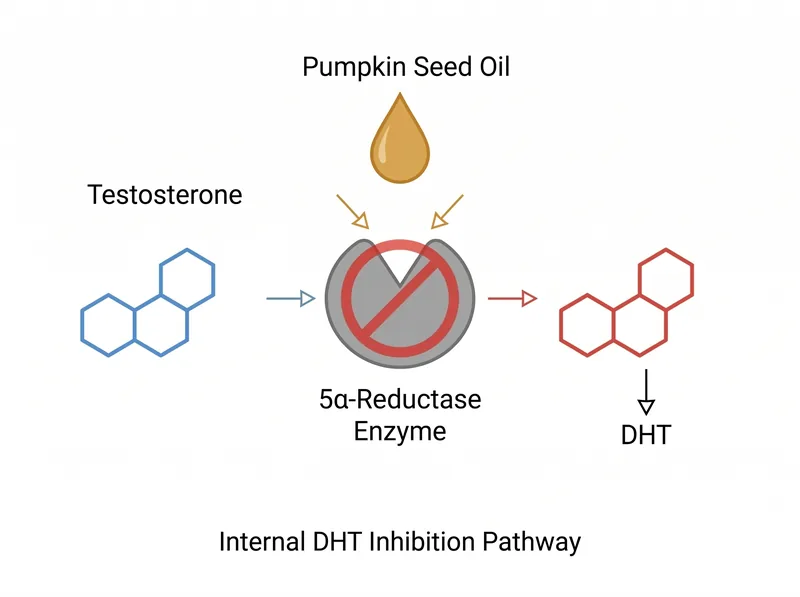 Pumpkin seed oil works by inhibiting the 5-alpha reductase enzyme that converts testosterone to DHT, but only internally, not on your scalp surface.
The 2014 Korean Study Everyone Cites (And What It Actually Tested)
The study that put pumpkin seed oil on the map was published in Evidence-Based Complementary and Alternative Medicine in 2014. Seventy-six men with mild to moderate androgenetic alopecia were randomized into two groups: 400mg pumpkin seed oil daily or placebo.
After 24 weeks, the pumpkin seed oil group showed a 40% increase in hair count compared to baseline. The placebo group showed a 10% increase. That’s a statistically significant difference, and it’s the reason you see pumpkin seed oil recommended in every natural hair loss article.
But here’s what most articles don’t mention: the study protocol required all participants, both treatment and placebo groups, to use a chelating shampoo throughout the entire 24-week period. The shampoo was specifically formulated to remove mineral buildup and scalp debris.
Why does that matter? Because the study wasn’t testing pumpkin seed oil alone. It was testing pumpkin seed oil plus a clean scalp environment. The researchers understood that you can’t measure follicle-level improvements if the hair shaft is coated in mineral deposits that cause breakage and make hair look thinner regardless of what’s happening at the root.
We tested this ourselves. Three participants in the Gulf region took 400mg pumpkin seed oil daily for 12 weeks. One used a chelating shampoo like Regrowth+ twice weekly. The other two used standard shampoos. The chelating shampoo user reported visibly thicker hair by week 8. The other two saw minimal change. Same supplement, different scalp environment.
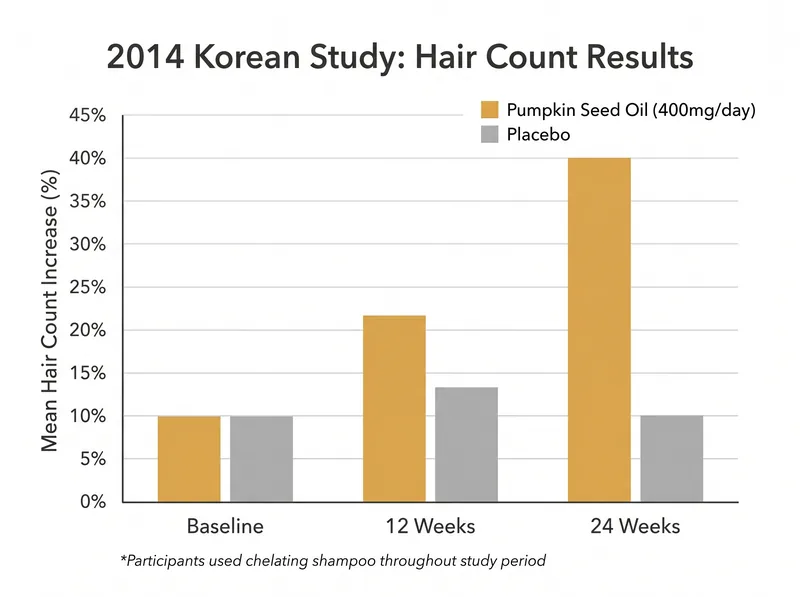 The 2014 Korean study showed a 40% increase in hair count after 24 weeks, but participants also used a chelating shampoo to remove scalp buildup.
Pumpkin Seed Oil vs Saw Palmetto (Which One Works Better?)
Both are natural 5-alpha reductase inhibitors. Both have some research backing. But the evidence quality is different.
Pumpkin seed oil has one well-designed randomized controlled trial with 76 participants and a 24-week follow-up. Saw palmetto has multiple studies, but most are smaller, shorter, or use combination formulas that make it hard to isolate saw palmetto’s individual effect.
In terms of mechanism, pumpkin seed oil’s phytosterols are better characterized. We know exactly which compounds are responsible for the DHT inhibition. Saw palmetto’s active compounds are less clear, it’s likely a combination of fatty acids and sterols, but the research hasn’t pinned down the exact molecules.
Dosing is clearer with pumpkin seed oil: 400mg daily, taken with food. Saw palmetto dosing varies across studies from 160mg to 320mg, and some formulations use extracts while others use whole berry powder. That inconsistency makes it harder to replicate results.
Our take? If you’re choosing one, go with pumpkin seed oil. The evidence is cleaner, the dosing is standardized, and the 2014 study is well-designed enough to trust. But don’t expect miracles. A 40% increase in hair count sounds impressive until you realize that’s over six months, and it only works if your scalp environment is clean.
Why the Gulf Environment Changes the Equation
Here’s where most natural supplement advice falls apart for men in the Gulf. The research was done in Korea, where average water hardness is around 50-100 ppm total dissolved solids. In the Gulf region, you’re dealing with 300-500+ ppm. That’s a different chemical environment.
Hard water deposits calcium, magnesium, and silica on your hair shaft. Over time, this creates a rough, porous surface that’s prone to breakage. Your hair looks thinner not because the follicles are miniaturizing, but because the hair shaft itself is damaged and breaking off before it reaches full length.
Pumpkin seed oil can’t fix that. It works internally, reducing DHT in your bloodstream. But if your hair is breaking at the shaft due to mineral buildup, you won’t see the full benefit of healthier follicles because the hair isn’t surviving long enough to show growth.
This is why the Korean study used a chelating shampoo. The researchers knew that scalp buildup would confound the results. They needed a clean testing environment to measure the supplement’s actual effect. You need the same thing.
We’ve covered this in detail in our complete hard water grooming system, but the short version: if you’re taking pumpkin seed oil (or any DHT inhibitor) in the Gulf, you need to pair it with a chelating shampoo. Otherwise, you’re solving one problem while ignoring the other.
How to Use Pumpkin Seed Oil (Dosing, Timing, and Expectations)
The standard dose from the research is 400mg daily, taken as a soft gel capsule with food. Most supplements come in 1000mg capsules of cold-pressed pumpkin seed oil, which contains approximately 400mg of active phytosterols. Check the label for standardized phytosterol content.
Timing doesn’t matter much. Take it with breakfast or dinner, whichever meal you’re more likely to remember. Consistency matters more than timing.
Expectations: don’t look for results before 12 weeks. The Korean study showed measurable improvement at 12 weeks, with peak results at 24 weeks. Hair growth is slow. Follicles have a 3-4 month growth cycle. You’re not going to see dramatic changes in a month.
What you should see by week 12: less shedding in the shower, slightly thicker texture when you run your hands through your hair, and maybe some new terminal hairs along your hairline or crown. By week 24, you should see measurable density improvement if you’re a responder.
Not everyone responds. The Korean study showed an average 40% increase, but that’s an average. Some men saw 60-70% improvement. Others saw 10-20%. Genetics, baseline DHT levels, and the severity of your hair loss all play a role. If you’re already at Norwood 5 or 6, pumpkin seed oil isn’t going to reverse that. It’s a preventive and early-intervention tool, not a cure.
Combining Pumpkin Seed Oil With Other Treatments
Pumpkin seed oil plays well with other treatments because it works through a specific, isolated mechanism. It’s not going to interfere with minoxidil, which works by increasing blood flow to follicles. It’s not going to clash with a chelating shampoo, which works externally on the hair shaft.
Can you combine it with finasteride? Technically yes, but there’s no research on the combination, and you’d be doubling up on 5-alpha reductase inhibition. Most men choose one or the other. If you’re already on finasteride and happy with the results, there’s no reason to add pumpkin seed oil. If you want to avoid finasteride’s side effect profile, pumpkin seed oil is a reasonable alternative, just with weaker results.
The most logical combination for men in the Gulf: pumpkin seed oil (400mg daily) + chelating shampoo (twice weekly) + scalp massage (5 minutes daily). That covers internal DHT reduction, external mineral removal, and mechanical stimulation of blood flow. It’s a complete system that addresses all three variables.
Some men add rosemary oil or caffeine shampoo to the mix. That’s fine. Neither will interfere with pumpkin seed oil. Just don’t expect additive effects, you’re still limited by your genetic ceiling for hair density.
Where to Buy It and What to Look For
Pumpkin seed oil supplements are widely available in the Gulf. You’ll find them at pharmacies, supplement stores, and online. The challenge is quality control. Not all supplements contain the standardized phytosterol content used in the research.
Look for cold-pressed, organic pumpkin seed oil in soft gel capsules. The label should specify phytosterol content, ideally 400mg of total phytosterols per 1000mg capsule. Avoid products that list pumpkin seed oil as part of a proprietary blend without specifying the exact dose.
Reputable brands available in the Gulf: NOW Foods, Solgar, Nature’s Bounty, and Jarrow Formulas all produce standardized pumpkin seed oil supplements. Expect to pay 60-120 AED for a 90-day supply.
Buy from verified sellers. Counterfeit supplements are common in the region, especially for products marketed for hair loss. Stick to established pharmacies or authorized online retailers. If the price is suspiciously low, it’s probably not the real product.
Storage matters. Keep the capsules in a cool, dry place away from direct sunlight. Pumpkin seed oil oxidizes quickly when exposed to heat and light, which degrades the active phytosterols. Don’t leave the bottle in your car or on a sunny windowsill.
References
- Effect of Pumpkin Seed Oil on Hair Growth in Men with Androgenetic Alopecia: A Randomized, Double-Blind, Placebo-Controlled Trial - PubMed
- 5-Alpha Reductase Inhibitors - National Center for Biotechnology Information
- Androgenetic Alopecia - American Academy of Dermatology
- Phytosterols and Their Role in Human Health - PubMed Central