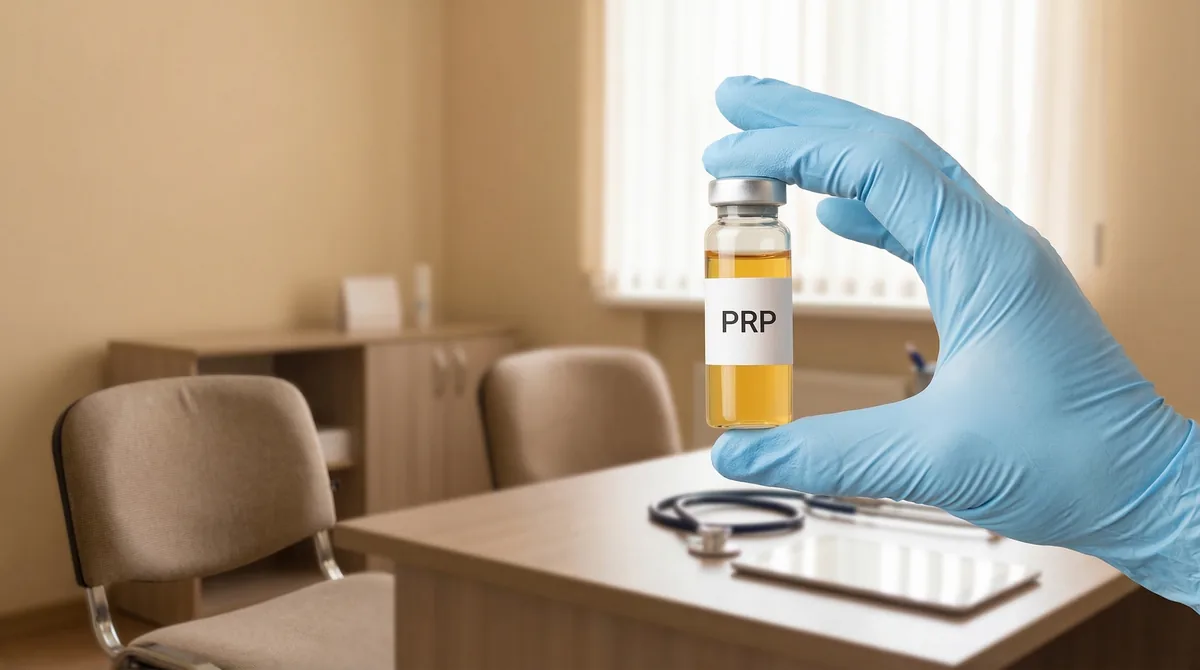
Platelet-rich plasma therapy is everywhere in Gulf dermatology clinics. Walk into any skin clinic in the region and you’ll see PRP listed alongside facials and laser treatments, often with before-and-after photos that look too good to be true.
Some of those photos probably are too good to be true. But the treatment itself has legitimate science behind it. The question is whether it’s worth what they’re charging.
What PRP actually is
PRP therapy involves drawing your blood, processing it in a centrifuge to concentrate the platelets, and injecting that concentrated plasma back into your scalp. Platelets contain growth factors that, in theory, stimulate hair follicle activity and promote new growth.
The science is plausible. Growth factors like PDGF, TGF-beta, and VEGF are involved in tissue repair and cell proliferation. Concentrating them and delivering them directly to thinning areas should provide a growth stimulus.
The clinical evidence is supportive but not overwhelming. A 2017 meta-analysis in the Journal of Cosmetic Dermatology reviewed 11 studies and found that PRP treatment showed statistically significant improvements in hair density compared to placebo. However, the authors noted significant variability in protocols, concentrations, and outcome measures across studies.
This is an important distinction. PRP works, but how well it works depends heavily on the specific protocol your clinic uses, and there is no universally standardized approach.
What to expect during treatment
The procedure is straightforward. A nurse draws 20 to 60ml of blood from your arm. The blood is placed in a centrifuge for about 10 minutes to separate the plasma and concentrate the platelets. The concentrated PRP is then injected into areas of thinning using a fine needle.
Most clinics apply a topical anesthetic cream 30 minutes before the injections. The injections are uncomfortable but tolerable. The entire appointment takes about 45 to 60 minutes.
Afterward, you might have some scalp tenderness, minor swelling, or tiny bruises at the injection sites. These resolve within a day or two. There’s no significant downtime. You can wash your hair the next day and return to normal activities immediately.
Results timeline
Don’t expect to see anything for at least eight weeks. Hair growth is slow, and the first signs of improvement are usually reduced shedding rather than visible new growth.
Most men who respond to PRP notice meaningful improvement between months three and six. Full results typically appear around nine to twelve months, by which point you’ve usually completed the initial series of three to four sessions.
About 60 to 70% of men see some improvement. The results are most noticeable in men with early-to-moderate thinning. If your hair loss is advanced or the follicles are no longer active, PRP is unlikely to help significantly.
What it costs in the Gulf
PRP pricing in the Gulf varies enormously, and the variation isn’t always correlated with quality.
Budget clinics offer PRP sessions for 500 to 800 AED per session. Mid-range dermatology practices charge 1,000 to 1,500 AED. Premium clinics with specialized equipment and experienced practitioners charge 2,000 to 3,000 AED per session.
For a standard protocol of four initial sessions plus two maintenance sessions per year, you’re looking at:
- Budget: 4,000 to 6,400 AED first year
- Mid-range: 6,000 to 10,000 AED first year
- Premium: 10,000 to 16,000 AED first year
The price difference often reflects the centrifuge technology, the PRP concentration achieved, and the experience of the injector. Cheaper isn’t necessarily worse, but you should ask about their specific protocol before committing.
What to ask your clinic
Before booking, ask these questions:
What centrifuge system do they use? Double-spin systems generally produce higher platelet concentrations than single-spin systems. Some premium clinics use FDA-cleared PRP preparation kits that produce more consistent results.
What is the platelet concentration? A good PRP preparation should concentrate platelets to 4 to 7 times baseline levels. Below 3x is considered subtherapeutic and unlikely to produce meaningful results.
How many sessions do they recommend? Be wary of clinics that push 8 to 12 initial sessions. The research supports 3 to 4 initial sessions for most patients. More isn’t necessarily better.
Do they combine PRP with microneedling? Some clinics use a derma roller or microneedling pen before PRP injection, which may improve growth factor penetration. A 2019 study in Dermatologic Surgery found that combining microneedling with PRP produced better results than PRP alone.
Who should and shouldn’t try PRP
Good candidates: Men with early-to-moderate androgenetic alopecia (Norwood stages 2 to 4), men who want to complement minoxidil or finasteride, men who want a non-pharmaceutical approach.
Poor candidates: Men with advanced baldness (Norwood 6+), men with autoimmune-related hair loss (alopecia areata may respond, but results are less predictable), men with blood disorders or on anticoagulant medication, anyone expecting dramatic transformation from a single session.
Our verdict
PRP is a legitimate treatment with real but modest benefits. It’s not a miracle cure, and any clinic marketing it as one should be avoided. It works best as part of a broader strategy that includes addressing environmental factors (hard water, vitamin D), topical treatments (minoxidil), and potentially oral medication (finasteride).
The cost in the Gulf is significant but not prohibitive for men who are serious about maintaining their hair. The key is choosing a clinic with proper equipment and a transparent protocol, not just the cheapest option or the one with the flashiest marketing.
If you’re going to invest in PRP, do it early. Like most hair loss treatments, it’s far more effective at maintaining what you have than recovering what you’ve already lost.