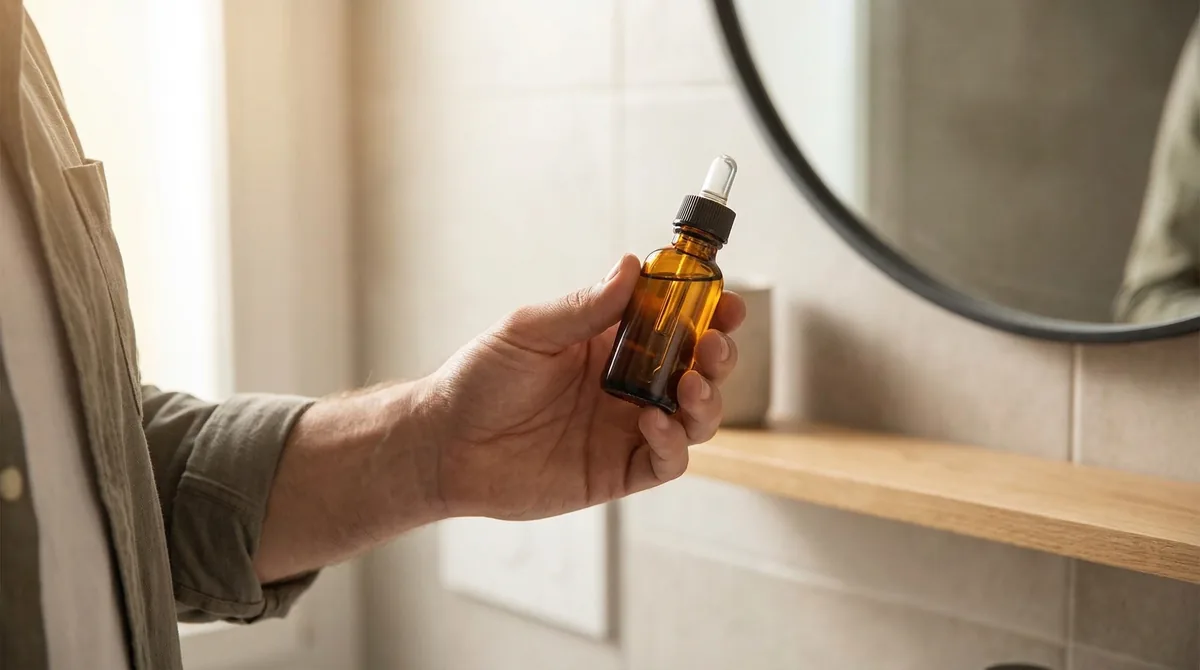
You moved to the Gulf, your hair started thinning, and someone told you to try minoxidil. Now you’re standing in a pharmacy wondering which strength to buy, whether the generic is the same as the brand name, and whether this thing actually works or if you’re about to spend six months rubbing liquid on your head for nothing.
We’ve been there. Here’s what you need to know.
What minoxidil actually does
Minoxidil is a vasodilator. It widens blood vessels near the hair follicle, increasing nutrient delivery and extending the growth phase of the hair cycle. It was originally developed as a blood pressure medication. Hair growth was a side effect that turned into a business.
It doesn’t block DHT. It doesn’t fix the underlying cause of male pattern baldness. What it does is slow the process and, in many cases, regrow hair that has recently miniaturized. Think of it as buying time.
The clinical evidence is solid. A 2002 study in the Journal of the American Academy of Dermatology found that 5% minoxidil produced significantly greater hair regrowth than 2% after 48 weeks. A 2014 meta-analysis confirmed it as one of the few topical treatments with consistent clinical backing.
Where to buy it in the Gulf
Minoxidil 5% topical solution is available over the counter at most pharmacies across the Gulf. You don’t need a prescription for the liquid or foam versions.
The most commonly stocked brands include Rogaine (the original), Regaine (the same product under a different name in some markets), and several generic options. The generics contain the same active ingredient at the same concentration. We’ve used both. The results are identical.
Pricing varies. Brand-name Rogaine typically runs 150 to 250 AED for a three-month supply. Generics can be half that. Some online pharmacies deliver, but check that they’re licensed.
Important: Oral minoxidil is a different story. It requires a prescription, and you should only take it under medical supervision. The dosages for hair loss are much lower than the blood pressure doses, but cardiac side effects are possible.
Which strength to use
Go with 5%. The research consistently shows it outperforms the 2% solution, and the side effect profile is manageable for most men.
The main side effects are scalp irritation and unwanted facial hair growth. If you experience significant irritation, switching from the liquid (which contains propylene glycol) to the foam version usually solves it. The foam is alcohol-based and dries faster.
Apply it twice daily. Once in the morning, once before bed. Let it sit for at least four hours before washing. If twice daily isn’t realistic for your schedule, once daily still works. The results are reduced but not eliminated.
The shedding phase nobody warns you about
Somewhere between weeks two and eight, you’ll notice more hair falling out than before you started. This is normal.
Minoxidil pushes resting hairs into the shedding phase so new growth can replace them. It looks like the treatment is making things worse. It isn’t. This is the mechanism working.
The shedding typically lasts two to four weeks. If it persists beyond eight weeks, consult a dermatologist.
The Gulf factor: hard water and absorption
Here’s something most minoxidil guides won’t mention. The Gulf’s hard water creates mineral deposits on your scalp. Calcium and magnesium form a film that can reduce how well topical treatments absorb.
We tested this ourselves. Using a chelating shampoo twice a week before minoxidil application noticeably improved scalp condition and, subjectively, treatment response. There’s no controlled study on this specific interaction yet, but the logic is straightforward: a clean scalp absorbs better than one coated in mineral residue.
If you’re spending money on minoxidil, spend the extra 40 AED on a decent chelating shampoo. It’s the cheapest optimization you can make.
Realistic expectations
Minoxidil works best on recent hair loss. If the follicle has been dormant for years, you’re less likely to see regrowth. It’s most effective on the crown and mid-scalp. The hairline is more resistant.
You need to use it indefinitely. Stop, and the hair you regrew falls out within three to six months. This is the commitment. If you aren’t prepared to make it a permanent part of your routine, consider whether it’s the right choice.
About 40% of men see moderate regrowth. Another 40% see maintenance of existing hair. The remaining 20% don’t respond significantly. You won’t know which group you’re in until you’ve committed to at least six months of consistent use.
Our verdict
Minoxidil is one of the only hair loss treatments with decades of clinical evidence behind it. It’s accessible, affordable in the Gulf, and the side effects are mild for most men. The hard water factor makes proper scalp preparation more important here than in softer-water regions.
Start with 5% foam if you can find it. Use a chelating shampoo to keep your scalp clear. Give it six months before judging results. And be honest with yourself about whether you’ll stick with the routine long-term, because this isn’t a one-time fix.