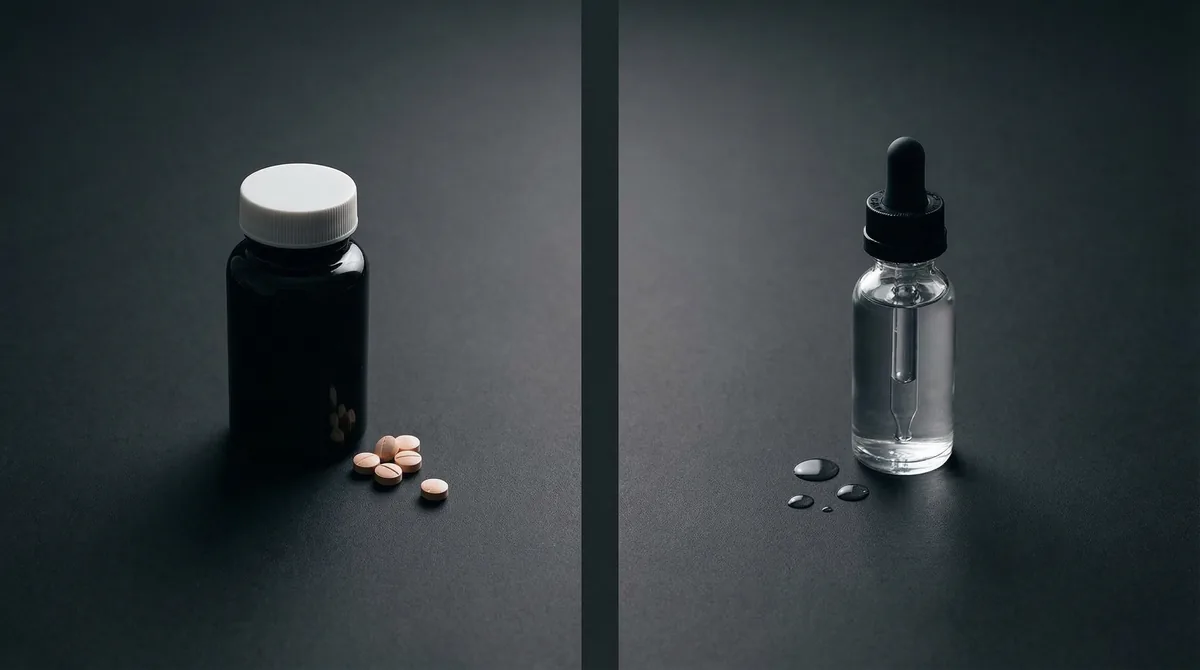

Two treatments dominate the conversation around male hair loss. Minoxidil and finasteride. Both have decades of clinical evidence. Both are available in the Gulf. And men here are using both, often based on whatever a pharmacist recommended or a friend suggested.
That isn’t the best way to make this decision. Here’s what the evidence actually shows.
How they work: completely different mechanisms
Minoxidil is a vasodilator. Applied topically, it widens blood vessels near the hair follicle, increasing nutrient delivery and extending the growth phase of the hair cycle. It does not address the hormonal cause of male pattern baldness. It works around it.
Finasteride is a 5-alpha reductase inhibitor. Taken orally, it blocks the enzyme that converts testosterone to DHT (dihydrotestosterone). DHT is the hormone responsible for miniaturizing hair follicles in men with androgenetic alopecia. By reducing DHT levels by roughly 70%, finasteride slows or stops the process that causes the hair to thin.
The distinction matters. Minoxidil stimulates growth. Finasteride prevents further loss. They’re solving different parts of the same problem.
Effectiveness: what the research shows
A landmark 2004 study published in the Journal of the American Academy of Dermatology compared both treatments head-to-head. After 12 months, finasteride 1mg produced superior hair count increases compared to minoxidil 5% in men with vertex (crown) hair loss.
However, minoxidil showed better results for some men with frontal hairline recession. The response varies by individual and by the pattern of loss.
For maintenance (keeping what you have), finasteride is more effective. A 5-year follow-up study showed that 90% of men on finasteride maintained their hair or improved, compared to a gradual decline in the placebo group.
For regrowth (getting back what you’ve lost), both can deliver, but minoxidil tends to produce more visible early growth. The combination of both treatments outperforms either one alone.
Side effects: the honest version
This is where the conversation gets charged. So let’s be straightforward.
Minoxidil side effects are mostly local. Scalp irritation, dryness, and flaking are common with the liquid solution (the propylene glycol is usually the culprit). Switching to the foam version solves this for most men. Unwanted facial and body hair growth can occur, especially with higher concentrations. These effects reverse when you stop using it.
Finasteride side effects are systemic. The most discussed are sexual: reduced libido, erectile dysfunction, and decreased ejaculate volume. Clinical trials reported these in 1 to 2% of men taking 1mg daily. Most of the time, side effects resolve after discontinuation.
Post-finasteride syndrome (persistent sexual, neurological, or physical side effects after stopping the drug) has been reported and is being studied. The medical community is still debating its prevalence and mechanism. If this possibility concerns you, it’s a legitimate reason to choose minoxidil instead or to try a lower dose.
We’re not dismissive of the side effect risk, and we’re not alarmist about it. The data says most men tolerate finasteride well. The data also says a small percentage don’t. You deserve to know both facts.
Availability and cost in the Gulf
Minoxidil 5% is available over the counter at most Gulf pharmacies. Expect to pay 40 to 80 AED for a one-month supply of generic liquid, or 150 to 250 AED for a three-month supply of branded foam (Rogaine/Regaine). No prescription required for the topical form.
Finasteride 1mg requires a prescription in the Gulf. Most dermatologists here prescribe it readily for male pattern baldness. A month’s supply of generic finasteride costs 30 to 60 AED, making it one of the most cost-effective treatments available. Brand-name Propecia costs significantly more but contains the same active ingredient.
Both are affordable for long-term use, which matters because both require indefinite commitment to maintain results.
The Gulf-specific factor
Something unique to men living in hard water regions: minoxidil absorption can be reduced by mineral deposits on the scalp. If you’re using minoxidil in the Gulf without chelating your scalp regularly, you may not be getting the full benefit.
Finasteride works systemically (via oral absorption), so water quality doesn’t affect its efficacy. This is a meaningful advantage for Gulf residents who haven’t yet addressed their water situation.
If you’re using minoxidil, pair it with a chelating shampoo twice a week. If you’re on finasteride, water quality doesn’t matter for the drug’s effectiveness, though it still matters for your overall hair and scalp health.
Our take: which one to choose
There’s no universal answer, but here’s our framework:
Start with minoxidil if you’re in the early stages of thinning, you want to avoid oral medication, or you’re primarily concerned with crown thinning. It’s accessible, reversible, and low-risk.
Consider finasteride if your hair loss is progressing despite minoxidil, you have a family history of significant baldness, or you want the strongest preventive option available. Talk to a dermatologist first.
Use both if you’re serious about maximising results. The combination addresses hair loss from two different angles and consistently outperforms monotherapy in clinical trials.
Whatever you choose, start sooner rather than later. Both treatments work better on hair that’s thinning than on hair that’s already gone.