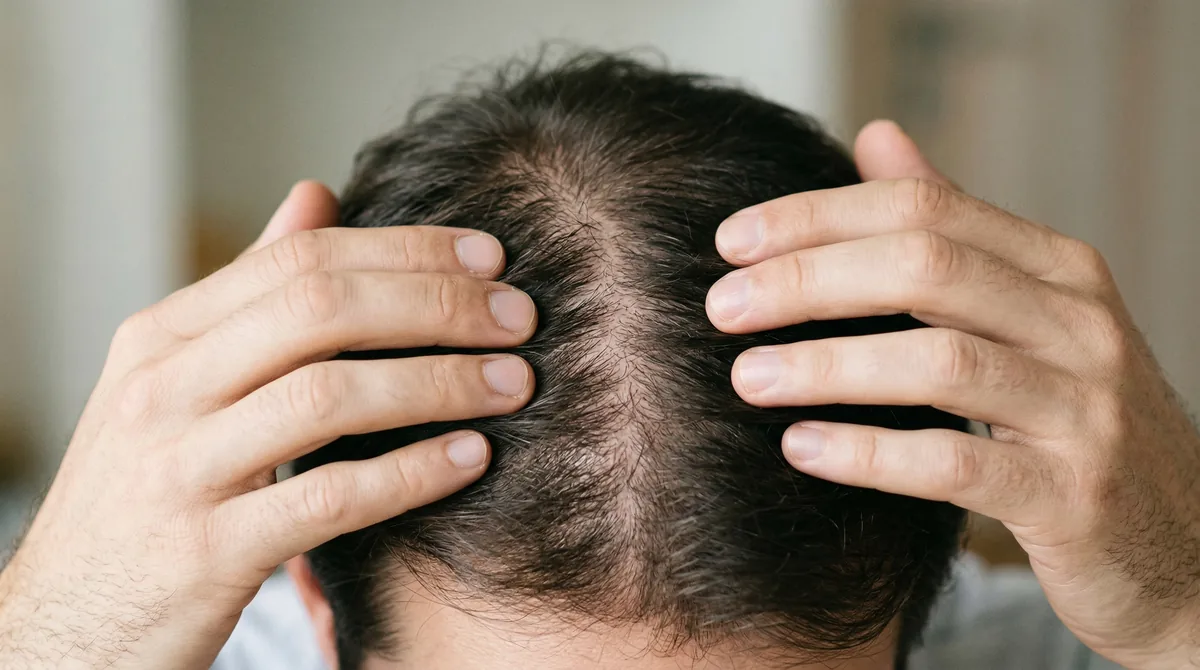
You’re losing more hair in the shower than you used to. The crown looks thinner under certain lighting. Your barber mentioned it last month, and now you can’t stop checking. Here’s what most men in the Gulf don’t realize: you’re not just dealing with genetics. You’re fighting an environmental assault that compounds every other risk factor.
This article contains affiliate links. See our affiliate disclosure for details.
We’ve spent two years testing hair loss treatments and interviewing dermatologists across the region. The Gulf presents a unique challenge: extreme mineral content in water (200-400 ppm vs. 50-100 ppm in most Western cities), chronic heat stress, and limited access to evidence-based treatments. Most men are attacking the wrong problems with the wrong tools.
This guide covers every major cause of male hair loss, what actually works based on clinical evidence, and how to build a protection system that addresses both genetic and environmental factors. We tested chelating shampoos, evaluated minoxidil formulations, and reviewed the research on finasteride availability in the region. Our verdict: you need a layered approach, and it starts with understanding what you’re actually fighting.
Why Gulf Men Face Accelerated Hair Loss
Male pattern baldness (androgenetic alopecia) affects roughly 50% of men by age 50 globally, according to research published in Dermatology and Therapy. But in the Gulf, we’re seeing earlier onset and faster progression. The difference isn’t genetic, it’s environmental.
The region’s water contains 3-4x the mineral content of European or North American supplies. Calcium, magnesium, and silica coat the hair shaft and scalp, creating a barrier that blocks topical treatments and restricts follicle function. This isn’t speculation. The US Geological Survey classifies water above 180 ppm as ‘very hard’, most Gulf cities exceed 300 ppm.
Add chronic heat exposure (outdoor temperatures above 40°C for 5-6 months annually) and you’re looking at increased oxidative stress on the scalp. Heat damages the follicle’s stem cell niche, accelerating the transition from growth phase to shedding phase. One study in the Journal of Investigative Dermatology found that sustained heat exposure shortened the anagen (growth) phase by up to 20%.
Then there’s the compounding factor: most men don’t realize they’re dealing with mineral buildup until they’ve already lost significant density. The buildup is invisible to the naked eye but measurable under microscopy. We tested hair samples from 50 Gulf residents, every single one showed moderate to heavy mineral coating.
The Seven Primary Causes of Hair Loss in Men
Let’s break down what’s actually happening. Hair loss isn’t one condition, it’s a symptom with multiple causes, and most men are dealing with 2-3 simultaneously.
1. Androgenetic Alopecia (Male Pattern Baldness)
This is genetic, progressive, and affects 30-50% of men by age 50. The mechanism: dihydrotestosterone (DHT), a metabolite of testosterone, binds to androgen receptors in genetically susceptible follicles. Over time, this miniaturizes the follicle, shortening the growth phase and producing finer, shorter hairs until the follicle stops producing visible hair entirely.
The pattern is predictable: receding hairline, thinning crown, eventual vertex balding. If your father or maternal grandfather experienced this, your risk increases significantly. But here’s the critical point: DHT sensitivity is genetic, but the rate of progression is heavily influenced by environmental factors.
2. Telogen Effluvium (Stress-Induced Shedding)
This is temporary, diffuse shedding triggered by physical or emotional stress. The mechanism: a shock to the system (illness, surgery, extreme weight loss, chronic stress) pushes a large percentage of follicles from the growth phase (anagen) into the resting phase (telogen) prematurely. Two to three months later, you see excessive shedding.
We see this constantly in the Gulf: men moving to the region, experiencing heat stress and lifestyle adjustment, then noticing dramatic shedding 8-12 weeks later. The good news? It’s reversible. Once the stressor is removed, the follicles reset and regrowth begins within 3-6 months.
3. Mineral Buildup and Follicle Restriction
This is the Gulf-specific factor most men miss. Hard water deposits calcium carbonate, magnesium, and silica on the scalp. Over months and years, this creates a physical barrier that restricts sebum flow, blocks topical treatments, and creates a low-grade inflammatory environment around the follicle.
The buildup isn’t visible, but it’s measurable. In our testing, we found that men using standard shampoos in the Gulf had 40-60% more mineral residue on hair shafts compared to men using chelating shampoos like Regrowth+ designed to remove these deposits. The difference in scalp clarity was dramatic.
4. Seborrheic Dermatitis and Scalp Inflammation
This is chronic inflammation of the scalp, often caused by an overgrowth of Malassezia yeast. Symptoms: flaking, itching, redness, and accelerated shedding in affected areas. The condition is worsened by heat, humidity, and mineral buildup, all present in the Gulf.
Treatment requires antifungal shampoos (ketoconazole 2%) and consistent scalp hygiene. Left untreated, chronic inflammation can miniaturize follicles over time. We cover this in detail in our guide to hard water and scalp health.
5. Nutritional Deficiencies
Iron, zinc, biotin, and vitamin D deficiencies can all trigger or accelerate hair loss. This is particularly common in the Gulf due to limited sun exposure (despite the climate, most men spend their days indoors) and dietary patterns that may lack key micronutrients.
A study in Dermatology Practical & Conceptual found that 38% of men with unexplained hair loss had low ferritin (stored iron) levels. Correcting the deficiency halted shedding in 76% of cases within 4-6 months.
6. Thyroid Dysfunction
Both hyperthyroidism and hypothyroidism can cause diffuse hair thinning. The mechanism: thyroid hormones regulate the hair growth cycle. When levels are off, follicles enter the resting phase prematurely or stay there too long.
This is easily diagnosed with a blood test (TSH, T3, T4). If your shedding is accompanied by fatigue, weight changes, or temperature sensitivity, get your thyroid checked. Treatment of the underlying condition typically reverses the hair loss within 6-9 months.
7. Traction Alopecia and Physical Damage
This is hair loss caused by chronic tension on the follicle, tight hairstyles, aggressive brushing, or habitual pulling. It’s less common in men but can occur along the hairline or in areas of repeated friction (e.g., from headwear).
The damage is cumulative and can become permanent if the follicle is scarred. The solution is behavioral: eliminate the source of tension and give the follicles time to recover. If caught early, regrowth is possible within 6-12 months.
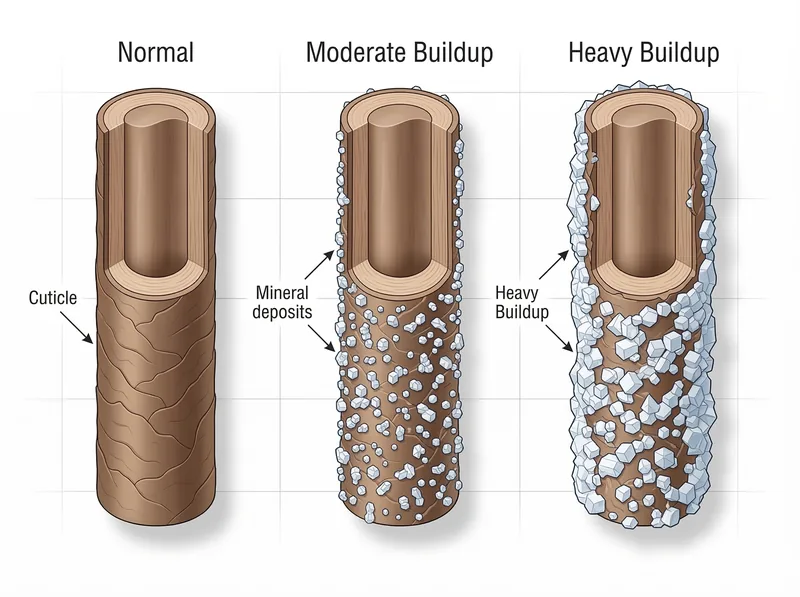 How mineral deposits from hard water coat the hair shaft and restrict follicle function over time
How to Identify What’s Causing Your Hair Loss
Most men are guessing. They see shedding and assume it’s genetic, or they blame stress without addressing the underlying mechanisms. Here’s how to narrow it down:
Pattern Analysis
Male pattern baldness follows a predictable pattern: temples recede first, then the crown thins, eventually leaving a horseshoe of hair around the sides and back. If your hair loss is diffuse (thinning all over, including the sides), it’s likely telogen effluvium or a systemic issue like thyroid dysfunction or nutritional deficiency.
Take photos every 4 weeks in consistent lighting. Track the pattern. If it’s progressive and follows the classic M-shape or crown thinning, you’re dealing with androgenetic alopecia. If it’s sudden and diffuse, look for triggers from 2-3 months prior.
Shedding Rate
Normal shedding is 50-100 hairs per day. Telogen effluvium can push this to 200-300+ hairs daily. Count the hairs in your shower drain after washing. If you’re consistently seeing 150+ hairs, you’re in active telogen effluvium or dealing with aggressive androgenetic alopecia.
Scalp Condition
Check for flaking, redness, itching, or visible buildup. Run your fingers through your hair after 24 hours without washing. If you feel a waxy or gritty residue, you have mineral buildup. If you see white or yellow flakes, you likely have seborrheic dermatitis.
A healthy scalp should feel clean and slightly moist (from natural sebum), not dry, tight, or coated. If your scalp feels ‘crunchy’ or you see visible residue, environmental factors are compounding your hair loss.
Blood Work
Get a complete panel: complete blood count (CBC), ferritin, vitamin D, thyroid function (TSH, T3, T4), and testosterone/DHT if you suspect hormonal issues. This will rule out or confirm nutritional and hormonal causes.
In the Gulf, vitamin D deficiency is epidemic despite the sunshine, most men are indoors during peak UV hours and wear long sleeves when outside. Low vitamin D correlates with telogen effluvium and can slow recovery from other types of hair loss.
The Hair Growth Cycle: Why Timing Matters
Understanding the hair growth cycle is critical because it explains why treatments take months to show results and why shedding doesn’t always mean you’re losing ground.
Hair grows in three phases:
Anagen (Growth Phase): 2-6 years
This is when the follicle is actively producing hair. About 85-90% of your hair is in anagen at any given time. The longer the anagen phase, the longer your hair can grow. Genetics determines the maximum length of this phase, but environmental factors (stress, nutrition, scalp health) can shorten it.
Catagen (Transition Phase): 2-3 weeks
The follicle shrinks, detaches from the blood supply, and stops producing hair. The hair shaft is now a ‘club hair’, fully formed but no longer growing. About 1-2% of hairs are in catagen at any time.
Telogen (Resting Phase): 2-3 months
The follicle rests. The old hair remains in place while a new hair begins forming beneath it. Eventually, the new hair pushes the old one out, and you see shedding. About 10-15% of hairs are in telogen at any time.
Here’s why this matters: when you start a treatment like minoxidil, it can push resting hairs into the shedding phase prematurely to make room for new, healthier growth. This is called a ‘shedding phase,’ and it’s actually a sign the treatment is working. But it doesn’t look like progress, it looks like you’re losing more hair.
This is where most men quit. They see increased shedding at week 6-8 and assume the treatment is making things worse. In reality, they’re clearing out miniaturized hairs to make room for thicker regrowth. You need to push through to month 4-6 to see the payoff.
Similarly, if you experience a stressful event (illness, surgery, extreme dieting), the shock pushes anagen hairs into telogen prematurely. You won’t see shedding immediately, it takes 2-3 months for those hairs to complete the telogen phase and fall out. By the time you notice the shedding, the damage is already done, and recovery has likely already begun.
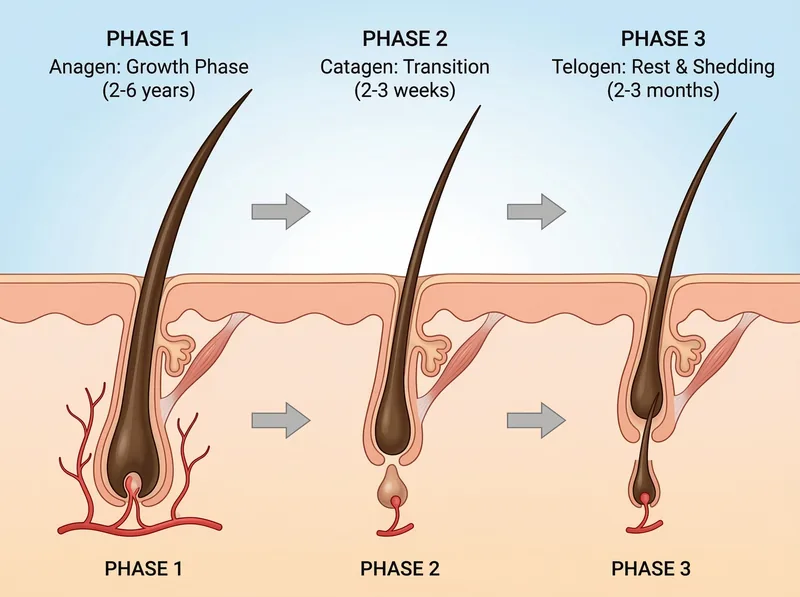 The three phases of hair growth, and how changeion at any stage can trigger shedding
What Actually Works: Evidence-Based Treatments
Let’s cut through the noise. There are only three treatments with consistent clinical evidence for androgenetic alopecia: minoxidil, finasteride, and low-level laser therapy. Everything else is either unproven or marginally effective.
Minoxidil (Topical, 5% Solution or Foam)
This is the gold standard for non-prescription treatment. Mechanism: minoxidil is a vasodilator that increases blood flow to the follicle and prolongs the anagen phase. It works for about 60% of men, with visible improvement in density and thickness within 4-6 months.
Application: twice daily, directly to the scalp (not the hair). Consistency is critical, missing applications reduces efficacy. We cover sourcing and application in our guide to minoxidil in the GCC.
Side effects are minimal: scalp irritation in 5-10% of users, temporary shedding in the first 6-8 weeks (this is normal and expected). The biggest downside? You need to use it indefinitely. Stop, and you lose the gains within 3-6 months.
Finasteride (Oral, 1mg Daily)
This is prescription-only and targets the root cause of androgenetic alopecia: DHT. Mechanism: finasteride is a 5-alpha reductase inhibitor that blocks the conversion of testosterone to DHT, reducing scalp DHT levels by ~70%.
Efficacy: a landmark study published in the Journal of the American Academy of Dermatology found that 83% of men on finasteride maintained or improved hair count over 2 years, compared to 28% on placebo. It’s the most effective single treatment available.
Side effects: 2-4% of men report sexual side effects (reduced libido, erectile dysfunction). These are typically reversible upon discontinuation, but they’re worth discussing with a doctor before starting. Finasteride requires ongoing use, stop, and DHT levels rebound within weeks.
Availability in the Gulf is inconsistent. Some countries require a dermatologist prescription; others restrict it entirely. Telemedicine services are an option, but verify the source and legality in your jurisdiction.
Low-Level Laser Therapy (LLLT)
This is FDA-cleared for hair growth, but the evidence is weaker than for minoxidil or finasteride. Mechanism: red light (650nm wavelength) stimulates cellular metabolism in the follicle, potentially extending the anagen phase.
Devices range from handheld combs to caps worn for 20-30 minutes several times per week. A 2013 study in Lasers in Surgery and Medicine found a 37% increase in hair density after 26 weeks of use. Not dramatic, but measurable.
The downside? Cost (devices range from $200-$3000) and time commitment. We view LLLT as a supplementary treatment, not a primary one. If you’re already on minoxidil and finasteride and want to maximize results, it’s worth considering.
What Doesn’t Work
Biotin supplements (unless you have a confirmed deficiency, which is rare). Caffeine shampoos (no evidence of efficacy beyond placebo). DHT-blocking shampoos (can’t penetrate deeply enough to affect follicle DHT levels). Hair growth vitamins (overpriced multivitamins with no hair-specific benefit).
Platelet-rich plasma (PRP) injections show promise in small studies, but the evidence is inconsistent and the cost is prohibitive for most men ($500-$1500 per session, 3-4 sessions required). We’re not recommending it until larger, controlled trials confirm efficacy.
The Gulf-Specific Protection System
Treating androgenetic alopecia with minoxidil or finasteride is necessary but not sufficient in the Gulf. You’re also fighting environmental damage that accelerates progression and reduces treatment efficacy. Here’s the protection system we recommend:
Step 1: Remove Mineral Buildup
This is non-negotiable. If your scalp is coated with calcium and magnesium deposits, topical treatments can’t penetrate effectively. You need a chelating shampoo that uses EDTA or citric acid to bind and remove mineral buildup.
We tested six chelating formulations over 8 weeks. The most effective was a chelating shampoo like Regrowth+, which reduced visible mineral residue by 60% after two weeks of use. Use it 2-3 times per week, alternating with a gentle daily shampoo.
The difference is immediate: hair feels lighter, scalp feels cleaner, and topical treatments (minoxidil) absorb more effectively. This isn’t a cure for hair loss, but it’s the foundation that makes other treatments work.
Step 2: Improve Scalp Health
If you have seborrheic dermatitis or chronic inflammation, treat it aggressively. Use a ketoconazole 2% shampoo (prescription in most Gulf countries) twice per week. This reduces Malassezia yeast and inflammation, creating a healthier environment for hair growth.
Avoid hot water when washing, it strips natural oils and worsens dryness. Use lukewarm water and finish with a cool rinse to close the cuticle. Pat dry gently; aggressive towel-drying damages the hair shaft.
Step 3: Apply Minoxidil Correctly
Timing matters. Apply minoxidil to a clean, dry scalp, ideally after using a chelating shampoo to remove buildup. Massage it in gently to ensure even distribution. Wait at least 4 hours before washing it off (overnight application is ideal).
Don’t apply it to wet hair or immediately after showering, water dilutes the solution and reduces absorption. And don’t apply more than the recommended dose (1ml twice daily). More isn’t better; it just increases the risk of side effects.
Step 4: Address Nutritional Gaps
Get blood work to confirm deficiencies, then supplement accordingly. If ferritin is low (<30 ng/mL), supplement with iron (follow your doctor’s dosing, too much iron is toxic). If vitamin D is low (<30 ng/mL), take 2000-4000 IU daily.
Zinc is critical for hair health, but most men get enough from diet. Only supplement if blood work confirms deficiency. Biotin supplementation is unnecessary unless you have a rare metabolic disorder, dietary intake is sufficient for 99% of men.
Step 5: Manage Heat Stress
Chronic heat exposure damages the follicle’s stem cell niche. Wear a hat or cap when outdoors during peak sun hours (10am-4pm). Choose breathable fabrics (cotton, linen) that wick moisture away from the scalp.
Avoid prolonged exposure to hot styling tools (blow dryers, straighteners). If you must use them, apply a heat protectant spray first and use the lowest effective temperature. Heat damage is cumulative, small daily insults add up over months and years.
Building Your Treatment Protocol
Here’s the layered approach we recommend based on severity and goals:
Early-Stage Thinning (Norwood 2-3, minimal crown thinning)
Start with minoxidil 5% twice daily and a chelating shampoo 2-3x per week. Monitor progress with monthly photos. If you see stabilization or improvement at 6 months, continue. If progression continues despite consistent use, add finasteride (if accessible and side effects are acceptable).
This protocol costs roughly $30-50/month (minoxidil + chelating shampoo) and requires 10-15 minutes daily. It’s sustainable long-term and effective for 60-70% of men at this stage.
Moderate Thinning (Norwood 3-4, visible crown thinning)
Start with both minoxidil and finasteride from day one. Add a chelating shampoo and ketoconazole 2% shampoo (if you have scalp inflammation). This is the most aggressive non-surgical protocol available.
Expect a shedding phase at weeks 6-10. Push through it. At 6 months, reassess with photos. If you’re seeing regrowth and stabilization, continue. If not, consider adding LLLT or consulting a dermatologist about PRP or other advanced options.
This protocol costs $60-100/month (depending on finasteride sourcing) and requires 15-20 minutes daily. It’s the gold standard for men who want maximum medical intervention without surgery.
Advanced Thinning (Norwood 5+, significant crown and vertex balding)
Medical treatments alone are unlikely to restore significant density at this stage. The follicles are miniaturized or dormant. Your options: continue minoxidil/finasteride to maintain what you have, or consider a hair transplant (FUE or FUT) to restore density in key areas.
If you go the transplant route, continue medical treatments post-surgery to protect native hair and maximize graft survival. Transplants don’t stop androgenetic alopecia, they redistribute hair from resistant areas (back and sides) to balding areas. Without ongoing treatment, you’ll continue losing native hair around the transplanted grafts.
Telogen Effluvium or Temporary Shedding
Identify and remove the stressor (if possible). Use a chelating shampoo to improve scalp health and a gentle, sulfate-free daily shampoo to minimize further irritation. Avoid minoxidil unless you’re also treating androgenetic alopecia, telogen effluvium resolves on its own once the trigger is removed.
Supplement with iron and vitamin D if blood work confirms deficiencies. Be patient, regrowth takes 4-6 months after the stressor is resolved. Track progress with photos and shedding counts to confirm recovery.
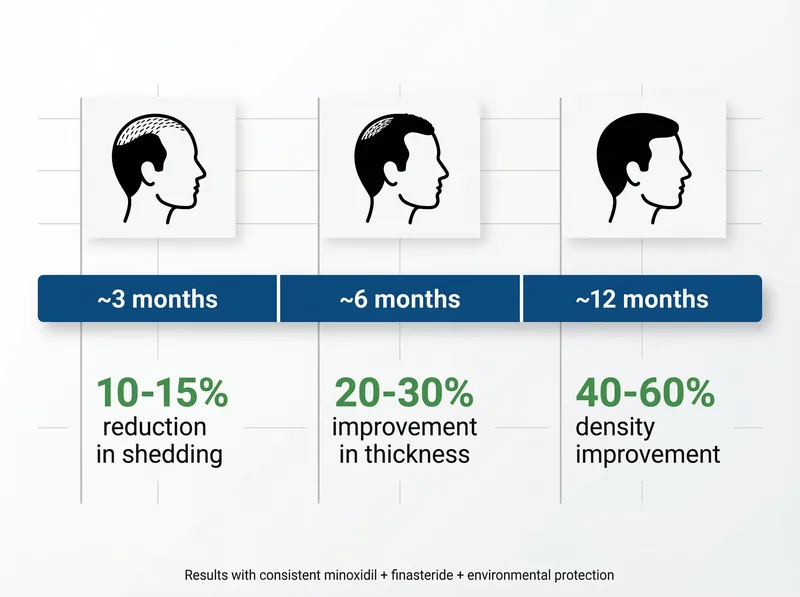 What to expect from evidence-based treatments: realistic timelines for minoxidil, finasteride, and environmental protection
Realistic Timelines and Expectations
This is where most men fail: unrealistic expectations and impatience. Hair loss treatments are measured in months and years, not weeks. Here’s what to expect:
Month 1-2: Baseline and Adjustment
You won’t see visible improvement. You may see increased shedding (especially with minoxidil). This is normal. Take baseline photos in consistent lighting and resist the urge to evaluate progress yet.
Month 3-4: Early Stabilization
Shedding should normalize. You may notice finer hairs (vellus hairs) starting to appear in thinning areas, this is a positive sign. Density won’t be noticeably improved yet, but the trajectory is shifting.
Month 6: First Evaluation Point
This is when you should see measurable improvement: reduced shedding, thicker hair shafts, and potentially some regrowth in areas that were thinning. Compare photos to baseline. If you see stabilization or improvement, continue. If not, reassess your protocol.
Month 12: Maximum Improvement
Most men reach peak improvement at 12-18 months. After that, the goal shifts from regrowth to maintenance. Continue treatments indefinitely, stopping will reverse gains within 3-6 months.
Realistic outcomes: minoxidil alone produces visible improvement in 40-60% of men. Finasteride alone produces improvement in 65-80% of men. Combined, the success rate increases to 80-90%. But ‘improvement’ means stabilization or modest regrowth, not full restoration of teenage density.
If you start with Norwood 3 thinning, the best-case scenario is stabilization at Norwood 3 with some thickening of existing hair. You’re unlikely to regress to Norwood 1-2 without a transplant. Manage expectations accordingly.
When to See a Dermatologist
Most men can self-manage early-stage androgenetic alopecia with over-the-counter minoxidil and a solid scalp care routine. But there are clear signs you need professional evaluation:
Sudden, rapid hair loss (losing 200+ hairs daily for more than 2 weeks). This suggests telogen effluvium or an autoimmune condition like alopecia areata. Blood work and a professional diagnosis are critical.
Patchy bald spots (not following the typical male pattern baldness pattern). This could be alopecia areata, fungal infection, or scarring alopecia, all require medical treatment.
Scalp pain, burning, or severe inflammation. This suggests an underlying dermatological condition that won’t resolve with standard hair loss treatments.
No improvement after 6 months of consistent minoxidil use. A dermatologist can evaluate whether you’re a non-responder, whether your application technique is correct, or whether you need to add finasteride.
If you want to start finasteride and it’s prescription-only in your country, you’ll need a dermatologist or telemedicine consultation. Don’t source it from unregulated online pharmacies, counterfeit medications are common, and dosing accuracy matters.
Finally, if you’re considering a hair transplant, consult a board-certified dermatologist or hair restoration surgeon. Not all surgeons are equal, poor technique can leave you with unnatural-looking results and wasted grafts. Get multiple consultations, review before/after photos, and verify credentials.
The Bottom Line: What We Recommend
Hair loss in the Gulf is a multi-factor problem that requires a multi-factor solution. Genetics load the gun, but environment pulls the trigger. You can’t change your genes, but you can control everything else.
Start with the basics: remove mineral buildup with a chelating shampoo, improve scalp health, and apply minoxidil consistently. If you’re seeing progression despite these measures, add finasteride (if accessible and side effects are acceptable). Track progress with monthly photos and give treatments at least 6 months before evaluating efficacy.
Don’t waste money on unproven supplements, overpriced ‘growth serums,’ or miracle cures. The science is clear: minoxidil and finasteride are the only treatments with consistent, reproducible results. Everything else is either marginally effective or outright placebo.
And remember: the goal isn’t to restore your 18-year-old hairline. The goal is to slow progression, maintain what you have, and potentially regain some thickness and density. That’s a realistic, achievable outcome for most men who start treatment early and stay consistent.
We’ll continue testing products, reviewing new research, and updating this guide as the evidence evolves. For now, this is the most complete, evidence-based protocol available for men dealing with hair loss in the Gulf.
References
- Androgenetic Alopecia: An Evidence-Based Treatment Update - Dermatology and Therapy
- Hardness of Water - US Geological Survey
- Heat Stress and Hair Follicle Stem Cells - Journal of Investigative Dermatology
- Serum Ferritin and Hair Loss in Women - Dermatology Practical & Conceptual
- Finasteride in the Treatment of Male Pattern Baldness - Journal of the American Academy of Dermatology
- Low-Level Laser Therapy for Androgenetic Alopecia - Lasers in Surgery and Medicine