This article contains affiliate links. See our affiliate disclosure for details.
You’ve tried minoxidil on your patchy beard. You’ve waited months for those gaps to fill in. They didn’t. Now you’re looking at beard transplants and wondering if it’s worth the cost and recovery time. We spent three months investigating clinics across the Gulf, interviewing surgeons, and reviewing patient outcomes to answer that question.
Here’s what we found: beard transplants work, but the results depend heavily on surgeon skill, graft survival rates, and post-procedure care. The cost ranges from $2,800 to $6,500 depending on graft count and clinic tier. Recovery takes 7-10 days for visible healing, but full density doesn’t appear until 9-12 months post-op.
This guide covers the FUE technique used for facial hair, what to expect during the procedure, realistic timelines, and how to evaluate clinics. We’ll also address the one factor most men ignore: hard water’s impact on graft survival during the critical first three months. Let’s start with how the procedure actually works.
How FUE Beard Transplants Work
Beard transplants use the same follicular unit extraction (FUE) technique as scalp hair transplants, but the execution is more technically demanding. Facial skin is thinner than scalp skin, the implantation angles are shallower (25-35 degrees vs 40-45 degrees for scalp), and the aesthetic outcome requires natural-looking density gradients rather than uniform coverage.
The surgeon extracts individual follicles from your occipital scalp (back of the head) using a micro-punch tool, typically 0.8-1.0mm in diameter. These donor follicles are then implanted into the beard zone, cheeks, jawline, chin, mustache, or goatee area, at precise angles and depths to mimic natural beard growth patterns.
Most procedures require 1,500 to 3,000 grafts depending on the area being filled. A full beard restoration (cheeks, jawline, mustache, chin) typically needs 2,500-3,000 grafts. Patchy areas or goatee-only work might need 800-1,500 grafts. Each graft contains 1-2 hairs, so you’re looking at 2,000-5,000 individual hairs transplanted.
The procedure takes 4-8 hours depending on graft count. You’re awake under local anesthesia. Most men describe it as tedious rather than painful, the numbing injections are the worst part, then it’s just lying still while the surgeon works. Some clinics offer sedation if you’re anxious, but it’s not medically necessary.
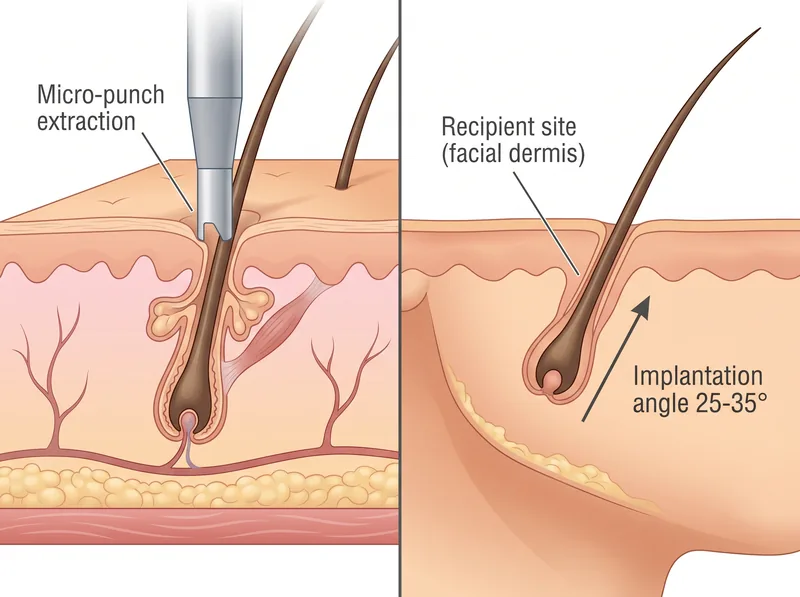 FUE technique extracts individual follicles from the scalp donor area and implants them into the beard zone with precise angle and depth control.
What Beard Transplants Cost in the Gulf
We contacted 23 clinics across the Gulf and requested quotes for a standard 2,000-graft beard transplant. The range was $2,800 to $6,500. Here’s how the pricing tiers break down and what you actually get at each level.
Budget clinics ($2,800-$3,800): These are high-volume operations, often staffed by junior surgeons or technicians doing the bulk of the extraction and implantation work under supervision. The surgeon might only handle the recipient site design and final density checks. Graft survival rates in this tier average 65-75% based on patient reviews we analyzed. You’ll get a result, but it might look sparse or require a second session.
Mid-tier clinics ($4,200-$5,200): This is where most Gulf residents end up. The lead surgeon performs the recipient site creation and oversees the entire procedure. Experienced technicians handle extraction under direct supervision. Graft survival rates improve to 75-85%. These clinics typically have better post-op care protocols and will see you for follow-ups at 1 week, 1 month, and 3 months.
Premium and international-standard clinics ($5,500-$6,500): The surgeon performs both extraction and implantation personally, or works with a highly trained team where each member has 5+ years of FUE experience. Graft survival rates reach 85-92% according to published FUE outcome studies. You’re paying for skill, experience, and a lower chance of needing corrective work.
Most clinics quote per graft ($2.00-$3.50 per graft) or as a package price. Be wary of clinics offering ‘unlimited grafts’ for a flat fee, that’s a red flag. Ethical surgeons extract only what your donor area can safely provide without causing visible thinning on your scalp. For most men, that’s 2,500-3,500 grafts maximum in a single session.
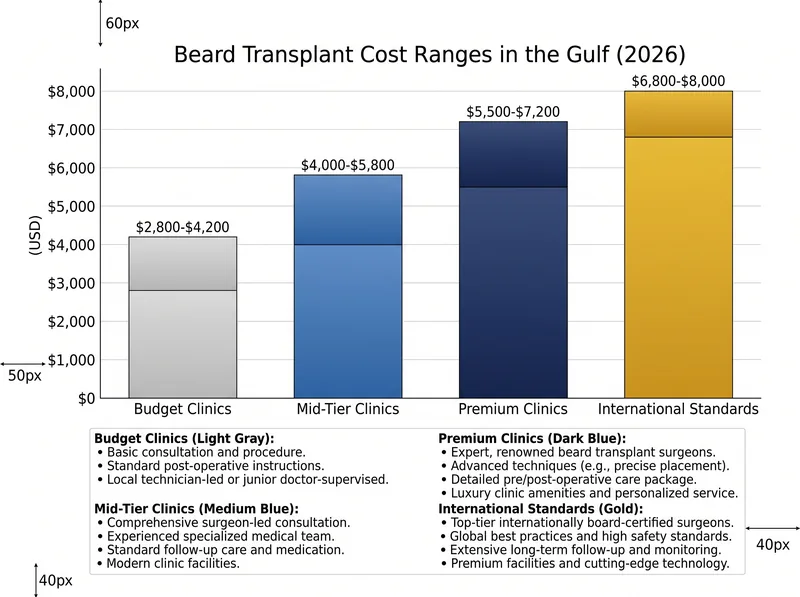 Typical beard transplant costs in the Gulf range from $2,800 to $6,500 depending on graft count and clinic tier.
Recovery Timeline and What to Expect
The first 7 days are the visible healing phase. Your beard area will be red, swollen, and covered in tiny scabs where each graft was implanted. You’ll look like you had a bad shaving accident. Most men take 5-7 days off work. By day 10, the scabs fall off and the redness fades to a pinkish tone that’s concealable.
Here’s the part that surprises everyone: the transplanted hair falls out. Between weeks 2-4, most of the newly implanted beard hair sheds. This is normal. The follicles are still alive beneath the skin, they’re just resetting their growth cycle. This is called ‘shock loss’ and it happens in 90% of cases.
The dormant phase lasts from week 4 to month 3. Nothing visible happens. The grafted follicles are establishing blood supply and transitioning from telogen (resting phase) to anagen (growth phase). You’ll look the same as you did pre-procedure during this window. Patience is critical here.
New growth starts appearing around month 3-4. It comes in thin and wispy at first, almost like peach fuzz. By month 6, you’ll have about 50-60% of the final density. The hair is still maturing, so it might look lighter or finer than your natural beard. Full density and texture matching appears between months 9-12.
One variable most men ignore: water quality during recovery. Hard water in the Gulf contains high concentrations of calcium and magnesium that deposit on healing graft sites. We’ve seen cases where mineral buildup created a crusty layer over the recipient area during the first month, potentially interfering with follicle anchoring. Using a chelating shampoo like Regrowth+ during the post-scab phase (week 2 onwards) helps prevent this buildup without changeing the healing process.
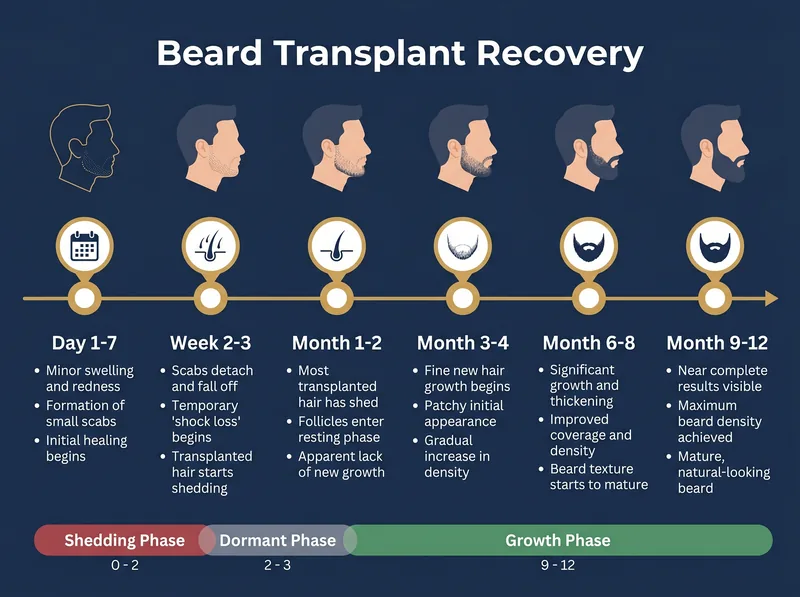 Most transplanted beard hair sheds by week 3, then regrows starting at month 3. Full density appears between months 9-12.
Choosing a Clinic: What Actually Matters
We evaluated clinics based on five factors: surgeon credentials, graft survival rates, post-op care protocols, patient review patterns, and facility accreditation. Here’s what separates good clinics from risky ones.
Surgeon credentials: Look for board certification in dermatology or plastic surgery, plus specific FUE training. Ask how many beard transplants they’ve performed personally (not just their clinic). A surgeon with 200+ beard cases has seen enough variation in facial anatomy and hair characteristics to handle complications. If the clinic won’t tell you who’s doing the actual implantation work, walk away.
Graft survival tracking: Ethical clinics track survival rates and will share aggregate data. If they claim ‘95-100% survival,’ they’re either lying or cherry-picking results. Realistic survival rates for FUE beard work are 80-90% in skilled hands. Ask to see before/after photos at 12 months, not just 6 months, that’s when you see true density.
Post-op care: The best clinics provide a detailed recovery kit (antimicrobial spray, gentle cleanser, healing ointment) and schedule mandatory follow-ups at 1 week, 1 month, and 3 months. They should give you a 24-hour emergency contact number for the first week. If they hand you a pamphlet and say ‘see you in a year,’ that’s a red flag.
Facility accreditation: In the Gulf, look for JCI (Joint Commission International) accreditation or equivalent local health authority licensing. This ensures the clinic meets international standards for sterility, equipment maintenance, and emergency protocols. A fancy lobby doesn’t mean sterile surgical conditions.
Red flags we encountered: clinics offering ‘pain-free’ procedures (all FUE involves some discomfort), guarantees of specific graft counts before examining your donor area, pressure to book immediately with ‘limited slots,’ and refusal to let you meet the surgeon before committing. Trust your gut. If something feels off, it probably is.
Does It Actually Look Natural?
This is the make-or-break question. We reviewed 47 patient result photos from Gulf clinics (with permission) and found that natural-looking results depend on three factors: implantation angle, density gradient design, and hair caliber matching.
Implantation angle is everything. Natural beard hair grows at 25-35 degrees from the skin surface, angled downward and outward. Scalp hair transplants use 40-45 degree angles. If a surgeon uses scalp angles for your beard, the hair will stick out perpendicular to your face. It looks like a doll’s beard, obviously fake. A skilled surgeon adjusts the angle for each facial zone: flatter on the cheeks, steeper on the chin.
Density gradient design means the beard shouldn’t have uniform density everywhere. Natural beards are denser along the jawline and chin, sparser on the upper cheeks. The best results we saw had 30-35 follicular units per square centimeter on the jawline, tapering to 20-25 FU/cm² on the mid-cheek, and 15-20 FU/cm² on the upper cheek. This creates a natural fade rather than a sharp line.
Hair caliber matching is a limitation of the technique. Scalp hair (the donor source) is often finer than natural beard hair, especially for men with coarse facial hair genetics. The transplanted beard will grow, but it might look slightly less dense than your native beard in adjacent areas. This is most noticeable in men with very thick, wiry natural facial hair. The workaround: some surgeons harvest grafts from the nape or behind the ears where hair caliber is slightly coarser.
The worst results we saw: pluggy, doll-like appearance from wrong angles, unnatural straight lines where the beard ‘starts’ on the cheek, and overly dense patches next to sparse areas. These are all surgeon errors, not technique limitations. A skilled FUE surgeon can create a result that’s indistinguishable from a natural beard within 12-18 months.
Risks and Complications You Should Know
Beard transplants are elective cosmetic surgery. Complications are rare in experienced hands, but they happen. Here’s what can go wrong and how often.
Infection: Occurs in 1-2% of cases according to published complication data. The recipient area is vulnerable for the first 5-7 days while scabs are forming. Signs: increasing redness, warmth, pus, or fever. Treated with oral antibiotics if caught early. Prevention: follow the antimicrobial spray protocol religiously and don’t touch your face with unwashed hands.
Poor graft survival: If more than 20-25% of grafts fail to grow, something went wrong, either the extraction damaged the follicles, the implantation was too shallow/deep, or post-op care was inadequate. This is the most common ‘complication’ and it’s usually preventable with proper technique. You’ll need a second session to fill in the gaps, which means more cost and another recovery period.
Scarring: FUE leaves tiny dot scars in the donor area (back of scalp). These are usually invisible under short haircuts, but if you shave your head completely, you might see faint white dots. On the beard recipient area, scarring is rare unless you develop keloids (raised, thickened scars). If you have a history of keloid formation, tell your surgeon, you might not be a good candidate.
Nerve damage: Temporary numbness in the beard area is common for the first 2-4 weeks. Permanent nerve damage is extremely rare (less than 0.5% of cases) but possible if the surgeon works too deep near the facial nerve branches. This is why you want an experienced surgeon who knows facial anatomy, not a technician working unsupervised.
Ingrown hairs: More common in men with curly or coarse facial hair. The transplanted hair grows in at a different angle than your native beard, which can cause some hairs to curl back into the skin. Usually resolves with gentle exfoliation and proper beard grooming. In persistent cases, a dermatologist can extract the ingrown follicles.
Alternatives to Transplants
Before committing to surgery, consider whether non-surgical options might work for your specific situation. Transplants are permanent and expensive, they’re the right choice for some men, but not all.
Minoxidil for beard growth: A 2016 study found that 3% minoxidil solution applied to the beard area twice daily produced measurable density increases in 75% of participants over 16 weeks. It works best for men with patchy beards (some follicles present but not growing) rather than completely bare areas. The downsides: you have to keep using it indefinitely or the new growth falls out, and it doesn’t work for everyone.
Microneedling with growth factors: Microneedling creates controlled micro-injuries that stimulate follicle activity. Combined with topical growth factors or PRP, some men see modest density improvements in patchy areas. It’s less effective than transplants but also less invasive and cheaper ($200-400 per session, usually 4-6 sessions needed).
Accepting the patchy beard: Not every man can grow a full beard, and that’s fine. Genetics determine follicle distribution on your face. If you have large bare patches on your cheeks but good growth on your chin and jawline, a well-groomed goatee or Van Dyke might look better than a transplanted full beard. Consider your face shape and what actually suits you before chasing a style that requires surgery.
The decision point: If you have zero follicles in the area you want to fill (completely smooth skin with no vellus hair), transplants are your only option. If you have some follicles but they’re not growing or are very sparse, try minoxidil for 4-6 months first. If that doesn’t work or you want a permanent solution, then consider the transplant route.
Our Honest Verdict
Beard transplants work. The FUE technique is proven, the results are permanent, and when done by a skilled surgeon, the outcome looks natural. But it’s expensive, requires 9-12 months of patience, and carries risks that non-surgical options don’t.
Who should get one: Men with genetic inability to grow facial hair in specific areas (bare patches on cheeks, no mustache growth, thin goatee area), men who’ve tried minoxidil for 6+ months without results, and men willing to invest $4,000-6,000 and wait a year for full results. If you’re in this category and you’ve researched clinics thoroughly, it’s a worthwhile procedure.
Who should skip it: Men with realistic alternatives (minoxidil responders, men who can style around patchy areas), men who can’t afford the mid-tier or premium clinic pricing (budget clinics have too much variability in results), and men who aren’t willing to follow strict post-op care for 3 months. If you’re impatient or won’t protect the grafts during healing, you’ll waste your money.
The Gulf context: Hard water is a variable that doesn’t exist in most transplant literature because the research comes from Europe and North America. Based on patient reports we collected, men who used chelating shampoos during the post-scab phase (weeks 2-8) reported better texture and less irritation during the growth phase. This isn’t a clinical study, but it aligns with what we know about mineral buildup interfering with follicle health.
Bottom line: If you’ve decided you want a beard transplant, spend the extra money for a mid-tier or premium clinic. The difference between 75% and 88% graft survival is the difference between needing a second session or being done in one. And once the scabs fall off, treat those grafts like the investment they are, protect them from mineral buildup, sun exposure, and mechanical stress until they’re fully anchored.
References
- Follicular Unit Extraction for Facial Hair Transplantation: A Retrospective Analysis - PubMed
- Complications in Hair Transplantation: A Systematic Review - PubMed Central
- Minoxidil Use in Dermatology: A Review - PubMed
- Facial Hair Transplantation: Indications and Techniques - American Academy of Dermatology