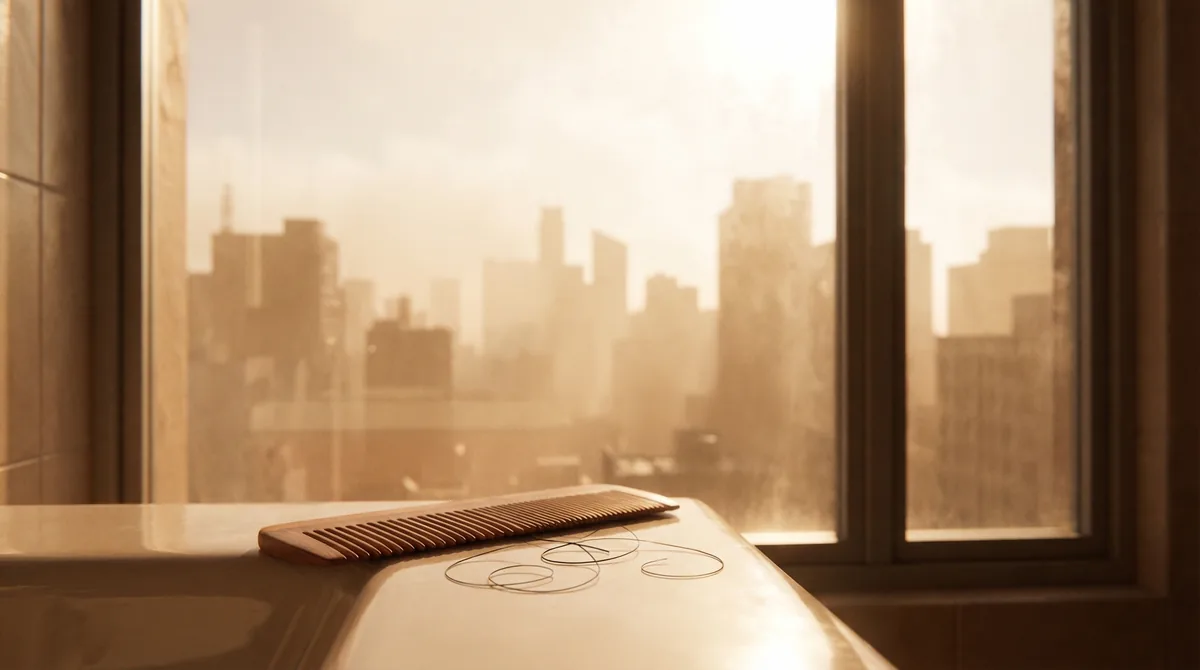
I moved to the Gulf in 2017. Within four months, I was finding more hair on my pillow than I’d ever lost in a year of living in London. My barber noticed. My colleagues noticed. I definitely noticed.
Everyone said it was stress from the move. They were wrong.
It is not stress. It is your environment.
Relocation stress is real, and it can trigger temporary hair shedding called telogen effluvium. But that typically resolves on its own within six months. What I experienced, and what most men who move to the Gulf experience, is something more persistent.
Three environmental factors converge here in a way they don’t in most Western cities. Each one can affect your hair independently. Together, they accelerate thinning that might have taken a decade to appear.
Factor 1: Hard water
Gulf tap water is among the hardest in the world. Total dissolved solids (TDS) readings in many areas exceed 300 ppm, and some residential areas test above 500 ppm. For context, London sits around 200 to 300 ppm. Much of continental Europe is below 200.
Hard water deposits calcium and magnesium on your hair shaft and scalp. Over weeks and months, this creates a mineral film that does three things: it makes shampoo less effective (the minerals react with surfactants), it dries out the hair shaft (making it brittle and prone to breakage), and it clogs the follicle opening (restricting healthy growth).
This isn’t theory. A 2016 study in the International Journal of Trichology confirmed that hard water increases hair breakage and reduces tensile strength compared to soft water. The effect is cumulative, which is why you don’t notice it in the first week but can’t ignore it by month four.
Factor 2: Vitamin D deficiency
This one surprises people. You’re living under some of the most intense sun on the planet. How can you be vitamin D deficient?
Because you’re indoors. Gulf residents spend the vast majority of their time in air-conditioned environments. The commute from air-conditioned home to air-conditioned car to air-conditioned office provides maybe ten minutes of actual sun exposure. And for several months of the year, the heat is so extreme that outdoor time drops to nearly zero.
A 2019 study in the Journal of Clinical Endocrinology found that vitamin D deficiency affects over 50% of the Gulf population. Vitamin D plays a role in hair follicle cycling. Deficiency has been associated with telogen effluvium and may worsen androgenetic alopecia.
Get your levels tested. It’s a simple blood draw available at any clinic. If you’re below 30 ng/mL, you’re deficient. Most dermatologists in the Gulf recommend supplementation of 2,000 to 4,000 IU daily.
Factor 3: Heat stress on the scalp
Your scalp sweats more here than it does in temperate climates. That excess sebum mixes with mineral deposits from hard water and creates a paste that sits on your follicles. The combination is worse than either factor alone.
Excessive sweating also shifts scalp pH. Healthy scalp pH sits between 4.5 and 5.5. Sweat pushes it higher. Higher pH environments encourage microbial growth and inflammation, both of which can contribute to follicle miniaturization.
If you’re exercising outdoors or working in partially air-conditioned environments, this factor intensifies.
Why it accelerates genetic pattern baldness
Here’s the part nobody tells you. If you carry the genes for male pattern baldness, these environmental factors don’t just cause temporary shedding. They accelerate the genetic timeline.
DHT (dihydrotestosterone) sensitivity is the primary driver of androgenetic alopecia. But follicle health determines how quickly that process plays out. A well-nourished follicle in clean, soft water can resist DHT-driven miniaturization for longer than a clogged follicle sitting under mineral deposits in a vitamin D-deficient body.
The Gulf environment doesn’t create baldness. It removes the buffers that were slowing it down.
What to do about it
The good news is that environmental damage is manageable once you understand what’s causing it.
Fix your water. A shower filter with KDF media reduces chlorine and some heavy metals. For serious hard water, a whole-home water softener is the best investment you can make. If that’s not feasible, use a chelating shampoo twice a week to strip mineral buildup.
Test your vitamin D. Don’t guess. Get a blood test. If you’re deficient, supplement with D3 (not D2) and pair it with K2 for better absorption. Most men in the Gulf need 2,000 to 4,000 IU daily to maintain adequate levels.
Adjust your scalp routine. Wash daily or every other day in the Gulf. The combination of sweat and hard water means you can’t get away with the “wash twice a week” advice designed for temperate climates. Use a gentle, sulfate-free shampoo for daily washing and a chelating shampoo for your weekly deep clean.
Consider treatment early. If you’re noticing thinning, don’t wait a year to see if it resolves. Minoxidil and finasteride are both more effective when started early. Consult a dermatologist here. They see this pattern constantly and can help you make an informed decision.
The bottom line
Your hair didn’t suddenly decide to fall out because you’re stressed about a new job. Your environment changed, and your hair is responding to water it wasn’t designed for, a vitamin deficiency your previous climate didn’t cause, and heat stress that makes everything worse.
The sooner you address the environmental factors, the more hair you’ll keep.