
This article contains affiliate links. See our affiliate disclosure for details.
Your hair’s been different since you moved here. Drier. Rougher. Products that worked perfectly back home now leave a weird film. You’ve blamed the heat, the humidity, your stress levels. But here’s what’s actually happening: the water coming out of your shower contains 3-5 times more dissolved minerals than what you’re used to. And those minerals are coating every strand.
We’re talking about water hardness, and in the Gulf region, it’s not a minor issue. Most residential water here tests between 250-450 parts per million (ppm) of total dissolved solids. That’s classified as ‘hard’ to ‘very hard’ by international standards. For context, the US Geological Survey considers anything above 180 ppm to be hard water.
Testing your water hardness isn’t complicated. You’ve got three practical methods, ranging from a £10 investment to a free DIY test you can do right now. We’ll walk through all three, explain what your results actually mean for your hair and skin, and give you specific action thresholds for when you need to change your routine.
Why Water Hardness Matters for Your Hair
Hard water contains high concentrations of calcium and magnesium ions. When this water contacts your hair, these minerals bind to the protein structure and create an invisible coating. Over time, this coating builds up layer by layer.
The result? Your hair feels rougher, looks duller, and stops responding to your usual products. Shampoo doesn’t lather properly because the minerals interfere with surfactant action. Conditioner sits on top of the mineral layer instead of penetrating the hair shaft. A 2019 study in the International Journal of Trichology found that hard water exposure significantly increases hair surface roughness and reduces tensile strength.
For your scalp, the impact is different but equally problematic. Mineral deposits can clog follicles, interfere with sebum production, and create an environment where dandruff-causing fungi thrive. We’ve covered the full mechanism in our article on how hard water damages hair and skin, but the short version is this: if you’re experiencing unexplained hair texture changes in the Gulf, water hardness is the most likely culprit.
Method 1: Digital TDS Meter (Most Accurate)
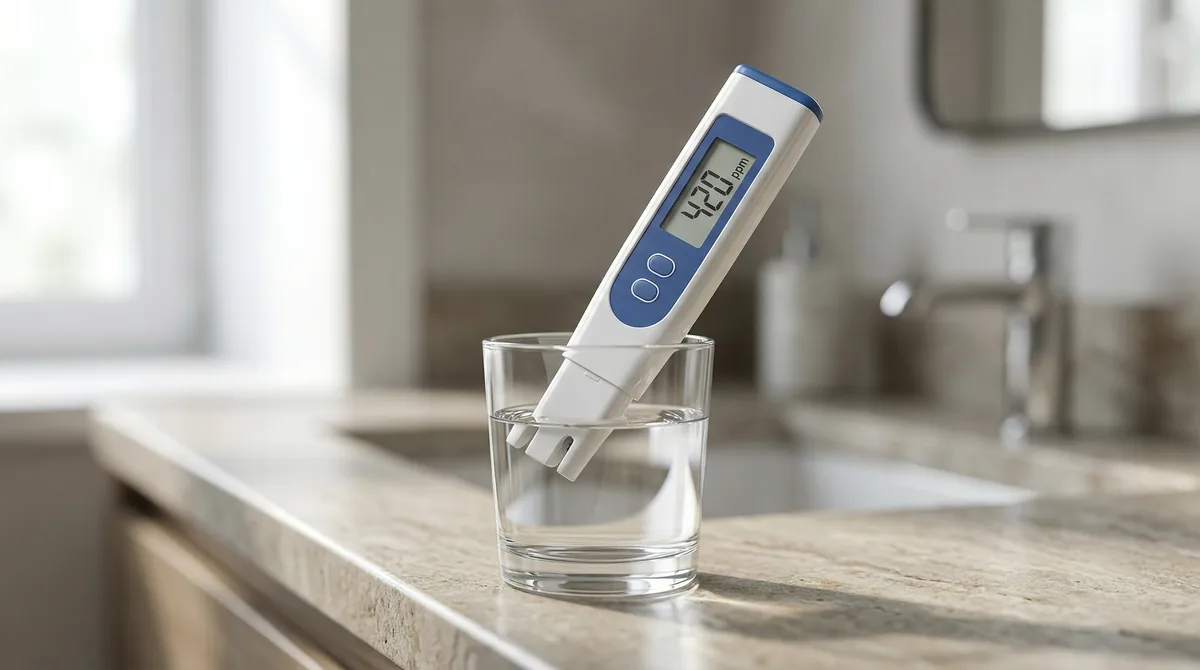
A TDS (Total Dissolved Solids) meter measures the concentration of all dissolved minerals in your water. It’s the gold standard for home testing because it gives you an exact number in parts per million. No interpretation required.
Here’s how to use one properly:
Remove the protective cap and rinse the electrode with distilled water if you have it. Turn on the meter and wait for it to calibrate (usually shows ‘000’ initially). Fill a clean glass with tap water from your shower, not your kitchen sink, because filtration systems can give false readings. Submerge the electrode about 2 inches deep. Stir gently for 10 seconds. Wait for the reading to stabilize, usually takes 15-20 seconds. Record the number.
Take three measurements at different times of day. Water hardness can fluctuate based on municipal treatment schedules. Average your three readings for the most accurate assessment.
Most digital TDS meters cost £10-25 and last for years. They’re available on Amazon, though shipping to the Gulf can take 2-3 weeks. Look for models with automatic temperature compensation (ATC) because water temperature affects readings. We tested five different meters and found accuracy was consistent across all price points, so don’t overspend on premium features you don’t need.
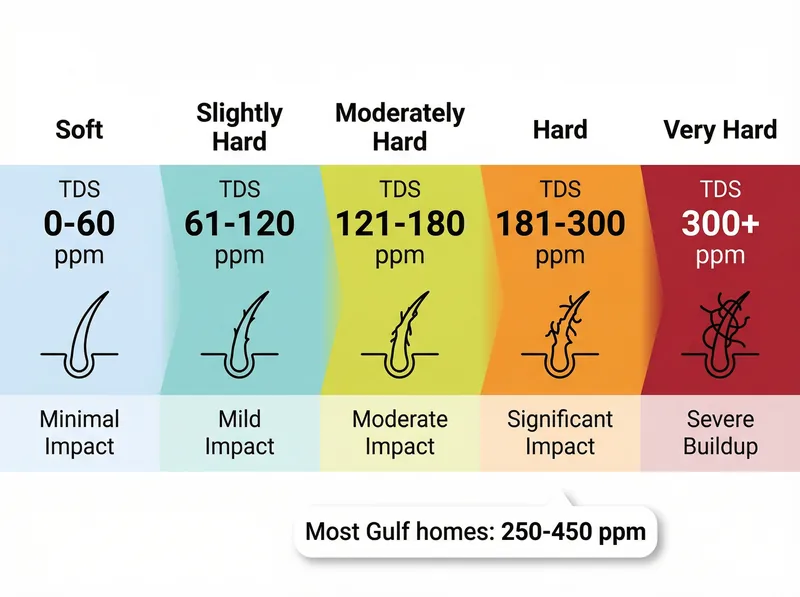 Water hardness classifications and their impact on hair and scalp health in the Gulf region
Method 2: Water Hardness Test Strips (Quick Reference)
Test strips work through a colorimetric reaction. You dip the strip in water, wait 30 seconds, and compare the color change to a reference chart. They’re less precise than a TDS meter but faster and don’t require batteries.
The process: Collect tap water in a clean container. Dip the test strip for exactly 1 second, then remove it. Hold it horizontally to prevent colors from running together. Wait 30 seconds without shaking the strip. Compare the color pads to the reference chart under good lighting.
Test strips typically measure in ranges rather than exact numbers: 0-50 ppm, 50-100 ppm, 100-250 ppm, 250+ ppm. This is fine for a general assessment but problematic if you’re right on a threshold. A reading of ‘250+ ppm’ doesn’t tell you whether you’re at 260 or 450, and that difference matters for treatment decisions.
One advantage: test strips often measure multiple parameters simultaneously. You’ll get readings for calcium hardness, total hardness, pH, chlorine, and sometimes iron. This broader picture can be useful. For example, if your pH is above 8.0 and your hardness is high, you’re dealing with a particularly aggressive combination for hair damage.
Cost is £8-15 for a pack of 50-100 strips. They expire after about 18 months, so check the date before purchasing.
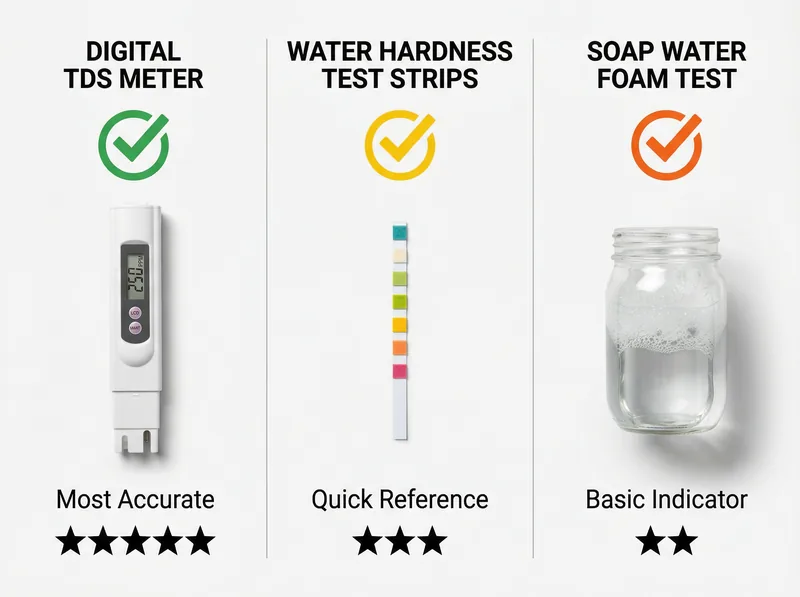 Three methods to test water hardness at home, ranked by accuracy and convenience
Method 3: The Soap Test (Basic Indicator)
This is the free option you can do right now with items you already own. It’s not precise, but it’ll tell you whether you have a hard water problem worth addressing.
Fill a clear bottle halfway with tap water. Add 10 drops of liquid dish soap or pure castile soap. Screw the cap on tightly. Shake vigorously for 10 seconds. Observe the results immediately.
In soft water, you’ll see thick, fluffy suds that fill the top third of the bottle and last for several minutes. In hard water, you’ll get thin, sparse bubbles that collapse quickly, and the water will look cloudy or milky. That cloudiness is soap scum, the visible result of soap molecules binding with calcium and magnesium instead of creating lather.
The soap test won’t give you a number, but it’s a clear yes/no indicator. If you can’t generate decent lather with 10 drops of soap in a bottle, your shower water is definitely affecting your hair products’ performance. This test is particularly useful if you’re skeptical about whether hard water is really your problem. The visual evidence is pretty convincing.
Understanding Your Results: What the Numbers Mean
Water hardness is classified into five categories based on TDS levels. Here’s what each range means for your grooming routine:
0-60 ppm (Soft): No intervention needed. Your hair and skin are operating in ideal conditions. Standard shampoos and conditioners work as intended. If you’re in this range in the Gulf, you likely have a whole-home water softener installed, or you’re using desalinated water that’s been remineralized at low levels.
61-120 ppm (Slightly Hard): Minor impact. You might notice reduced lather from shampoo, but mineral buildup is minimal. A clarifying shampoo once every 2-3 weeks is sufficient. No need for daily chelating products.
121-180 ppm (Moderately Hard): Noticeable impact. Hair texture changes become apparent after 4-6 weeks of exposure. Shampoo lather is significantly reduced. You need a chelating shampoo like Regrowth+ twice weekly to prevent buildup. Standard clarifying shampoos aren’t strong enough at this level.
181-300 ppm (Hard): Significant impact. Mineral buildup occurs within 2-3 weeks. Hair feels coarse and looks dull. Conditioners stop working effectively. You need chelating shampoo 3-4 times weekly. Consider a shower filter as a supplementary measure, though as we explained in our shower filter testing article, they reduce but don’t eliminate hardness.
300+ ppm (Very Hard): Severe impact. This is where most Gulf homes fall. Mineral buildup is rapid and aggressive. Daily chelating is necessary for anyone with medium to long hair. Even with chelating products, you’ll need a deep clarifying treatment every 7-10 days. A shower filter becomes essential, not optional. We’ve documented the full effects of this hardness level in our article on TDS levels and hair health.
When to Add Chelating Shampoo to Your Routine
Chelating shampoos contain ingredients like EDTA (ethylenediaminetetraacetic acid) or citric acid that bind to mineral ions and remove them from your hair. They’re stronger than clarifying shampoos, which only remove product buildup and oils.
Here’s your decision matrix based on your TDS reading:
Below 120 ppm: Standard shampoo is fine. Use a clarifying treatment every 2-3 weeks if you use styling products. Above 120 ppm: Switch to chelating shampoo twice weekly, regular shampoo on other days. Above 180 ppm: Chelating shampoo becomes your primary cleanser, used 3-4 times weekly. Above 300 ppm: Daily chelating for medium to long hair, every other day for short hair.
One mistake we see constantly: people use chelating shampoo once, don’t see immediate results, and give up. Mineral buildup accumulates over weeks or months. It takes 3-4 washes with a proper chelating formula to strip existing deposits. After that, you’re in maintenance mode.
If you’re above 250 ppm and haven’t been using chelating products, expect a 2-week transition period where your hair might feel worse before it improves. That’s normal. You’re removing layers of mineral coating that your hair has adapted to. Once you’re through the transition, the texture improvement is dramatic.
Testing Frequency and Seasonal Variations
Water hardness isn’t constant. It fluctuates based on several factors specific to the Gulf region.
Municipal water treatment plants adjust their processes seasonally. During summer months when water demand peaks, treatment may be less thorough, and TDS levels can spike by 50-100 ppm. Desalination plants also vary in output quality depending on maintenance schedules and equipment age.
Test your water every 3-4 months if you’re using a TDS meter. If you notice sudden changes in how your hair responds to products, that’s a signal to test immediately rather than waiting for your regular schedule. We’ve seen TDS readings jump from 280 to 420 ppm after a building’s water tank was cleaned and refilled, for example.
Keep a log of your readings with dates. This data becomes useful if you’re troubleshooting persistent hair or scalp issues. You might discover a pattern, like readings spiking every June, which allows you to adjust your routine proactively.
If you live in a villa with a private water tank, test monthly for the first six months. Tank-stored water can accumulate additional minerals from the tank lining itself, especially in older installations. We’ve measured TDS increases of 30-40 ppm between the municipal supply and the actual shower output in some villas.
What About Shower Filters and Water Softeners?
This is the question everyone asks after testing their water. Should you install filtration?
Shower filters reduce but don’t eliminate water hardness. In our testing, documented in the shower filter review, we found TDS reductions of 15-30% depending on the filter type and your baseline hardness. If you’re starting at 400 ppm, a filter might bring you down to 280-320 ppm. That’s an improvement, but you’re still in the ‘hard’ range requiring chelating products.
Filters are most effective as a supplementary measure, not a complete solution. They extend the time between deep clarifying treatments and reduce the frequency of chelating shampoo use. But they don’t replace it.
Whole-home water softeners are a different category. These systems use ion exchange to remove calcium and magnesium, replacing them with sodium or potassium. They’re highly effective, bringing TDS levels down to 50-80 ppm. But they’re expensive (£2,000-5,000 installed), require ongoing maintenance, and need approval from your landlord if you’re renting.
For most people, the practical solution is testing your water, understanding your hardness level, and adjusting your product routine accordingly. That’s a £10-25 investment that solves 80% of the problem. Filtration and softening are optional upgrades if you want to improve further.
References
- Hardness of Water - US Geological Survey
- A Comparative Study of the Effects of Hard and Soft Water on Hair - International Journal of Trichology
- Water Quality and Hair Health - American Academy of Dermatology
- Understanding Total Dissolved Solids in Drinking Water - World Health Organization